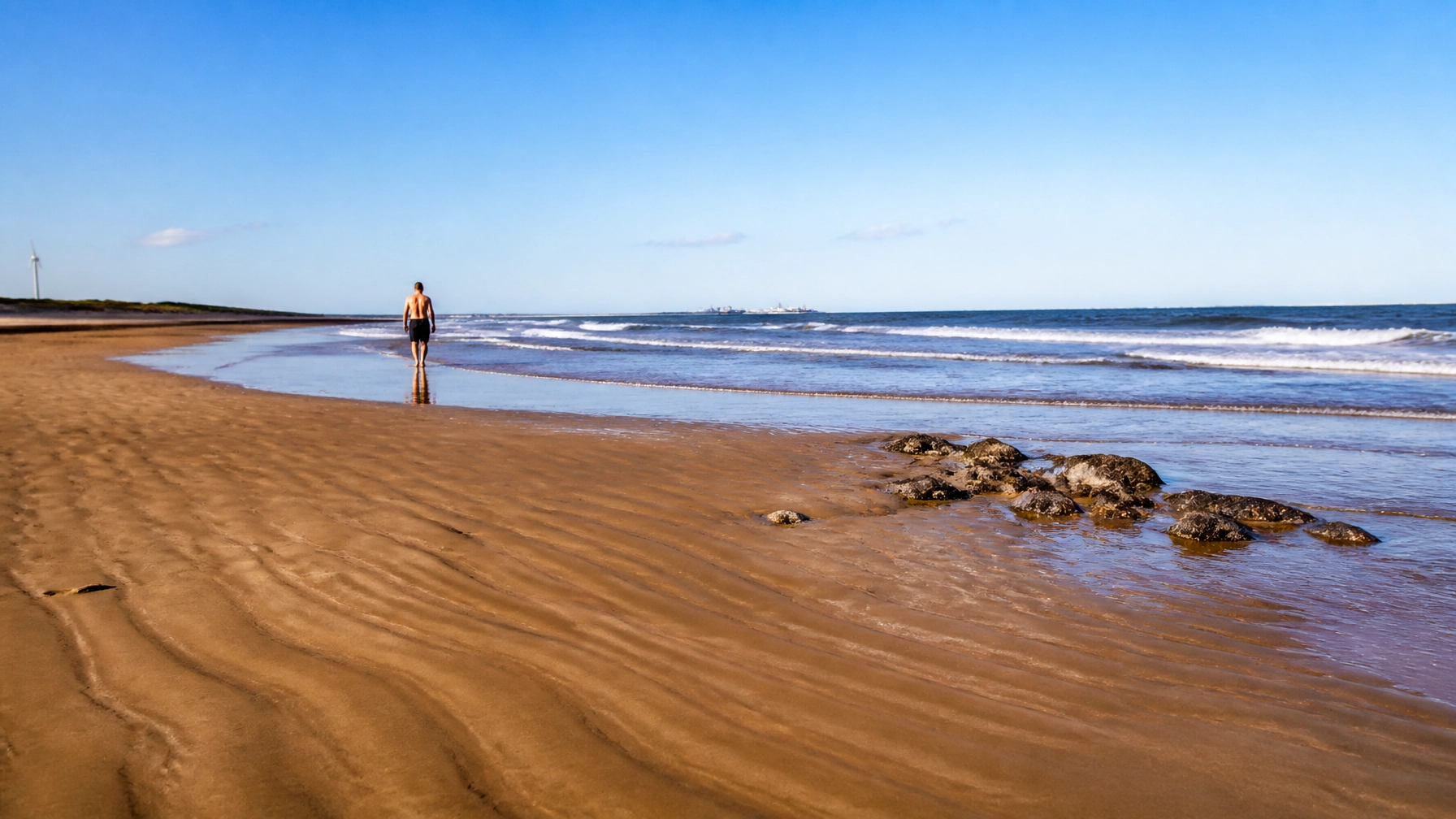
The coastline of Northumberland is celebrated for its rugged beauty, with vast stretches of golden sand and the deep, often unpredictable blues of the North Sea. For families in Blyth, the local beach is a sanctuary, a place for weekend strolls and summer dips. However, beneath the serene surface of the water, the elements can shift in an instant, turning a peaceful afternoon into a fight for survival. This was the reality faced by Paul Turner, a local father whose quick thinking and selfless bravery recently prevented a tragedy that has resonated throughout the coastal community.
The day began like many others on the Northumberland coast, with clear skies and a gentle breeze that drew locals and visitors alike to the shoreline. The atmosphere was one of typical British seaside leisure, with children playing in the shallows and dogs running along the surf. Paul Turner was enjoying the day with his own family, keeping a watchful eye on the horizon as he often did, having grown up with a deep respect for the sea. It was this ingrained vigilance that allowed him to notice something that many others had overlooked: a young girl, no more than twelve years old, who had drifted significantly further from the shore than the other swimmers.
A Moment of Sudden Crisis
What started as a routine swim quickly escalated into a life-threatening situation. The girl, who had been paddling happily just minutes before, had unknowingly entered a rip current. These "rivers of the sea" are powerful, narrow channels of fast-moving water that can sweep even the strongest swimmers away from the beach at speeds of up to five miles per hour. To the untrained eye, a rip current often looks like a patch of calm, darker water where waves are not breaking, making it appear deceptively safe. For the young girl in the water at Blyth, the current had taken hold with terrifying efficiency, pulling her into deeper water where her feet could no longer touch the sandy bottom.
Paul Turner noticed the change in her body language before anyone else. The playful splashing had been replaced by a frantic, rhythmic thrashing of arms: a classic sign of a swimmer in distress. While others on the beach were still enjoying the sunshine, Paul’s paternal instincts and local knowledge kicked in. He realised that the girl was not just playing; she was exhausted, panicking, and being dragged further out into the North Sea. Without a second thought for his own safety or the freezing temperature of the water, Paul began to move. He didn't wait for a lifeguard or a rescue boat; he knew that in the world of coastal emergencies, seconds are the difference between a rescue and a recovery.
As he ran towards the surf, the gravity of the situation became clear to the few bystanders who had begun to gather at the water's edge. The girl’s head was bobbing sporadically above the white foam of the waves, her cries for help barely audible over the roar of the wind. Paul dived into the water, his focus entirely on the small figure drifting further away. The initial shock of the cold was intense, but the adrenaline of the moment pushed him forward. He was swimming against the very forces that were claiming the young girl, navigating the surf with a determination that only comes from a direct confrontation with crisis.
The Fight Against the Tide
Reaching the girl was only half the battle. When Paul finally made contact, he found her in a state of sheer exhaustion, her energy spent trying to swim directly back to the shore: a common mistake that leads to many drownings in rip currents. He immediately set about calming her, using a firm but reassuring tone to stop the panic that was threatening to pull them both under. Paul knew that he couldn't swim directly against the current; he had to use his knowledge of the sea to find a way out. He instructed the girl to hold onto him and began to swim parallel to the shore, moving across the current rather than against it.
The physical toll of the rescue was immense. The North Sea is notorious for its strength, and even for a fit man like Paul, the effort of towing another person through the choppy water was draining. Every wave that crashed over them threatened to separate them, but Paul held firm. His thoughts were not on his own fatigue, but on the young life he was currently responsible for. On the beach, the silence of the crowd was broken only by the sound of the waves, as onlookers watched the two figures struggle in the distance. It was a display of raw human bravery, an individual standing against the overwhelming power of nature.
After what felt like an eternity to those watching from the sand, Paul managed to break free of the rip current’s grasp. He navigated into a breaking wave that helped push them back toward the shallower sandbars. As his feet finally touched the ground, the relief was palpable. He carried the girl the last few metres to the dry sand, where her terrified parents were waiting. The girl was shaken and had swallowed a significant amount of seawater, but she was alive. Paul, drenched and breathless, simply handed her over to her family, his job done. The humility he showed in the moments following the rescue was as notable as the act itself, as he downplayed his role despite having clearly saved a life.
Lessons from the North Sea Shore
In the days following the incident at Blyth, Paul Turner has been hailed as a local hero, though he remains reluctant to accept the title. For him, the rescue was simply an act of necessity, something any parent would hope someone would do for their child. However, the story has sparked a vital conversation about sea safety along the Northumberland coast. The North Sea is a beautiful asset for the region, but it is also an environment that demands constant respect. Rip currents remain one of the leading causes of lifeguard call-outs in the UK, and understanding how to identify and survive them is essential for anyone visiting the coast.
The primary advice from safety experts, echoed by the circumstances of Paul’s rescue, is to "Float to Live." If caught in a current, the instinct to swim hard against it is often what leads to tragedy. By floating on one’s back and staying calm, a swimmer can conserve energy until they are out of the current or until help arrives. Paul’s decision to swim parallel to the beach was the textbook response to a rip, and it is a lesson he hopes others will take to heart. His bravery serves as a reminder that while the sea is a place of joy, it is also a place where vigilance can never be compromised.
As summer approaches and more families head to the beaches of the North East, the story of Paul Turner and the girl at Blyth will remain a powerful testament to the impact of a single person's courage. It highlights the importance of looking out for one another and the profound difference that quick, decisive action can make. While Paul may see himself as just a dad who was in the right place at the right time, to a young girl and her family, he is the man who turned a day of potential tragedy into a story of survival and hope. The Northumberland coast remains as beautiful as ever, but for those who know what happened that day, the waves now carry a reminder of the hero who walked among them.