The sun was high over a local playground in Preston this week when a standard afternoon of outdoor play turned into a profound display of character and community spirit.
In a scene that has since resonated across Lancashire, a group of young schoolgirls took a decisive stand against exclusion, intervening when they witnessed a peer with Down’s syndrome being targeted by a group of older bullies. The incident, which took place near the heart of the city, has sparked a wider conversation about the power of youth-led advocacy and the simple, transformative nature of inclusive play. Witnesses describe a tense atmosphere that was quickly defused not by adult intervention, but by the moral clarity of children who refused to let a vulnerable contemporary be intimidated.
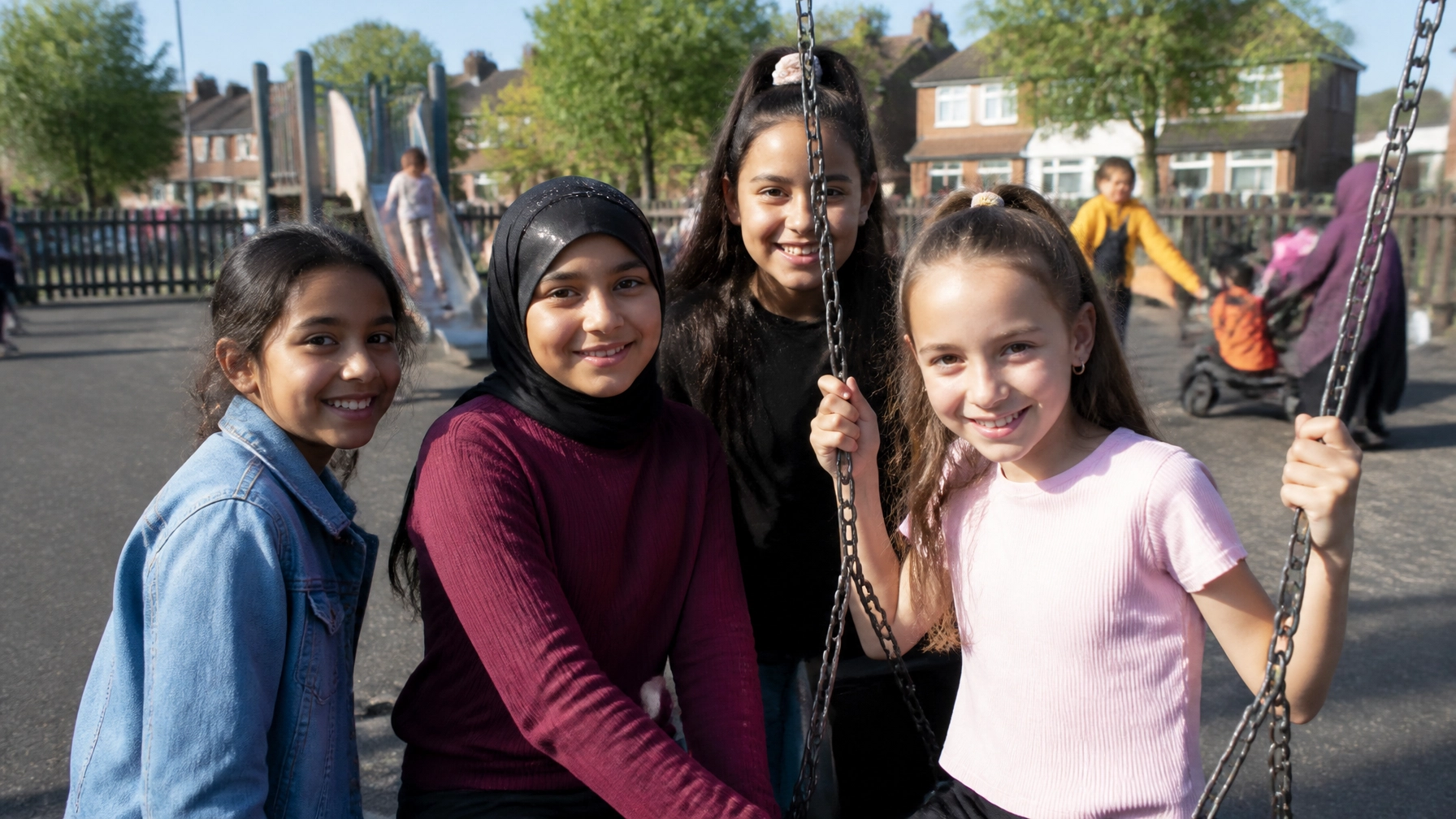
The afternoon began typically enough, with the park filled with families enjoying the unseasonably warm weather. However, the mood shifted when a seven-year-old girl, who was playing quietly near the swings, became the focus of unwanted attention. A small group of older children began mocking her movements and speech, using the playground’s shared space as a stage for disparagement. For several minutes, the girl remained isolated, her confusion evident as the taunts grew louder. It was at this point that four girls, aged between nine and eleven, decided that they could no longer remain bystanders. Without seeking the help of the parents seated on nearby benches, they walked directly into the centre of the confrontation, forming a protective circle around the younger girl and firmly telling the bullies that their behaviour was not welcome in the park.
An Unlikely Stand Against Local Intimidation
The bravery shown by the group was not just in their words, but in their immediate commitment to action. After successfully discouraging the bullies, who eventually moved to a different area of the park, the girls did not simply walk away. Instead, they spent the remainder of the afternoon ensuring the younger girl was fully integrated into their games. They helped her onto the slide, included her in a game of tag, and made sure she felt like a central part of the group. This immediate shift from a situation of fear to one of absolute belonging changed the entire dynamic of the playground. Parents who witnessed the event described it as a "masterclass in empathy," noting that the girls handled the situation with a maturity that far exceeded their years.
The impact of this intervention reached beyond the immediate emotional relief for the young girl and her family. For those watching, it served as a stark reminder of the social challenges faced by children with Down’s syndrome and other developmental disabilities. Statistics frequently highlight that children with additional needs are significantly more likely to experience bullying in public spaces, often leading to a withdrawal from community activities. By standing up and physically reclaiming the space for their new friend, the Preston girls sent a clear message that the playground is a sanctuary for everyone, regardless of their individual challenges. The girls’ parents later expressed that while they were proud, they were not entirely surprised, citing a growing emphasis on "active kindness" within their local primary schools.
The ripple effect of the girls' actions was felt almost instantly. As they played together, other children in the park began to gravitate towards the group, drawn by the positive energy and the evident sense of fun. What had started as a moment of potential trauma for one family was transformed into a communal celebration of childhood. The younger girl’s mother, who had been momentarily frozen by the suddenness of the bullying, spoke of her immense gratitude. She explained that seeing her daughter embraced by a group of older peers was a rare and beautiful sight, one that restored her faith in the local community’s ability to look out for its most vulnerable members. It was a testament to the fact that when children are taught to value diversity, they become the most effective guardians of social harmony.
Turning the Tide for Inclusive Play
This incident in Preston highlights a broader movement towards inclusive play that is gaining momentum across the United Kingdom. Experts in child psychology often point out that the playground is the first place where children learn the rules of social engagement and the consequences of exclusion. When children like the Preston group intervene, they are not just stopping a single instance of bullying; they are actively rewriting the social script for their peers. They are demonstrating that kindness is a choice and that standing up for others is a form of social leadership. The girls did not wait for a teacher or a guardian to tell them what was right; they acted on an instinctive understanding of fairness that is often more acute in children than in adults.
The city of Preston has long taken pride in its tight-knit communities, and this latest story has added a new chapter to that reputation. Local residents have taken to social media and community forums to praise the girls, with many calling for them to be formally recognised for their bravery. However, the girls themselves seem largely unfazed by the attention, reportedly telling their parents that they "just wanted to play" and didn't think it was fair that someone was being left out. This humble perspective is perhaps the most heartening aspect of the story; it suggests that for this new generation, inclusivity is not a chore or a performed virtue, but a fundamental expectation of how one should treat others in a shared environment.
In the days following the event, the park has seen a noticeable increase in multi-age and inclusive groups playing together. It appears that the "Preston Four," as they have been affectionately dubbed by some locals, have set a new standard for playground etiquette. Their actions have prompted other parents to have conversations with their own children about what it means to be an "upstander" rather than a bystander. In a world where digital interactions often replace face-to-face play, the physical reality of a group of girls standing in the sun to defend a friend reminds us of the enduring importance of physical community spaces and the vital social lessons they provide.
The Lasting Impact of Small Acts of Bravery
As the story continues to circulate, it serves as a powerful antidote to the often-negative headlines surrounding youth behaviour and antisocial incidents in urban areas. It provides a counter-narrative that highlights the quiet, everyday heroism that exists in British towns and cities. The focus is not on the bullies, whose names and faces have faded from the conversation, but on the enduring image of five girls laughing and playing together on a slide. This shift in focus is crucial; by elevating stories of kindness, communities can begin to marginalise the culture of bullying that often thrives in silence and indifference.
The long-term benefits for the young girl with Down’s syndrome are also significant. Early positive experiences of social inclusion are vital for building self-esteem and confidence in children with disabilities. This single afternoon in a Preston park may well have a lasting influence on her willingness to engage with others and her sense of safety in public spaces. It has also provided her family with a support network of local parents who were moved by the event, creating a stronger, more resilient community web around her. This is the true power of standing up: it creates a safety net that catches more than just the person being defended.
Looking forward, the hope is that the spirit of that Tuesday afternoon becomes the norm rather than the exception. While the Preston girls may have acted on impulse, their decision was rooted in a culture of respect that can be nurtured in any school or household. As the city continues to grow and change, the memory of this small act of bravery in a local park stands as a beacon of what is possible when individuals choose courage over comfort. It is a reminder that while bullies may attempt to claim the playground, it ultimately belongs to those who play with kindness, ensuring that every child has the chance to enjoy the simple joy of a sunny day in the park.