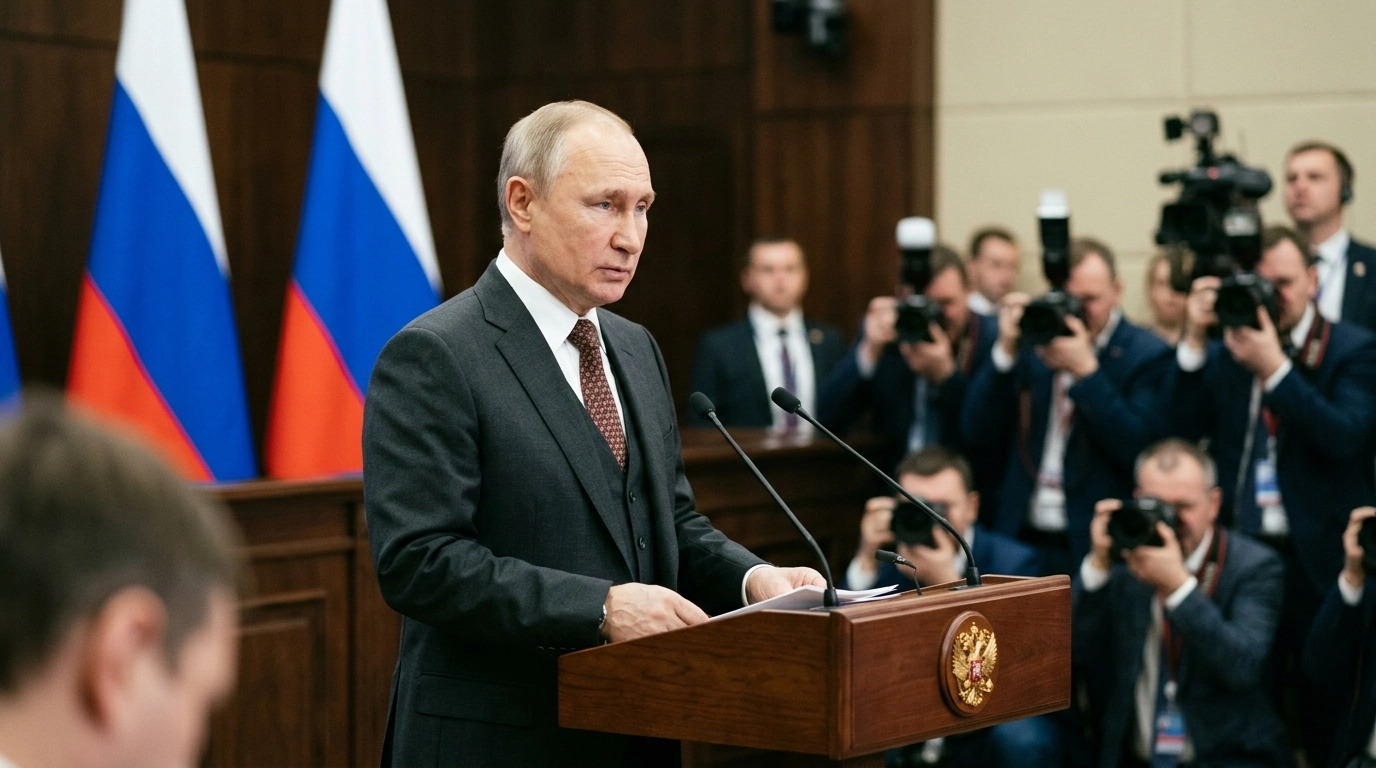
The geopolitical landscape of Eastern Europe faced a significant tremor this week as President Vladimir Putin publicly suggested that the conflict in Ukraine may be nearing a resolution. Speaking from a government briefing in Moscow, the Russian leader indicated that a combination of shifting tactical priorities and evolving international pressures could lead to a cessation of hostilities sooner than many analysts had previously predicted. This statement comes at a time when the front lines are experiencing some of their most volatile movements in months, with Ukrainian forces making notable gains in key sectors. The timing of Putin’s remarks is being closely scrutinised by global leaders, especially as it follows a series of high-profile drone strikes and successful Ukrainian counter-offensives that have stretched Russian defensive lines.
Despite the optimism suggested by the Kremlin, the situation on the ground remains incredibly complex. Reports from the Donetsk and Kupiansk sectors indicate that Ukrainian Azov units have liberated several key settlements, forcing Russian troops into tactical retreats to consolidate their positions. These developments mark a sharp contrast to the rhetoric coming out of Moscow just a few months ago, when victory was described as an “inevitability” by the end of 2026. Instead of a swift conclusion, the spring of 2026 has seen a stalemate in some regions and a breakthrough for Kyiv in others, leading to questions about whether Putin’s latest comments represent a genuine desire for peace or a strategic pause intended to regroup.
Military analysts suggest that the internal pressure within Russia may be a driving factor behind this shift in narrative. The economic cost of the sustained campaign, combined with an increasing number of drone incursions targeting critical infrastructure deep within Russian territory, has begun to alter the public discourse in Moscow. With refineries and energy hubs being neutralised by coordinated Ukrainian drone blitzes, the Kremlin may be looking for a way to de-escalate without appearing to concede defeat. The recent exchange of 1,000 prisoners of war, facilitated after a brief operational pause, is also being seen as a potential opening for more significant diplomatic engagement.
The Rhetoric of Resolution vs. Reality
The disparity between official Kremlin statements and the tactical reality in the Donbas region has never been wider. While President Putin frames the potential end of the war as a strategic choice, independent monitors have noted a significant slowing in Russian advances throughout early 2026. Data suggests that the territory captured by Russian forces in the first quarter of this year was significantly less than during the same period in 2025. This deceleration has likely forced a reassessment of the long-term viability of a purely military solution. The rhetoric of “ending soon” may be aimed at domestic audiences who are increasingly weary of a conflict that has entered its fifth year, providing a narrative of controlled conclusion rather than forced withdrawal.
International observers remain sceptical of any claims of imminent peace that do not include a complete withdrawal of Russian troops from sovereign Ukrainian land. The Ukrainian government has consistently stated that negotiations cannot proceed as long as their territories remain occupied. In his latest address, President Zelenskyy reinforced the position that while a ceasefire is desirable, it cannot serve as a mask for Russian re-armament. The friction between these two stances: Putin’s suggestion of a near end and Kyiv’s demand for full restoration: indicates that “ending soon” might have very different meanings in Moscow and Kyiv.
Furthermore, the role of drone warfare has fundamentally changed the calculus of the conflict. The ability of Ukrainian forces to strike 20+ Russian regions simultaneously has overwhelmed local air defence networks, including sophisticated S-400 and Pantsir-S1 systems. This technological shift has brought the war home to the Russian populace in a way that traditional frontline combat did not. By suggesting that a resolution is near, the Russian leadership may be attempting to manage the psychological impact of these strikes, offering a light at the end of a tunnel that has become increasingly dark for the nation’s logistics and infrastructure sectors.
Shifts on the Ground and Tactical Changes
The battlefield in May 2026 is defined by a level of technological sophistication that was previously unseen. The use of mass-coordinated drone swarms has rendered traditional large-scale troop movements more vulnerable than ever. In recent weeks, Ukrainian forces have utilised this advantage to disrupt Russian supply chains in the rear, creating windows of opportunity for ground forces to reclaim territory. This shift in momentum is particularly evident in the Kupiansk sector, where a series of surgical strikes on ammunition depots paved the way for the liberation of several villages. These successes have boosted Ukrainian morale and demonstrated that the “frozen” nature of the conflict is a misnomer.
Russian forces, in response, have shifted toward a more defensive posture, focusing on the fortification of existing lines rather than the pursuit of new territorial gains. This change in strategy aligns with Putin’s comments regarding a potential end to the war; by digging in and declaring the objective partially met, Moscow could attempt to freeze the conflict along current lines. However, the continuous pressure from Ukrainian counter-offensives makes such a stalemate difficult to maintain. The forced retreat from key logistical hubs in the east suggests that Russian fortifications, while extensive, are not impenetrable against a modern, drone-integrated military force.
The return of 1,000 Ukrainian prisoners of war during the Victory Day celebrations on May 9th provided a rare moment of humanitarian progress amidst the ongoing violence. This move, which was reportedly part of a temporary ceasefire agreement, has been interpreted by some as a trial balloon for broader diplomatic discussions. If both sides can manage a successful prisoner exchange and a short-lived pause in fighting, it may indicate a mutual exhaustion that could eventually lead to a more formal ceasefire. However, the underlying political issues: sovereignty, NATO membership, and territorial integrity: remain as contested as they were at the start of the full-scale invasion.
Global Implications and the Path Ahead
As the world reacts to the possibility of a shift in the Ukraine war, the international community remains divided on the most likely outcome. European leaders have expressed a cautious interest in the Kremlin’s changing tone but have reiterated their commitment to supporting Ukraine’s right to self-determination. The consensus among Western allies is that any peace must be sustainable and must not allow for a frozen conflict that Russia could exploit in the future. The logistical support from the West, particularly in terms of advanced air defence and drone technology, continues to be a decisive factor in maintaining the current battlefield shifts that have pressured Putin into these recent statements.
The economic fallout of the conflict continues to ripple through global markets, with energy prices and food security remaining at the forefront of international concern. A genuine end to the war would bring much-needed stability to these sectors, but the path to such a resolution is fraught with diplomatic minefields. There is a growing concern that Putin’s claims might be a tactical feint designed to reduce the urgency of Western military aid. If the international community scales back its support in anticipation of a resolution that never comes, the momentum could shift back in Russia’s favour, prolonging the suffering of those in the conflict zones.
Looking forward, the remainder of 2026 will likely be defined by a tense interplay between high-stakes diplomacy and intense battlefield activity. While the Russian President claims the end is near, the reality of the war remains one of attrition and technological evolution. For the millions of people affected by the violence, the hope for a swift conclusion is tempered by the knowledge of how many times such hopes have been dashed before. Whether these recent shifts lead to a lasting peace or merely a new phase of the conflict will depend on the actions taken in the coming weeks by both the commanders on the front lines and the politicians in the halls of power.