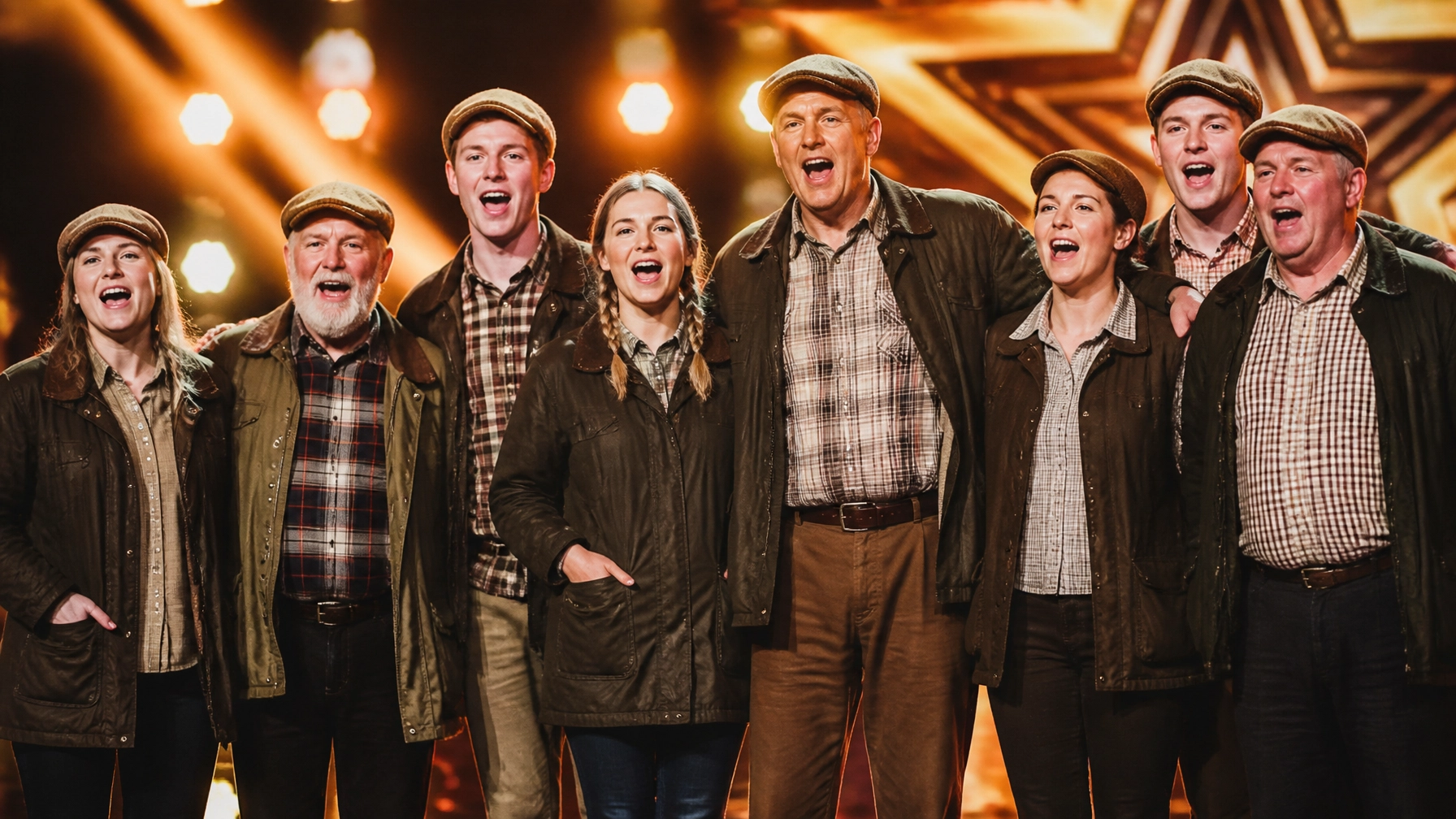
The roar of the crowd at the London Palladium was not just for the pitch-perfect harmonies or the unexpected stage presence of the Hawkstone Farmers’ Choir; it was a response to a raw, honest message about a crisis hidden in plain sight. When the group of men and women, clad in their finest wax jackets and flat caps, stood before the judges on Britain’s Got Talent, they brought with them the weight of the British countryside. Their journey from the muddy fields of the UK to the final stage of the nation’s biggest talent show has become a symbol of hope and a powerful tool for breaking the silence surrounding mental health in the agricultural sector.
The choir, which recently captured the hearts of millions and secured Amanda Holden’s Golden Buzzer, consists of working farmers who have turned to music as a form of collective therapy. For many, the stage lights were a world away from the solitary hours spent in tractor cabs or lambing sheds. Yet, as they performed a stirring rendition of Elbow’s “One Day Like This,” the transition from rural isolation to national spotlight appeared seamless. The performance was not merely about winning a competition; it was a calculated effort to ensure that the struggles of the farming community were heard by those far beyond the farm gate.
The success of the Hawkstone Farmers’ Choir comes at a critical time for the industry. Farming remains one of the most isolating professions in the country, with many workers spending upwards of sixteen hours a day alone. This isolation, combined with the financial pressures of modern agriculture, volatile weather patterns, and the constant demands of livestock welfare, has created a mental health emergency. By stepping onto the stage, these farmers have used their voices to illustrate that while they may work alone, they do not have to suffer in silence.
Breaking the Silence in the Furrows
The origins of the choir are as grounded as the members themselves. Formed from a diverse group of individuals representing various corners of the British Isles, the choir was born out of a shared need for connection. The agricultural community has long been known for its resilience and a "stiff upper lip" attitude, but that same stoicism has often prevented individuals from seeking help when they need it most. The choir serves as a weekly sanctuary, a place where the rigours of the working week are traded for the camaraderie of the rehearsal room. It is a space where the unique pressures of the job: from the rising costs of fertiliser to the impact of bovine TB: can be discussed openly between songs.
Members have spoken candidly about the transformative power of the group. One tenor, who manages a sheep farm in the Welsh Borders, noted that the choir had given him a reason to leave the farm on Tuesday nights, a break that he credited with saving his mental well-being. The act of singing together requires a level of vulnerability that is often foreign to the traditional image of the hardy British farmer. By embracing this vulnerability on national television, the choir has challenged the stereotypes that have often hindered open conversations about emotional health in rural areas.
The impact of their televised performances has been immediate and widespread. Rural charities have reported a significant uptick in enquiries following the choir’s appearances, with more farmers reaching out for support and advice. The visibility of the choir has provided a "permission slip" for others in the industry to acknowledge their own struggles. When the judges praised the choir not just for their musicality but for their bravery in addressing such a somber topic, it resonated with a community that often feels forgotten by the urban-centric headlines.
The Power of Collective Harmony
Beyond the emotional weight of their message, the choir has demonstrated a remarkable level of musical skill that surprised even the most seasoned critics. Their performances are characterised by a deep, resonant sound that seems to carry the very essence of the landscapes they tend. The choice of repertoire, often featuring anthems of resilience and community, has been deliberate. In the semi-finals, their version of Bastille’s “Pompeii” was rearranged to highlight the strength found in unity, a metaphor for the support networks they are trying to build within the farming world.
The connection to the Hawkstone name has also brought a level of mainstream attention that few rural initiatives manage to achieve. While the association with high-profile agricultural figures initially drew eyes to the group, it is the individual stories of the members that have kept the public engaged. Each singer brings a different perspective, from young entrants to the industry struggling with the cost of land, to veteran farmers who have seen the social fabric of rural villages decline over decades. Together, they represent a cross-section of a society that is vital to the nation's food security but often remains invisible to the consumer.
The choir’s success has also highlighted the lack of mental health resources specifically tailored for the agricultural sector. Traditional mental health services are often located in urban centres and may not fully grasp the specific nuances of farming life: the inability to "clock off," the blurring of home and work life, and the immense pressure of multi-generational expectations. The Hawkstone Farmers’ Choir has become an unofficial ambassador for a more localised, peer-led approach to support, proving that sometimes the best medicine is simply being among those who understand the life you lead.
A National Conversation on Rural Well-being
As the choir progressed through the competition, the narrative shifted from a feel-good story to a serious discussion about the future of the British countryside. Their presence in the final was a testament to the public’s appetite for authentic, meaningful content. In an era of manufactured pop stars, the sight of weather-worn faces singing from the heart provided a refreshing and necessary contrast. The "Farmers' Fortune" is not measured in prize money or recording contracts, but in the shift in public perception and the lives that may be saved by a renewed focus on rural mental health.
The legacy of the choir is expected to last far beyond the television season. Plans are already in motion for a regional tour, bringing their music and their message directly to agricultural shows and rural community halls across the country. The goal is to keep the conversation going, ensuring that the momentum built on Britain’s Got Talent is not lost once the confetti has been swept away. They are advocates for a cultural shift where checking in on a neighbour is as routine as checking the fences.
In the final reckoning, the Hawkstone Farmers’ Choir has achieved something far more significant than a talent show victory. They have raised the roof of the London Palladium, but more importantly, they have raised the profile of a community in need. Their voices, once isolated in the vastness of the British landscape, are now part of a national chorus calling for change. By singing joyfully together, they have shown that while the burdens of farming may be heavy, they are much lighter when shared.