The age-old riddle of whether the chicken or the egg came first has been given a strikingly modern resolution by a team of researchers who have bypassed nature’s traditional boundaries. In a development that feels more like the pages of a high-concept science fiction novel than a standard laboratory report, the first live chicks have successfully hatched from entirely artificial eggs. This achievement represents a fundamental shift in our understanding of avian development and offers a glimmer of hope for the ambitious, and often controversial, field of de-extinction.
The breakthrough, announced by the biosciences firm Colossal, involves a sophisticated incubation platform that replaces the calcium-rich shell provided by a mother bird with a high-tech synthetic alternative. In a demonstration that has captured the attention of both the scientific community and the general public, the team successfully removed a chicken embryo from a natural egg and nurtured it within an artificial construction until a healthy, fluffy hatchling emerged. This successful birth is more than just a technical curiosity; it is being hailed as a foundational pillar for the eventual return of species long lost to history.
The primary motivation behind this intensive research is the resurrection of the South Island giant moa, a flightless bird from New Zealand that could weigh upwards of 230 kilograms. Since the moa’s extinction, there has been no natural vessel capable of housing an embryo of such immense proportions. By creating a scalable, synthetic environment, the researchers believe they have solved one of the most significant physical bottlenecks in the path toward de-extinction.
Engineering the Breath of Life
At the heart of this innovation is a design that mimics the complex biological functions of a natural eggshell. A bird's egg is a marvel of evolutionary engineering, providing mechanical protection while simultaneously allowing the embryo to breathe through microscopic pores. Replicating this delicate balance of gas exchange and humidity control has historically been the primary obstacle for scientists attempting to grow avian life outside the shell.
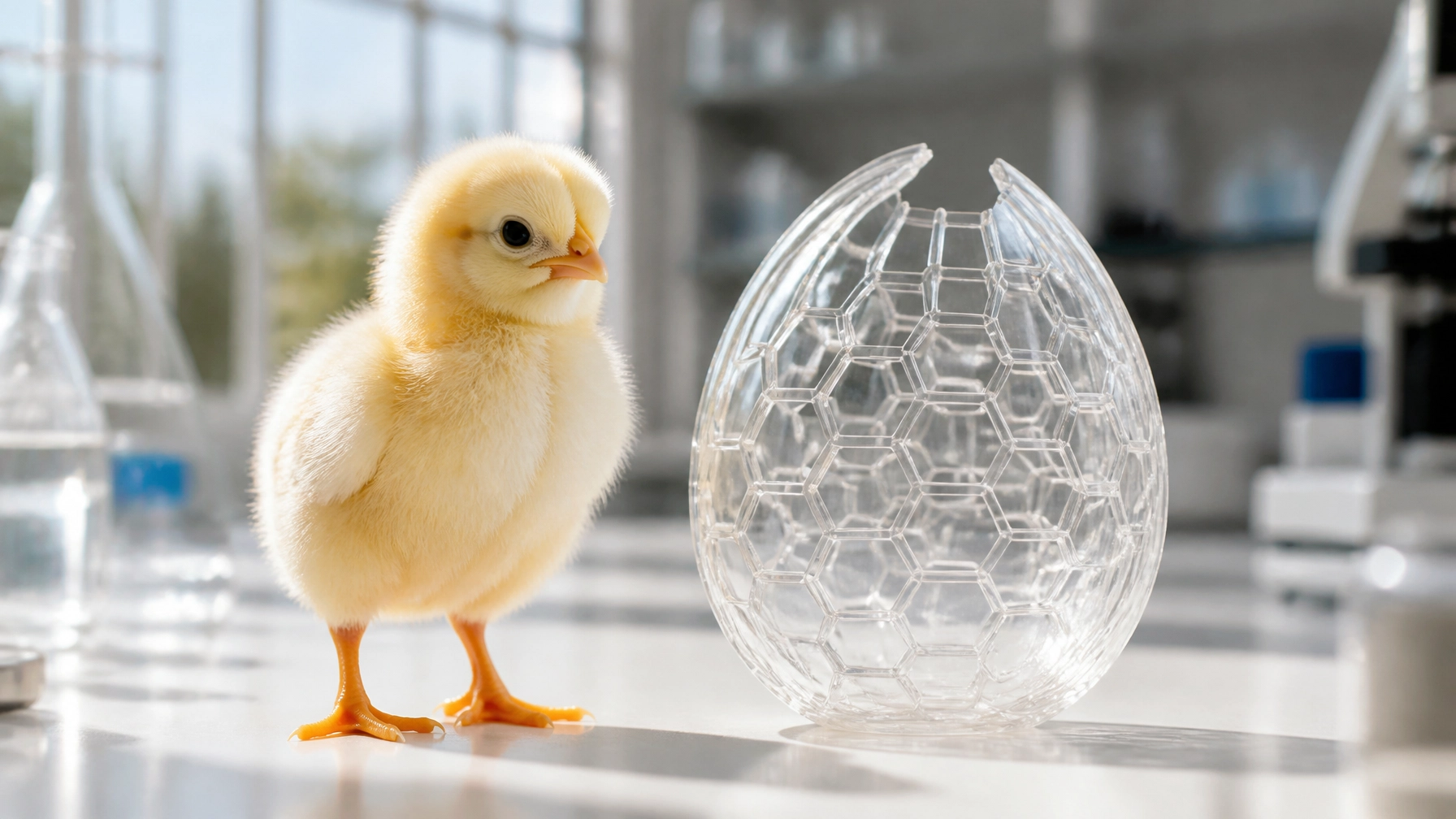
The new artificial egg utilises a lattice-like external structure coupled with a bioengineered, silicone-based membrane. This membrane has been specifically tuned to match the oxygen transfer capacity of a natural shell, ensuring that the developing embryo receives precisely the right amount of air without losing vital moisture. In previous attempts, embryos often failed because the artificial shells were either too permeable, leading to dehydration, or too airtight, resulting in suffocation. By using a lattice structure, the researchers have maximised the surface area available for gas exchange while maintaining the structural integrity required to protect the growing life within.
Furthermore, the transparency of the synthetic shell provides an unprecedented window into the developmental process. For the first time, scientists can observe anatomical milestones and the emergence of specific traits in real-time. In the context of genetic editing, this is particularly valuable. Researchers can visually confirm that the traits they have introduced: such as specific feather structures or limb proportions: are manifesting correctly before the bird ever reaches the hatching stage. This level of monitoring was previously impossible with opaque, natural eggs, which required invasive and often dangerous procedures to inspect.
Safeguarding Species on the Brink
While the headline-grabbing goal of the project remains the de-extinction of the moa and the woolly mammoth, the immediate practical applications for current conservation efforts are perhaps even more profound. The world is currently facing a biodiversity crisis, with many avian species hovering on the precipice of extinction. For birds like the Hawaiian crow or the Kakapo, every single egg is a precious resource.
Natural eggs are often fragile and susceptible to environmental changes, predation, or accidental breakage by the parents. The ability to move an embryo into a controlled, artificial environment could provide a safety net for the world’s most endangered birds. The system is designed to be fully scalable, meaning it could be adapted for eggs of various sizes and requirements. This provides a capability that current conservation programmes simply do not have: the ability to rescue an embryo from a damaged shell and see it through to a healthy hatch.
The technology also addresses the "surrogate" problem. In many de-extinction and intensive breeding projects, finding a suitable host or surrogate parent is a major logistical hurdle. If a species has no close living relatives that lay eggs of a similar size or composition, the project can stall indefinitely. By removing the need for a natural host shell entirely, the artificial egg platform allows scientists to focus on the genetic health and development of the embryo itself, rather than the search for a biological match that may not exist. This "de-extinction toolkit" is being built with the moa in mind, but its architects are clear that the technology is intended to support the broader spectrum of avian life.
The Rigour of the Scientific Method
Despite the excitement surrounding the hatching of these first chicks, the announcement has not been without its critics. Within the wider scientific community, there is a palpable sense of caution, largely stemming from the way the news was shared. Unlike traditional breakthroughs that are subjected to the rigorous scrutiny of peer review and published in established academic journals, this development was unveiled through a highly polished video presentation.
Some evolutionary geneticists have noted that while the visual evidence is impressive, the lack of published data makes it difficult to assess the true success rate of the technology. For a breakthrough to be truly validated, independent experts must be able to examine the methodology, the survival rates of the embryos, and the long-term health of the hatched chicks. Questions remain about whether birds raised in an entirely artificial environment will develop the same immune systems, bone density, and behavioural patterns as those hatched naturally.
There is also a broader ethical debate regarding the allocation of resources. Some critics argue that the millions of pounds being poured into de-extinction technology would be better spent protecting the habitats of species that are still with us today. They worry that the promise of "bringing species back" could lead to a lack of urgency in preventing current extinctions. However, proponents of the technology argue that these innovations are not mutually exclusive. The tools developed for de-extinction are the very same tools that will empower modern conservationists to save existing species.
The successful hatching of these chicks from a lattice-structured artificial shell is a testament to the power of synthetic biology. It represents a moment where the lines between the natural world and the laboratory have blurred to create something entirely new. Whether this technology eventually leads to a world where giant moas once again roam the forests of New Zealand remains to be seen. What is certain, however, is that the first steps have been taken, and the "new start" for nature may look more technological than we ever imagined. As the chicks grow and the technology matures, the focus will inevitably shift from the wonder of the "how" to the responsibility of the "why."