In the historic town of Windsor, where the shadow of the castle often defines the local narrative, a much smaller but equally significant story has been unfolding on the street corners. It is a tale of civic pride, intergenerational empathy, and the proactive spirit of a young resident who refused to look the other way when she saw a problem in her community. Poppy, a twelve-year-old schoolgirl with a keen eye for her surroundings, has recently become a local figure of praise after taking it upon herself to lead a significant restoration of a neglected public asset.
The focus of her attention was a local bus shelter that had, over many months, fallen into a state of severe disrepair. Public infrastructure often suffers from a creeping neglect; a few strands of ivy here, a layer of grime there, and before long, a functional space becomes an eyesore. For most residents, the shelter had become a background blur in their daily commute, a testament to the slow retreat of local maintenance. However, for Poppy, the state of the shelter was not just a matter of aesthetics; it was a matter of accessibility and dignity for the people who relied on it most.
The catalyst for her action was a poignant encounter with an elderly resident. While passing the stop, Poppy observed an older woman struggling to navigate the thick, encroaching ivy that had begun to swallow the seating area. The shelter, intended to provide refuge from the unpredictable British weather, had instead become a source of frustration. The glass was obscured by dirt, the pavement was slick with moss, and the wooden bench was almost entirely consumed by greenery. Seeing the difficulty faced by someone far more vulnerable than herself sparked a sense of duty in the young teenager. Rather than waiting for the local authorities to add the site to a long list of maintenance tasks, Poppy decided to take the lead.
A Simple Act of Kindness in Windsor
The transformation did not happen overnight, nor was it a solo effort, but it was Poppy’s vision that set everything in motion. Recognising that the task was too large for one person, she reached out to her school community for support. It is often said that the youth of today are disconnected from their local environments, buried in digital worlds, but Poppy’s initiative tells a different story. She articulated the problem clearly: a local grandmother, a neighbour, or a friend was unable to sit down while waiting for the bus because the community had let a small corner of Windsor go to seed.
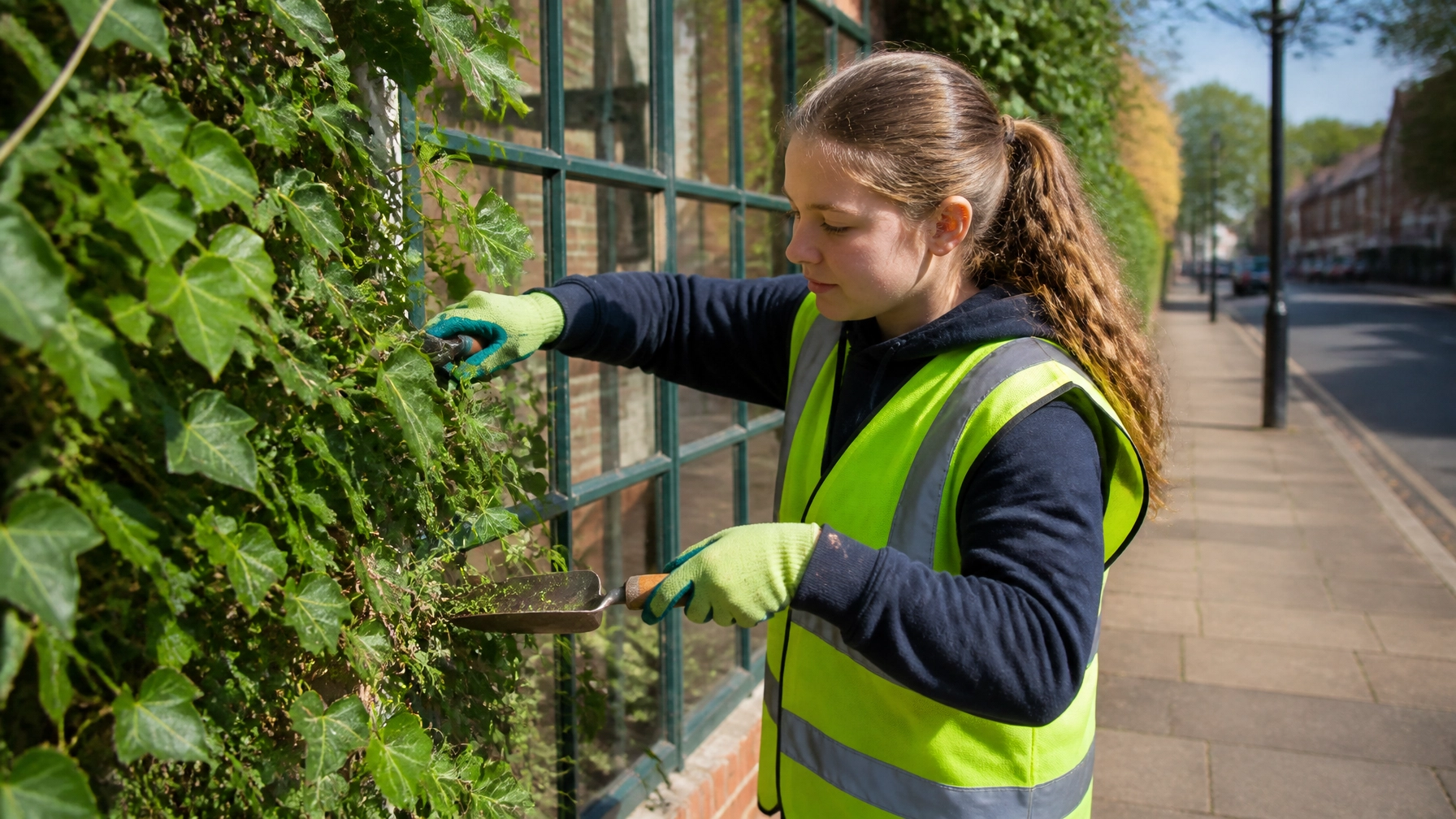
Her enthusiasm was infectious. Before long, she had coordinated a small team of teachers and staff from her school to join her. This was not a formal school project or a mandatory piece of community service; it was a grassroots response to a visible need. On the day of the clean-up, the group arrived equipped with high-visibility vests, gardening shears, trowels, and bin bags. The scene was a striking contrast to the usual quiet of the suburban street. Passers-by stopped to watch as the team began the laborious process of peeling back layers of neglected vegetation.
The work was physically demanding. The ivy had grown thick and woody, anchoring itself into the mortar of the brickwork and wrapping tightly around the metal frame of the shelter. Each vine removed revealed more of the original structure, a slow uncovering of a public space that had been hidden for far too long. For Poppy, the work was about more than just gardening; it was about reclaiming a piece of the town for the people who use it. As the bags filled with green waste, the atmosphere around the bus stop began to shift from one of neglect to one of active care.
Restoring Dignity to Local Public Spaces
The impact of such a project extends far beyond the physical removal of weeds and dirt. When public spaces are allowed to deteriorate, it sends a subtle message to the community that the area is not valued. This "broken windows" theory suggests that visible signs of neglect can lead to a decrease in civic pride and an increase in further anti-social behaviour. By contrast, when a twelve-year-old takes the time to polish the glass and sweep the floor of a bus stop, the message is the opposite: this place matters, and the people who use it matter.
For the elderly residents of Windsor, the bus shelter is often a vital link to the wider world. In an era where many services are moving online, the physical act of catching a bus to the shops, the post office, or a doctor's appointment remains a cornerstone of independent living for the older generation. A clean, safe, and accessible place to wait is not a luxury; it is a necessity. Poppy’s work ensured that the woman she had seen struggling, and many others like her, could once again wait for their transport in comfort and safety.
The response from the local neighbourhood was overwhelmingly positive. As the team worked, residents stopped to offer words of encouragement and thanks. Some were surprised to see such a young person leading the charge, highlighting a common misconception about the interests and capabilities of the younger generation. The project served as a reminder that community spirit does not always require large budgets or complex bureaucratic processes. Often, all it takes is one individual with a pair of gardening gloves and the determination to make a difference. The sight of the rejuvenated shelter, now clear of obstructions and shining in the sunlight, stood as a temporary but powerful monument to what can be achieved through local action.
Inspiring a New Generation of Community Action
Poppy’s initiative in Windsor serves as a blueprint for how young people can engage with their local areas. In a world that often feels overwhelmed by global issues that seem impossible to solve, focusing on the immediate surroundings provides a sense of agency and accomplishment. You might not be able to fix the climate or the economy overnight, but you can certainly clean a bus stop. This sense of local empowerment is crucial for developing the next generation of civic leaders and active citizens.
The story of the Windsor clean-up has resonated far beyond the immediate street. It highlights a growing trend of "micro-volunteering," where individuals take on small, manageable tasks that collectively improve the quality of life for everyone. It also raises important questions about the role of local councils and the balance between public services and community responsibility. While it is the duty of the state to maintain public infrastructure, the intervention of citizens like Poppy adds a layer of social cohesion that a scheduled maintenance van simply cannot provide.
As the school term continues and the seasons change, the bus shelter in Windsor remains a testament to Poppy’s hard work. It is likely that the ivy will eventually try to return, as nature always does, but the memory of the clean-up will remain. More importantly, the precedent has been set. Other students and residents have seen that change is possible and that age is no barrier to leadership. Poppy has shown that by looking out for the elderly and taking pride in the town, one person can indeed change the fabric of their community. Her story is a reminder to all of us to look a little closer at our own neighbourhoods and ask what small part we might play in making them a little brighter for everyone.