For thirteen years, a small poodle-cross named Gracie knew only the confines of a crowded, chaotic house. In a story that has captured the hearts of animal lovers across the country, this senior dog has finally stepped into the sunshine, trading a life of neglect for the rolling fields and quiet comfort of a forever home in Norfolk. Her journey is not just a tale of survival, but a stark reminder of the resilience of older animals and the profound impact of dedicated rescue work.
Gracie was one of several dozen animals removed from a property earlier this year. The conditions described by those on the scene were harrowing; it was a classic case of a "crowded home," where the number of animals far exceeded the owner’s ability to provide even the most basic care. For a dog of Gracie's age, the stress of such an environment is magnified. At thirteen, most dogs are enjoying their twilight years on a soft rug by a fireplace. Gracie, however, was competing for space and food, her matted white fur a testament to the lack of individual attention she had received for over a decade.
When she was first brought into the care of local rescue volunteers, Gracie was understandably shut down. The transition from a high-pressure environment to a clinical rescue setting can be overwhelming for any animal, let alone a senior who has spent her entire life in one place. Veterinarians who examined her found a litany of age-related issues that had gone untreated, including dental disease and the early stages of arthritis. Yet, despite her physical ailments and the trauma of her past, those who worked with her noticed a spark. Behind the weary eyes of a dog who had seen too much was a gentle soul waiting for a reason to trust again.
A New Chapter in the Norfolk Countryside
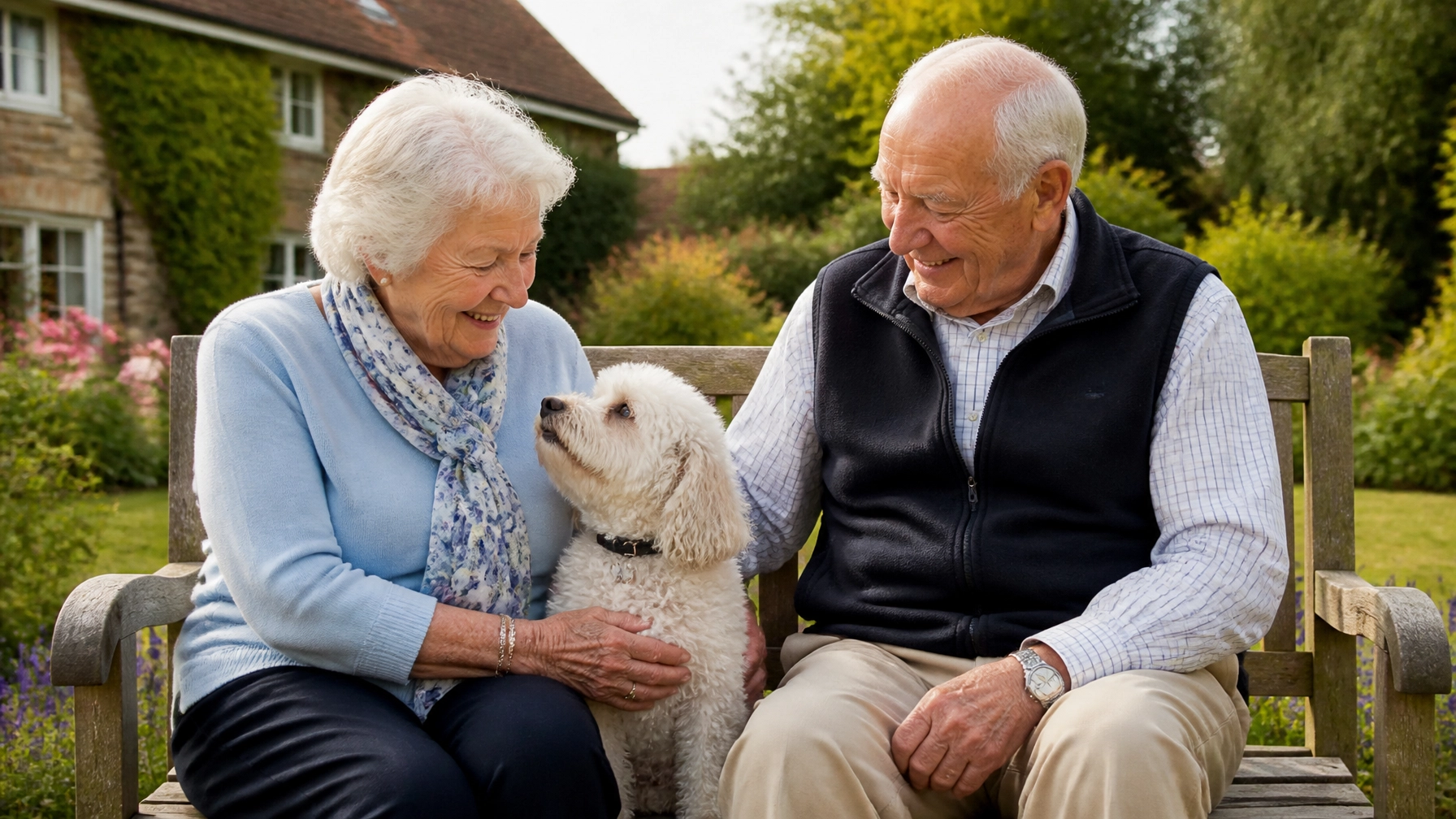
The search for a permanent home for a thirteen-year-old dog is rarely easy. Many prospective adopters are understandably hesitant to take on an animal with potential medical bills and a shorter life expectancy. However, for a couple living in a quiet village on the edge of the Norfolk Broads, Gracie was exactly what they were looking for. Having recently lost their own elderly dog, they weren't looking for a high-energy puppy; they wanted to give a "golden oldie" the best possible end to their story.
The move to Norfolk marked the first time Gracie had ever experienced a garden of her own. Her new owners describe the first few days as a period of cautious exploration. Used to the noise and smell of dozens of other animals, the silence of the countryside was initially a shock. She would sit by the backdoor, hesitant to step onto the grass, her nose twitching at the scent of lavender and fresh air. It took patience, soft voices, and plenty of treats, but eventually, the senior poodle-cross made her move.
Watching a dog like Gracie discover the world at thirteen is a transformative experience. Her owners speak of the "firsts" that most people take for granted: the first time she chased a slow-moving bee, the first time she fell into a deep, twitchy-pawed sleep on a proper orthopedic bed, and the first time she wagged her tail at the sound of the morning kettle. In Norfolk, she has found more than just a house; she has found a rhythm of life that is dictated by affection and routine rather than survival and competition.
The Hidden Crisis of Senior Dog Neglect
Gracie’s story brings into sharp focus a growing issue within the UK’s animal welfare sector: the plight of senior dogs in multi-animal households. While puppies often garner the most attention and the quickest adoption offers, older dogs are frequently the silent victims of hoarding and over-crowding. Because they are less demanding and often more submissive, they can fade into the background of a chaotic home, their health declining unnoticed until an intervention occurs.
The "crowded home" phenomenon is often born from a place of misplaced intention, where owners take in more animals than they can manage, leading to a breakdown in sanitation and welfare. For a dog like Gracie, being "rescued" is only the beginning. The rehabilitation of a senior dog requires a specific kind of care. It involves managing chronic pain, providing high-quality nutrition to rebuild muscle mass lost to inactivity, and, perhaps most importantly, offering emotional stability.
Experts in canine behavior note that senior dogs have a remarkable capacity for adaptation, but they require time. The "rule of three": three days to decompress, three weeks to learn the routine, and three months to feel at home: is often extended for seniors from neglected backgrounds. Gracie’s success is a testament to the fact that age is not a barrier to happiness. Her case has encouraged several local rescues to launch specific campaigns highlighting "Golden Oldies," aiming to find homes for the dozens of other senior dogs who find themselves in shelters through no fault of their own.
A Legacy of Second Chances and Hope
As Gracie settles into her new life, her days are filled with the simple pleasures she was denied for thirteen years. She enjoys short, leisurely walks along the hedgerows, her pace matched perfectly by her new companions. Her coat, once a tangled mess, is now kept short and clean, revealing a dog that looks years younger than her actual age. The dental work she received upon rescue has given her a new lease of life, allowing her to enjoy her meals without the pain that had shadowed her for years.
Her owners are keen to share her story not for the sake of the drama of her rescue, but to inspire others to consider the older dogs waiting in rescue centres. They describe the bond with a senior dog as something uniquely profound. There is a sense of mutual gratitude; the dog understands that their life has changed for the better, and the owner finds purpose in providing comfort to a soul that has known little of it. In Norfolk, Gracie isn't just a "rescue dog" or a "victim of a crowded home." She is a beloved family member, a fixture of the local community, and a living example of the fact that it is never too late for a happy ending.
The impact of Gracie’s story reaches far beyond the borders of Norfolk. It serves as a beacon of hope for rescue workers who often face the grim reality of animal neglect. To see a dog go from the depths of a crowded, neglected house to the serene beauty of the English countryside is the ultimate reward. For Gracie, the thirteen-year wait was long, but as she curls up in the sun-drenched corner of her new living room, it is clear that she is finally where she belongs. The chaos of her past has been replaced by the peace of her present, proving that even after a decade of darkness, the light can always be found.