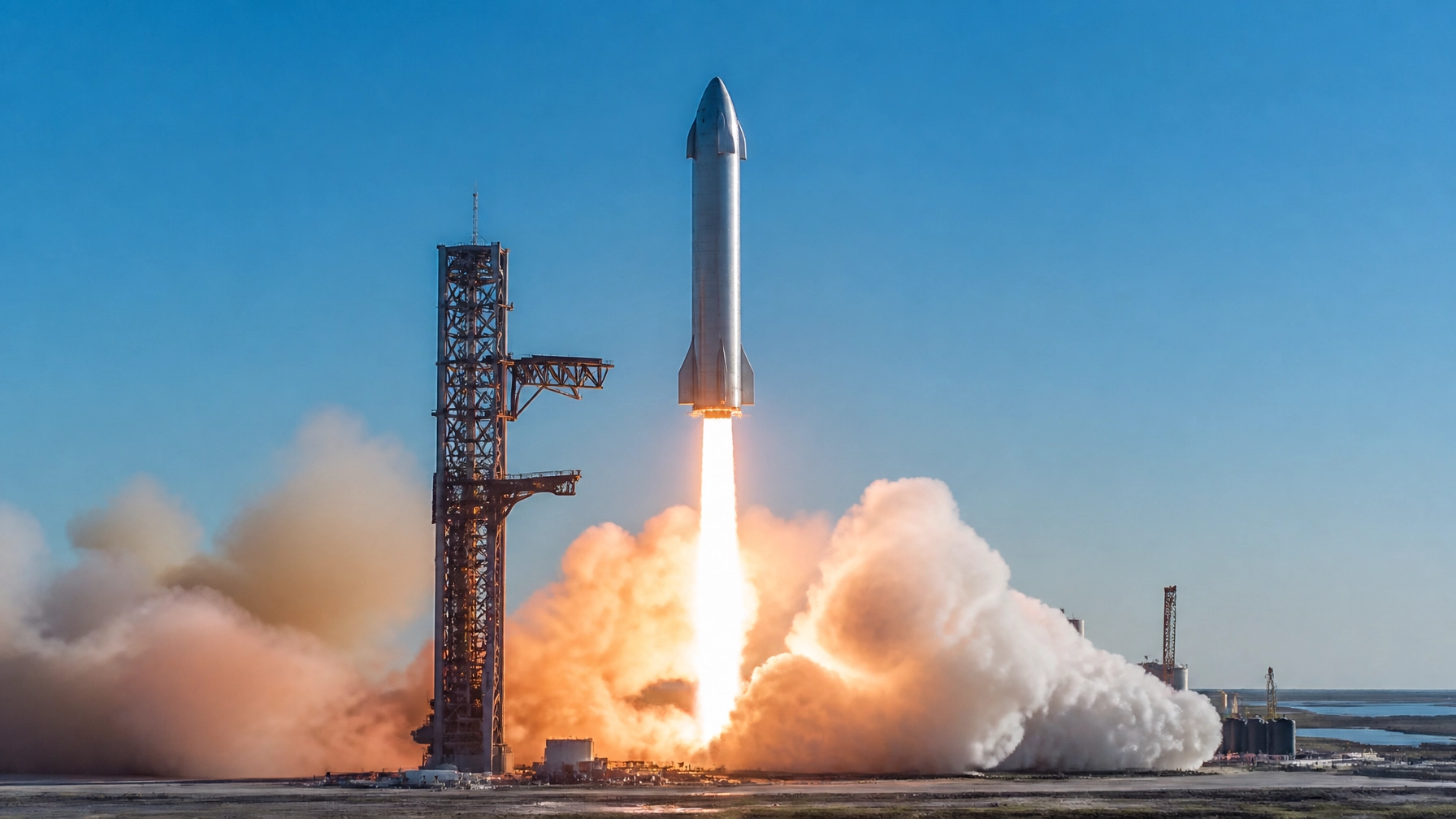
The landscape of South Texas was transformed into a theatre of fire and ambition this week as the most powerful flight system ever built successfully ascended from its coastal launchpad. This latest mission, the twelfth integrated test of the Starship platform, represented a pivotal moment for the burgeoning private space sector. As the morning sun rose over the Gulf of Mexico, the towering stainless-steel silhouette of the vehicle stood as a testament to years of rapid prototyping and engineering perseverance. This flight was not merely a repetition of previous efforts but the debut of the sophisticated Version 3 (V3) variant, a taller and more capable iteration of the craft designed to push the boundaries of what is possible in heavy-lift rocketry.
The countdown proceeded with clinical precision, a sharp contrast to the technical delays that had plagued an earlier attempt just forty-eight hours prior. At precisely the designated window, the thirty-three Raptor engines at the base of the Super Heavy booster ignited, generating a staggering seventeen million pounds of thrust. The sheer scale of the energy released was enough to shake the earth for kilometres around, as the 122-metre-tall stack began its slow, majestic climb towards the heavens. Within seconds, the vehicle cleared the launch tower, accelerating through the dense lower atmosphere and embarking on a journey that would see it reach the edge of space in a matter of minutes.
This mission served as a critical validation of the design changes implemented in the V3 series. Engineers had focused heavily on weight reduction and engine efficiency, aiming to increase the payload capacity of the vehicle while maintaining its structural integrity during the extreme stresses of atmospheric exit. As the rocket reached the point of maximum aerodynamic pressure, known as Max-Q, the structural reinforcements proved their worth. The vehicle maintained its trajectory with remarkable stability, a clear indication that the iterative design process employed by the development team is yielding tangible results in terms of reliability and performance.
A New Era of Super-Heavy Lift Capability
The primary objective of this flight was to test the performance of the enhanced Super Heavy booster and its ability to handle the "hot staging" separation technique. This manoeuvre involves igniting the engines of the upper stage while it is still attached to the booster, a complex process that requires precise timing and heat shielding to prevent the booster from being damaged by the exhaust. Approximately three minutes into the flight, the skies above Texas were illuminated by the blue-and-white flames of the Starship upper stage as it successfully detached from its massive first-stage partner.
While the separation itself was executed flawlessly, the booster's subsequent descent highlighted the inherent risks of experimental spaceflight. Following the detachment, the Super Heavy stage attempted a "boostback burn" intended to guide it toward a controlled splashdown in the Gulf of Mexico. However, data transmitted during the descent indicated that several of the Raptor engines failed to relight as planned. This resulted in a shorter-than-expected burn, causing the booster to hit the water at a higher velocity than intended. Despite the uncontrolled nature of the splashdown, the telemetry gathered during the attempt provides invaluable data for future missions, particularly as engineers work toward the ultimate goal of catching the booster with mechanical arms back at the launch site.
Despite the booster's challenges, the focus quickly shifted to the Starship upper stage, which continued its ascent into the vacuum of space. The V3 variant features a larger propellant capacity and upgraded avionics, allowing it to reach a suborbital trajectory with greater ease. On this mission, the craft also carried a secondary payload consisting of twenty-two demonstration satellites, designed to test the deployment mechanism in a microgravity environment. The successful release of these units marked a significant milestone, proving that the vehicle is moving closer to its intended role as a workhorse for deploying massive satellite constellations and heavy cargo into orbit.
Navigating the Challenges of Orbital Velocity
As the Starship upper stage reached its peak altitude, it entered a coasting phase that allowed the on-board systems to conduct a series of critical health checks. The heat shield, composed of thousands of hexagonal ceramic tiles, was subjected to the harsh environment of space before the inevitable return to Earth. This mission deliberately skipped the planned in-space engine relight test to prioritise the study of the vehicle's thermal protection system during re-entry. Understanding how the ship manages the intense heat generated by friction with the atmosphere is perhaps the greatest challenge facing the programme today.
The re-entry phase began as the craft dipped back into the upper layers of the atmosphere over the Indian Ocean. Plasma began to build up around the vehicle, creating a stunning visual display captured by on-board cameras and transmitted via satellite. The V3’s improved aerodynamic flaps, which are used to control the ship’s orientation during its "belly-flop" descent, were put to the ultimate test. Unlike previous versions, which struggled with flap degradation under extreme heat, the new design appeared to hold up significantly better. The vehicle maintained its attitude with high precision, demonstrating that the adjustments made to the thermal shielding and flap geometry were effective.
The final stage of the mission involved a complex landing manoeuvre. As the ship reached the lower atmosphere, it performed a rapid flip into a vertical orientation, reigniting its engines to slow its descent for a soft splashdown. In a major victory for the development team, the Starship upper stage achieved a controlled upright splashdown in the waters west of Australia. This success represents a massive leap forward in the quest for full reusability. By demonstrating that a vehicle of this size can survive the return from space and land with such accuracy, the programme has moved one step closer to making rapid, low-cost space travel a reality.
The Gateway to Lunar and Martian Frontiers
The implications of this successful test flight extend far beyond the immediate technical achievements. This mission was closely watched by international space agencies and private partners who are relying on this technology for the next generation of lunar exploration. The Starship system is a central component of the global effort to return humans to the Moon, serving as the vehicle that will ferry astronauts from lunar orbit down to the surface. The successful deployment of satellites and the controlled splashdown provide the necessary confidence that the platform is maturing at a rate that aligns with upcoming mission schedules.
Furthermore, the sheer volume of the Starship V3 allows for the transport of massive amounts of scientific equipment, life support systems, and infrastructure necessary for a long-term human presence on other worlds. Traditional rockets, while reliable, are limited by their narrow fairings and expendable nature. The ability to launch, land, and relaunch a craft of this scale changes the economic equation of space exploration entirely. It opens the door to ambitious projects that were previously deemed too expensive or logistically impossible, such as the construction of large-scale orbital laboratories or the establishment of permanent outposts on the lunar south pole.
Looking further ahead, the long-term vision for this platform remains focused on the Red Planet. The high-capacity propellant tanks and the ability to refuel in orbit are essential prerequisites for any mission to Mars. Each test flight, regardless of whether every objective is met, contributes to a vast library of data that informs the next iteration of the vehicle. This philosophy of "fail fast and fix faster" has allowed the programme to advance at a pace that was unthinkable during the mid-twentieth-century space race. With this latest success in the books, the focus now shifts to the thirteenth flight, which is expected to attempt the first-ever recovery of the booster back at the launch tower, a feat that would truly signal the dawn of a new era in human history.