The dream of spaceflight has long been reserved for those who fit a very specific physical mould.
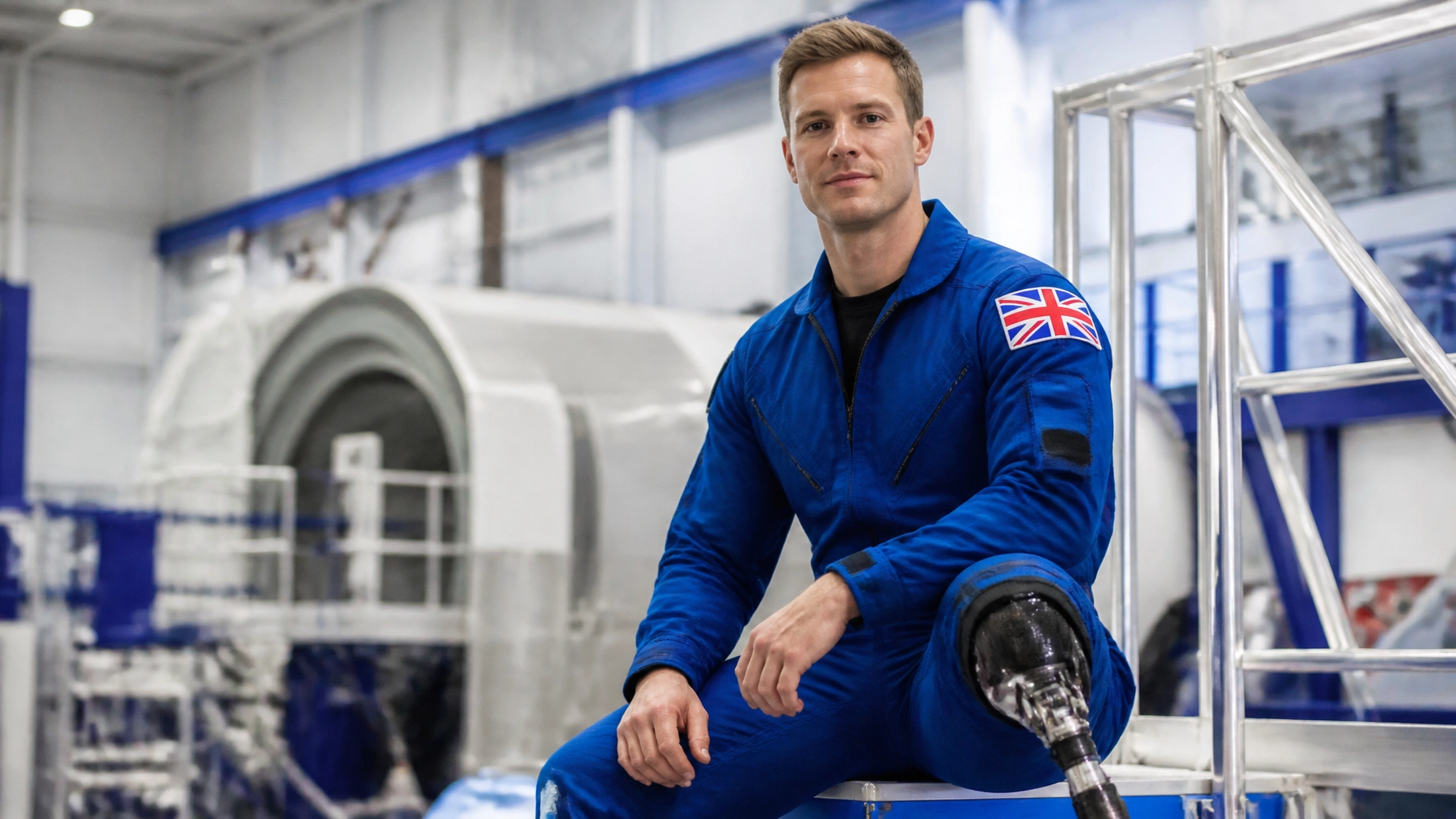
For decades, the rigorous selection criteria for astronauts were so stringent that even the slightest physical deviation could end a career before it even began. However, a groundbreaking development in the UK’s contribution to space exploration has effectively shattered that glass ceiling. John McFall, a British former Paralympic sprinter and a qualified medical doctor, is now standing on the precipice of history as he becomes the first person with a physical disability to be medically cleared for a long-duration mission to the International Space Station.
This milestone is not merely a personal achievement for McFall; it represents a fundamental shift in how the global space community views human capability. After years of intensive study, research, and rigorous physical testing, the European Space Agency has concluded that there are no medical or technical reasons why McFall could not head to the space station for a mission lasting six months or more. It is a moment of profound change, proving that the final frontier is becoming more inclusive than ever before.
McFall’s journey to this point is nothing short of extraordinary. Having lost his right leg in a motorcycle accident at the age of 19, he refused to let his circumstances define his future. He went on to become a world-class athlete, winning a bronze medal in the 100m at the Beijing 2008 Paralympic Games. Not content with athletic success alone, he pursued a career in medicine, eventually becoming a trauma and orthopaedic surgeon. It was this unique combination of high-level physical performance and medical expertise that made him the ideal candidate for the ESA’s "Fly!" feasibility study.
A New Horizon for Inclusive Space Exploration
The "Fly!" feasibility study was launched with a clear, ambitious goal: to determine whether an astronaut with a physical disability could safely and effectively live and work in the microgravity environment of the International Space Station. For the past two years, McFall has been the focal point of this research, undergoing the same gruelling training as any other astronaut candidate. This included centrifuge tests to simulate the intense G-forces of launch, survival training in extreme environments, and complex underwater simulations designed to mimic the weightlessness of space.
What makes this study particularly significant is that it didn't just look at whether McFall could "survive" in space. It examined his ability to thrive and perform essential mission duties. The research team looked at everything from how he would move through the station's narrow corridors to how he would manage his prosthesis in a vacuum. The findings have been overwhelmingly positive, suggesting that with minor adjustments, the existing infrastructure of the ISS is more than capable of accommodating individuals with lower-limb impairments.
The implications of these findings extend far beyond McFall’s potential flight. By proving that physical disability is not an inherent barrier to space exploration, the study has opened the door for a much wider pool of talent to contribute to our journey into the stars. It challenges the traditional "Right Stuff" narrative and replaces it with a more modern, inclusive vision of what it means to be an explorer. In a world where space agencies are looking toward long-term missions to the Moon and Mars, having a diverse range of perspectives and physical capabilities will be essential.
Breaking Down the Technical Barriers
One of the most significant concerns at the outset of the study was how a prosthetic limb would behave in space. On Earth, a prosthesis relies on gravity and the user's weight to function correctly. In microgravity, the dynamics change entirely. There were questions about whether the device might float away, cause injury to other crew members, or interfere with sensitive equipment. However, through a series of parabolic "vomit comet" flights, McFall and the technical team were able to test various modifications and techniques.
The results showed that not only was the prosthesis manageable, but in some cases, it provided unique advantages. The study found that there were "no technical showstoppers" that would prevent McFall from being a fully integrated member of a crew. This means he would be expected to perform the same scientific experiments, maintenance tasks, and emergency procedures as his colleagues. The focus was on ensuring that his presence would not impose any significant financial or operational burdens on the mission: a hurdle that has now been cleared.
The cooperation between international space agencies was also a crucial factor. NASA and other partners had to review the data and agree on the safety and medical clearances. The fact that an agreement has been reached across these global organisations highlights the universal importance of this work. It isn't just a British or European project; it is a global step forward in human rights and scientific progress. The successful clearance of McFall proves that when we apply our best minds to the problem of exclusion, the solutions are often well within our reach.
From the Paralympic Track to the Stars
For McFall, the transition from the running track to the launchpad is a natural extension of his lifelong commitment to pushing boundaries. He has often spoken about the "why not?" attitude that has driven his career. When the ESA announced they were looking for a "parastronaut," he saw it as an opportunity to use his medical background and his lived experience as an amputee to contribute to something bigger than himself. His involvement has provided the ESA with invaluable data that simply couldn't have been gathered in any other way.
As the study moves from the feasibility phase to the "Mission Ready" phase, the focus shifts to mission assignment. While a specific flight date has not yet been confirmed, McFall is now part of the active astronaut corps, ready to be selected for a future mission. His presence in the training halls at the European Astronaut Centre in Cologne serves as a constant reminder of how far we have come. He isn't just a test subject; he is a colleague, a scientist, and a pioneer.
The story of John McFall is a powerful reminder that the only true limits are the ones we place on ourselves: and each other. As we look up at the night sky, we can now do so knowing that the people representing humanity among the stars will increasingly reflect the diversity of humanity itself. This isn't just about one man going into orbit; it's about the fact that we, as a species, are finally learning to leave our prejudices on the ground as we reach for the heavens. The British Paralympian making space history is proving that when it comes to the human spirit, the sky is no longer the limit.