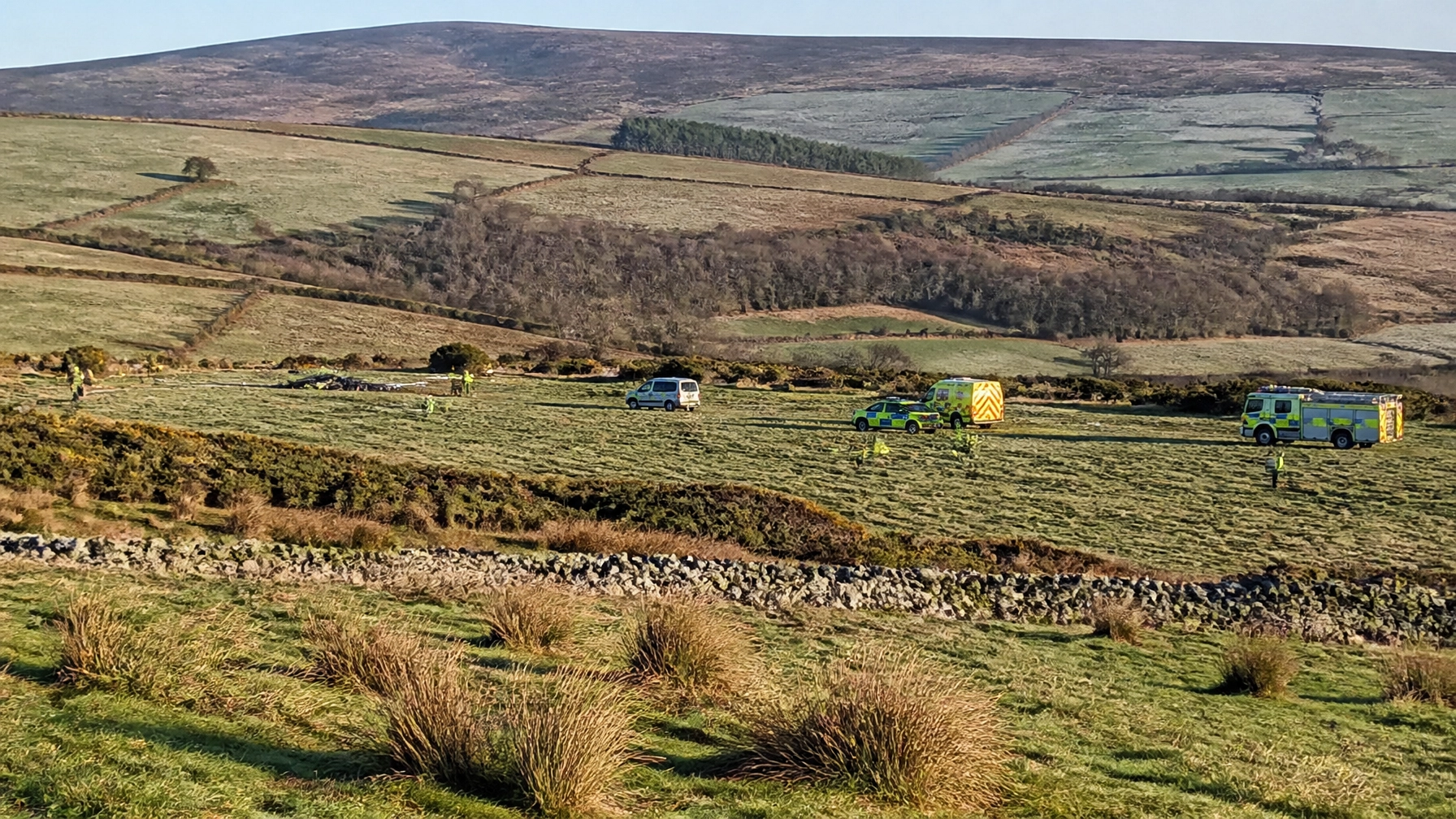
The quiet landscape of West Devon was shattered in the early hours of Wednesday morning following a catastrophic incident involving a Royal Navy helicopter. Three service personnel have been confirmed dead after their aircraft came down in a field near Okehampton, marking one of the most significant losses for the naval aviation community in recent years. The incident occurred just before 04:00 BST, a time when the surrounding moors are typically shrouded in mist and silence. Emergency services were dispatched to the scene immediately after reports emerged of a low-flying aircraft disappearing from radar near the A30 and A386 junction, a pivotal transport artery that skirts the northern edge of Dartmoor National Park.
The impact of the crash has sent shockwaves through the tight-knit communities of Devon and Cornwall, regions that have long shared a deep and historical bond with the Royal Navy. Residents in the vicinity of Okehampton reported hearing a low-frequency hum followed by a sudden silence, though the remote nature of the crash site meant that many were unaware of the scale of the tragedy until daybreak. The Royal Navy confirmed the deaths later that morning, stating that the families of the three crew members had been informed and were being supported by specialist officers. This loss is a poignant reminder of the inherent risks faced by those in the armed forces, even during routine training operations within domestic borders.
As the sun rose over the rolling hills of North Dartmoor, the peaceful morning light illuminated a scene of intense activity as recovery teams and military personnel established a secure perimeter. The contrast between the natural beauty of the Devon countryside and the grim reality of the crash site has been noted by many locals who gathered near the police cordons to pay their respects. For a county that serves as a primary training ground for the UK’s elite military units, the presence of helicopters is a daily occurrence, yet this event has turned a familiar sight into a focal point of national mourning.
The Incident on the Edge of Dartmoor
The specific location of the crash, a field near the junction of the A30 and A386, sits on the transition point between the rugged uplands of Dartmoor and the softer agricultural land of the Devon interior. This area is known for its challenging terrain and rapidly shifting weather patterns, factors that are often a core component of military flight training. On the morning of the incident, reports indicated that weather conditions were particularly difficult, with low visibility and heavy rain affecting much of the South West. While the aircraft was equipped with advanced navigational systems designed to handle such environments, the combination of darkness and atmospheric conditions would have required the highest levels of concentration and skill from the crew.
The emergency response was a multi-agency effort, involving Devon and Cornwall Police, the South Western Ambulance Service, and the Devon and Somerset Fire and Rescue Service. Because the crash occurred in a relatively accessible field compared to the deeper reaches of the moor, first responders were able to reach the site within minutes. However, it quickly became apparent that there were no survivors. The site was subsequently handed over to military authorities, who began the delicate process of securing the wreckage and ensuring that any hazardous materials, such as fuel or specialised equipment, were contained.
The impact of such an event on a small town like Okehampton cannot be overstated. The town serves as a gateway to the north of the moor and is a frequent stop for service members stationed at nearby bases or those moving between the naval hubs of Plymouth and the training grounds of the interior. The local community has reacted with a mixture of profound sadness and quiet resilience, with many businesses and residents expressing their solidarity with the Royal Navy. The presence of a military aircraft in a civilian field is a jarring sight, one that fundamentally alters the perception of the local landscape for those who live and work there every day.
The Merlin Force and Naval Training
While the specific variant of the helicopter involved is subject to formal identification in the ongoing investigation, the aircraft is understood to belong to the Merlin force, a cornerstone of the Royal Navy’s aerial capability. The Merlin is a versatile, multi-role helicopter used for everything from anti-submarine warfare and casualty evacuation to troop transport and search and rescue. These aircraft are known for their sophisticated technology and their ability to operate in some of the harshest environments on Earth, including the deck of a moving frigate in a North Atlantic gale. To maintain this level of proficiency, crews must undergo rigorous and frequent training, often involving low-level night flying exercises.
Training over Dartmoor provides a unique set of challenges that cannot be replicated in a simulator or over open water. The varied topography, featuring steep valleys and high tors, requires pilots to master the art of terrain-following flight. This type of training is essential for ensuring that crews are prepared for real-world operations where staying below radar or navigating complex inland environments is necessary. However, the margin for error at low altitudes is incredibly slim. The Royal Navy has always maintained that training is conducted under strict safety protocols, but the reality of military aviation is that it remains a high-stakes profession where the environment can be as formidable an opponent as any adversary.
The Merlin force is based primarily out of RNAS Culdrose in Cornwall and RNAS Yeovilton in Somerset. These bases are more than just military installations; they are the heart of the naval aviation community in the UK. The personnel who operate and maintain these aircraft are highly specialised, often spending years perfecting their craft. A loss of three crew members represents a significant blow to the institutional knowledge and the social fabric of these bases. In the mess decks and hangars of the South West, the three individuals lost in Devon were not just service members, but colleagues, mentors, and friends. The ripple effect of this tragedy will be felt across the entire naval service, from the highest levels of command to the youngest trainees just beginning their careers.
Investigation and Tributes
The focus has now shifted to the long and meticulous process of determining exactly what went wrong. The Defence Accident Investigation Branch (DAIB) has taken the lead, supported by specialists from the Air Accidents Investigation Branch. These teams will look at every possible factor, from mechanical failure and avionics glitches to environmental conditions and human factors. The aircraft’s flight data recorders, commonly known as black boxes, will be a primary source of information, providing a second-by-second account of the helicopter’s final moments. This investigation is not about assigning blame, but about ensuring that such a tragedy never happens again.
The process of recovering the wreckage is expected to take several days, if not longer, as every piece of debris must be mapped and analysed in situ. The field near Okehampton will remain a restricted area during this time, serving as a temporary memorial to the lives lost. Once the site is cleared, the land will eventually return to its agricultural use, but the memory of the early hours of June 3rd will persist in the local consciousness. In the coming weeks, a formal inquiry will be established to review the findings of the technical teams, a process that is essential for maintaining the integrity of military flight operations.
Tributes have begun to pour in from across the political and military spectrum. Leaders have expressed their gratitude for the service of the three crew members, highlighting the bravery required to undertake such demanding roles. More importantly, the focus remains on the families who are facing an unimaginable loss. In the Royal Navy, there is a tradition of "looking after one's own," and the support networks within the service are already in full swing. This incident is a stark reminder that the security and safety of the nation often come at a heavy price, paid by individuals whose names may not always be in the headlines, but whose contribution is foundational to the country’s defence. As the investigation continues, the people of Devon and the wider naval family will stand together in honouring the memory of those who fell in the line of duty.