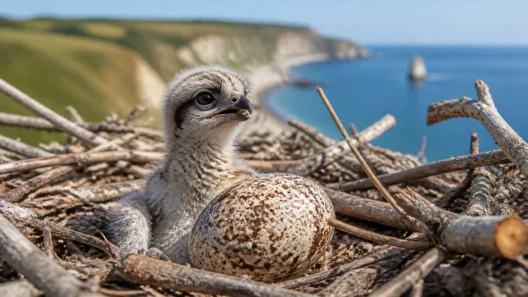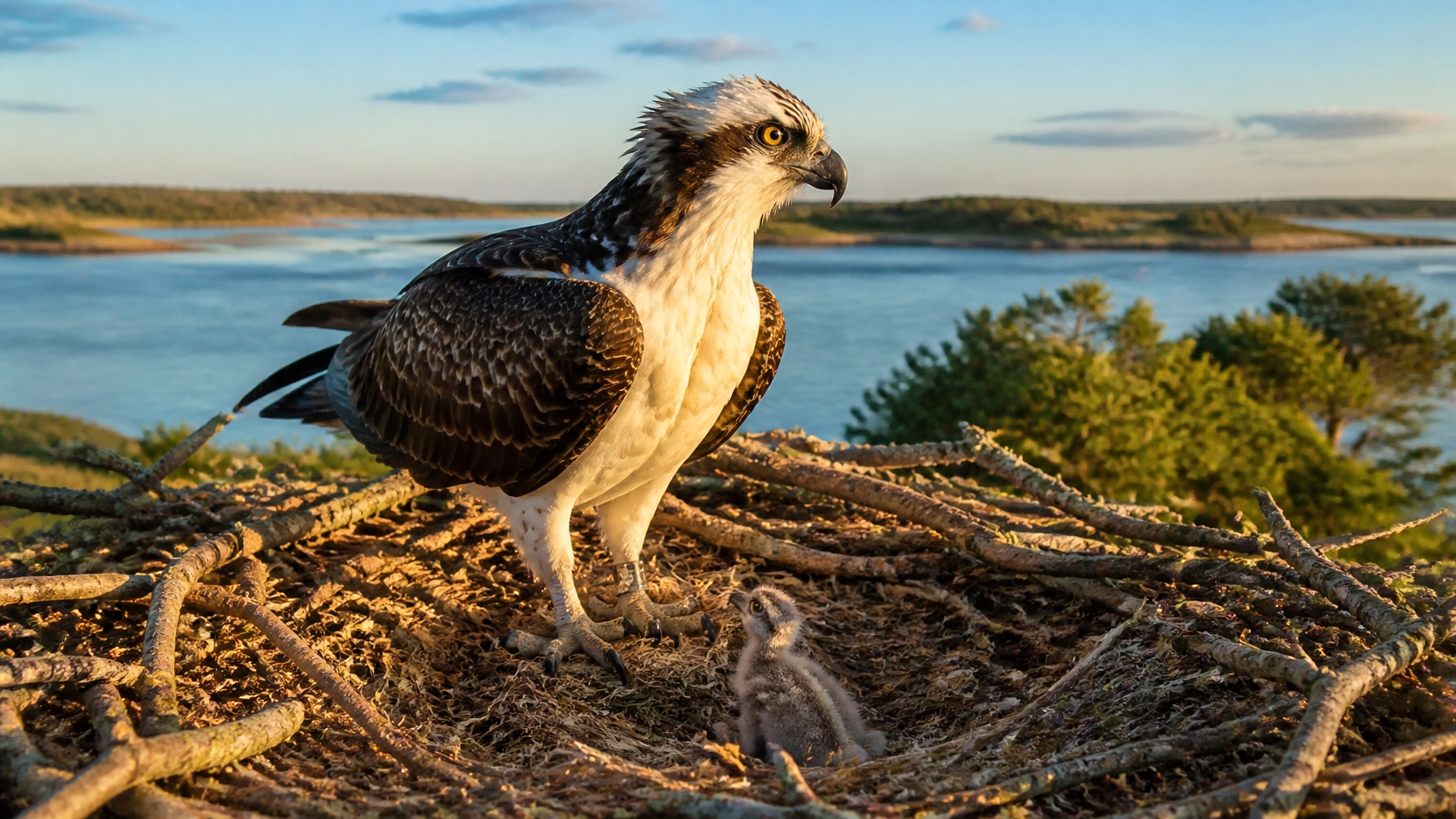
The first osprey chick of the 2026 season has officially emerged in Poole Harbour, marking a momentous occasion for wildlife enthusiasts and conservationists across the United Kingdom. In the early hours of Sunday morning, the delicate scratching and chirping from within one of the mottled eggs culminated in the arrival of a tiny, fluffy new resident. This successful hatch represents the continuation of a remarkable success story that has transformed the south coast of England into a vital stronghold for a species that was once driven to extinction in the region.
Observers monitoring the high-definition nest camera captured the moment the first cracks appeared, known as piping, late on Saturday evening. The adult female, known to thousands of followers as CJ7, remained remarkably calm throughout the process, occasionally shifting her weight to check on the progress beneath her. By dawn, the chick had fully broken free of its shell, appearing strong and alert as it sought warmth under its mother’s protective plumage. The male, Blue 022, was seen shortly after, delivering a fresh fish to the nest: a symbolic and practical gesture that signals the start of an intensive period of care and growth for the new family.
This hatching is the result of years of dedicated conservation work and a pioneering translocation project that aimed to restore breeding ospreys to the south coast after an absence of nearly two centuries. The arrival of the first chick each year is never taken for granted; it is a hard-won victory against the elements, the perils of long-distance migration, and the complexities of establishing a wild population in a busy, modern environment.
A New Chapter for the South Coast
The significance of this single chick cannot be overstated. For nearly 200 years, the skies over the English Channel and the salt marshes of Dorset were devoid of the dramatic sight of a hunting osprey. While the species began a slow recovery in Scotland during the mid-20th century, the south remained a silent territory. It was only through the vision of local conservationists and the implementation of a translocation programme: which saw young birds brought from stable populations in the north: that the dream of a self-sustaining southern population began to take shape.
This year’s first hatch is a testament to the suitability of Poole Harbour as a premier habitat for these magnificent birds of prey. The vast expanse of the harbour, with its shallow waters and abundance of grey mullet and other fish species, provides the perfect foraging ground. For the newly hatched chick, the next few weeks will be a period of rapid development. From a fragile, down-covered hatchling weighing only a few dozen grams, it will grow into a powerful raptor with a wingspan of nearly six feet by the time it is ready to fledge in late summer.
The success of the nest has also turned the area into a focal point for nature tourism and community engagement. Thousands of people now tune in to digital livestreams to watch the intimate details of the ospreys' lives, from the first egg being laid to the first tentative wing beats of the juveniles. This transparency has fostered a deep sense of local pride and ownership, with residents and visitors alike feeling a personal connection to the birds. The arrival of the 2026 chick is a shared victory, a piece of good news that resonates far beyond the boundaries of the harbour itself.
The Enduring Partnership of CJ7 and 022
At the heart of this success story is the remarkable bond between the two adult birds, CJ7 and Blue 022. Their partnership has become legendary among birdwatchers. CJ7, a female who spent several years as a "lone" bird searching for a mate, eventually found her match in 022, a male translocated as part of the reintroduction project. Their pairing was the catalyst for the first successful breeding in the harbour in modern times, and they have since become a reliable and highly efficient team.
The life of a breeding osprey is one of extraordinary endurance. Each autumn, these birds depart on a perilous journey of several thousand miles, crossing the Bay of Biscay and the Sahara Desert to reach their wintering grounds in West Africa. The fact that both birds return to the same nest site in Poole Harbour year after year is a feat of navigation and survival that continues to baffle and inspire scientists. Their arrival in late March is always met with a collective sigh of relief, as it confirms that the cycle of life can begin once again.
In the weeks leading up to this morning’s hatch, the pair worked in seamless coordination. Blue 022 took on the role of the primary provider, spending hours scouting the harbour and nearby coastal waters for the best catches. Meanwhile, CJ7 focused on the delicate task of incubation, protecting the eggs from the variable British spring weather, which this year has swung from unseasonably warm sunshine to biting coastal winds. Their synchronicity is a masterclass in avian cooperation, ensuring that the eggs were kept at a constant temperature and defended against potential nest intruders such as crows or intruding younger ospreys looking for a territory.
Restoring a Lost Legacy to British Skies
The return of the osprey to Poole Harbour is part of a broader movement to rewild and restore the UK’s natural landscapes. For too long, the narrative of British wildlife was one of decline and disappearance. However, stories like this hatch prove that with the right intervention and public support, it is possible to turn the tide. The osprey is an apex predator, and its presence in the harbour is a biological indicator of a healthy, functioning ecosystem. By protecting the osprey, conservationists are effectively protecting the entire food chain, from the water quality that supports the fish to the nesting sites that provide a home for a variety of other species.
As the first chick begins to feed and gain strength, attention will soon turn to the remaining eggs in the clutch. Most osprey nests contain two or three eggs, and if all goes well, the harbour could be home to a boisterous brood by the end of the week. Each successful fledgling adds to the genetic diversity and stability of the southern population, increasing the chances that these birds will eventually colonise other suitable habitats along the south coast, from the Isle of Wight to the estuaries of Devon and Cornwall.
Looking ahead, the challenges for the 2026 chick are significant. It must survive the vulnerable nestling stage, learn to hunt with precision, and eventually navigate the hazardous migration route to Africa. Yet, for today, the focus remains on the simple, uplifting reality of a new life beginning in a nest perched high above the Dorset coastline. In a world often dominated by complex and challenging news, the sight of a tiny osprey chick taking its first breaths in the salt-tinged air of Poole Harbour serves as a powerful reminder of the resilience of nature and the enduring impact of dedicated conservation. The sky over the south coast feels just a little more complete today, as a new generation takes its place in the long history of the British landscape.