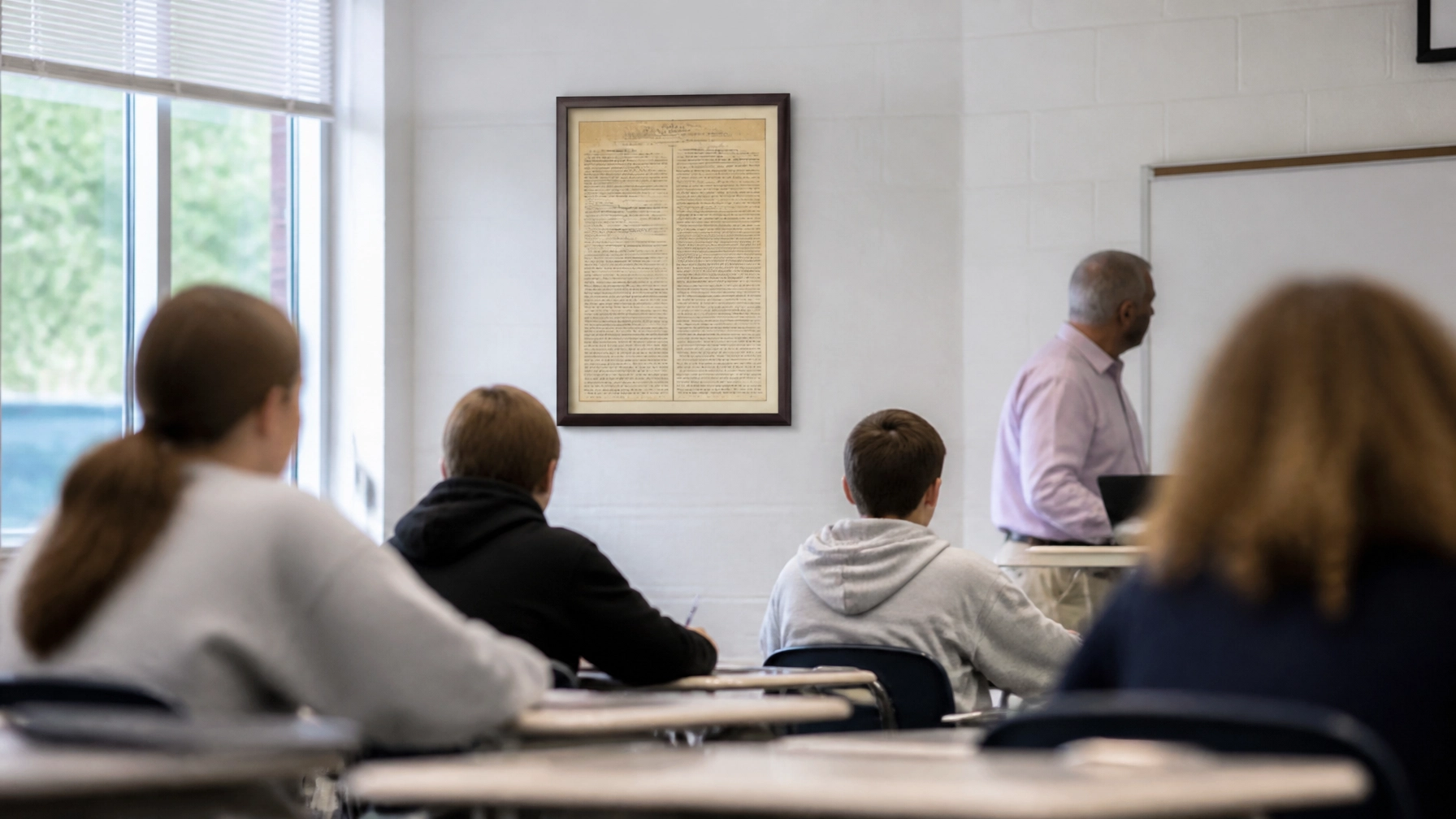
Public schools and higher education institutions across Louisiana have officially begun the process of installing Ten Commandments posters in every classroom, following a significant legal victory in the federal courts.
This development comes after the 5th U.S. Circuit Court of Appeals cleared the path for a contentious 2024 state law to be enforced, marking a major shift in the intersection of religion and public education in the United States. In February 2026, the appellate court lifted an injunction that had previously stalled the implementation of the mandate, effectively allowing Governor Jeff Landry’s administration to proceed with his directive that the religious texts be visible to students of all ages.
The move marks the culmination of a fierce legislative and judicial battle that began with the passage of House Bill 71. Louisiana has become the first state in decades to successfully mandate such displays, setting a precedent that supporters hope will be emulated across other conservative jurisdictions. The implementation is not limited to primary and secondary schools; it extends to the Louisiana State University System and various other state colleges, ensuring that the religious directives are present from kindergarten through to university graduation.
Educational Implementation and Mandatory Requirements
The legislation governing these displays is remarkably specific in its requirements, leaving little room for interpretation by local school boards or university administrators. According to the law, each classroom must display a poster featuring the Ten Commandments that is at least 11 by 14 inches in size. The text must be printed in a large, easily readable font to ensure visibility from anywhere in the room. Crucially, the law specifies a particular Protestant version of the Commandments, which has itself become a point of contention for those who argue that it excludes Catholic, Jewish, and other faith traditions that number or translate the ancient text differently.
Accompanying the Commandments is a mandated "context statement" intended to frame the display as a historical rather than purely religious endeavour. This statement describes the Ten Commandments as a foundational document of American law and governance, linking the biblical laws to the historical development of the United States legal system. Supporters argue that this framing provides a secular educational purpose, which they believe shields the law from constitutional challenges.
A notable aspect of the implementation is the funding mechanism. The law stipulates that no public money is required to purchase the posters. Instead, schools are directed to use donated materials or private funds. This has paved the way for organisations such as the Louisiana Family Forum to play a central role in the rollout. These groups have been actively coordinating the donation of thousands of posters to schools and colleges, ensuring that the mandate can be met without placing a direct financial burden on the state’s education budget. At the LSU System, the arrival of these posters has been met with a mixture of compliance and quiet concern amongst faculty and students, yet the administrative directive remains clear: the law must be upheld.
Constitutional Conflict and the Establishment Clause
The swift movement toward implementation has been met with fierce resistance from civil liberties organisations and a diverse group of plaintiffs, including parents and clergy members. Critics, led by the American Civil Liberties Union (ACLU), argue that the mandatory displays represent a clear violation of the First Amendment’s Establishment Clause, which prohibits the government from making any law "respecting an establishment of religion." They contend that by requiring a specific religious text to be displayed in every classroom, the state is effectively endorsing a particular faith and coercing students into a religious environment.
Legal experts opposing the law point to the 1980 Supreme Court case of Stone v. Graham, which struck down a similar Kentucky law. In that ruling, the court found that the Ten Commandments are undeniably a sacred text in the Jewish and Christian faiths and that their presence in classrooms serves no primary secular purpose. The plaintiffs in the Louisiana case argue that the state’s attempt to rebrand the Commandments as a "historical foundation" is a transparent legal manoeuvre that does not change the inherently religious nature of the content. They argue that for many students, particularly those from non-Christian backgrounds or secular households, the permanent presence of the Commandments creates an exclusionary atmosphere that is inappropriate for a public institution.
Furthermore, the choice of a Protestant version of the text has raised questions about religious neutrality. Critics argue that if the state were truly interested in historical foundations, it would include a wider array of legal and ethical codes from across history. By selecting one specific religious version, the state is seen by some as picking favourites in a way that the Constitution was designed to prevent. The legal challenge also highlights the "captive audience" doctrine, noting that students are legally required to attend school and therefore cannot simply choose to avoid the religious messaging being displayed on their classroom walls.
The Legal Landscape and Judicial Shift
The 2026 ruling by the 5th U.S. Circuit Court of Appeals represents a pivotal moment in the ongoing national debate over the role of faith in the public square. By lifting the injunction, the court did not necessarily rule that the law is constitutional in its finality, but it determined that the legal challenge had not yet met the high bar required to stop the law from taking effect while the litigation continues. The decision reflects a broader trend within the American judiciary towards a more "accommodationist" view of religious expression in government-funded spaces.
This shift has been encouraged by recent Supreme Court decisions that have moved away from the long-standing "Lemon test," a tripartite standard used for decades to determine whether a law violates the Establishment Clause. Newer judicial interpretations focus more on "history and tradition," an approach that Louisiana’s legal defence has leaned into heavily. Lawyers for the state argue that because the Ten Commandments have been depicted in government buildings: including the U.S. Supreme Court itself: for decades, their presence in schools is consistent with American heritage.
Governor Jeff Landry has been a vocal proponent of this perspective, often stating that the moral guidance of the Commandments is exactly what is needed to improve the social fabric of the state’s educational institutions. His administration has framed the legal victory as a win for "common sense" and traditional values. However, the battle is far from over. The case is expected to return to lower courts for a full trial on the merits, and it is widely anticipated that the matter will eventually reach the Supreme Court. The outcome of that potential showdown would have far-reaching implications, potentially redefining the boundaries of religious freedom and state-sanctioned speech in schools for generations to come.
As posters continue to appear in lecture halls in Baton Rouge and primary schools in rural parishes, the daily reality of Louisiana education is changing. For some, the displays are a welcome return to foundational principles; for others, they are a troubling sign of eroding secular protections. Regardless of personal belief, the presence of the Ten Commandments in Louisiana classrooms remains one of the most significant and divisive legal experiments in modern American history. The eyes of the nation remain fixed on the Pelican State as it navigates the complex path between historical acknowledgement and religious endorsement.