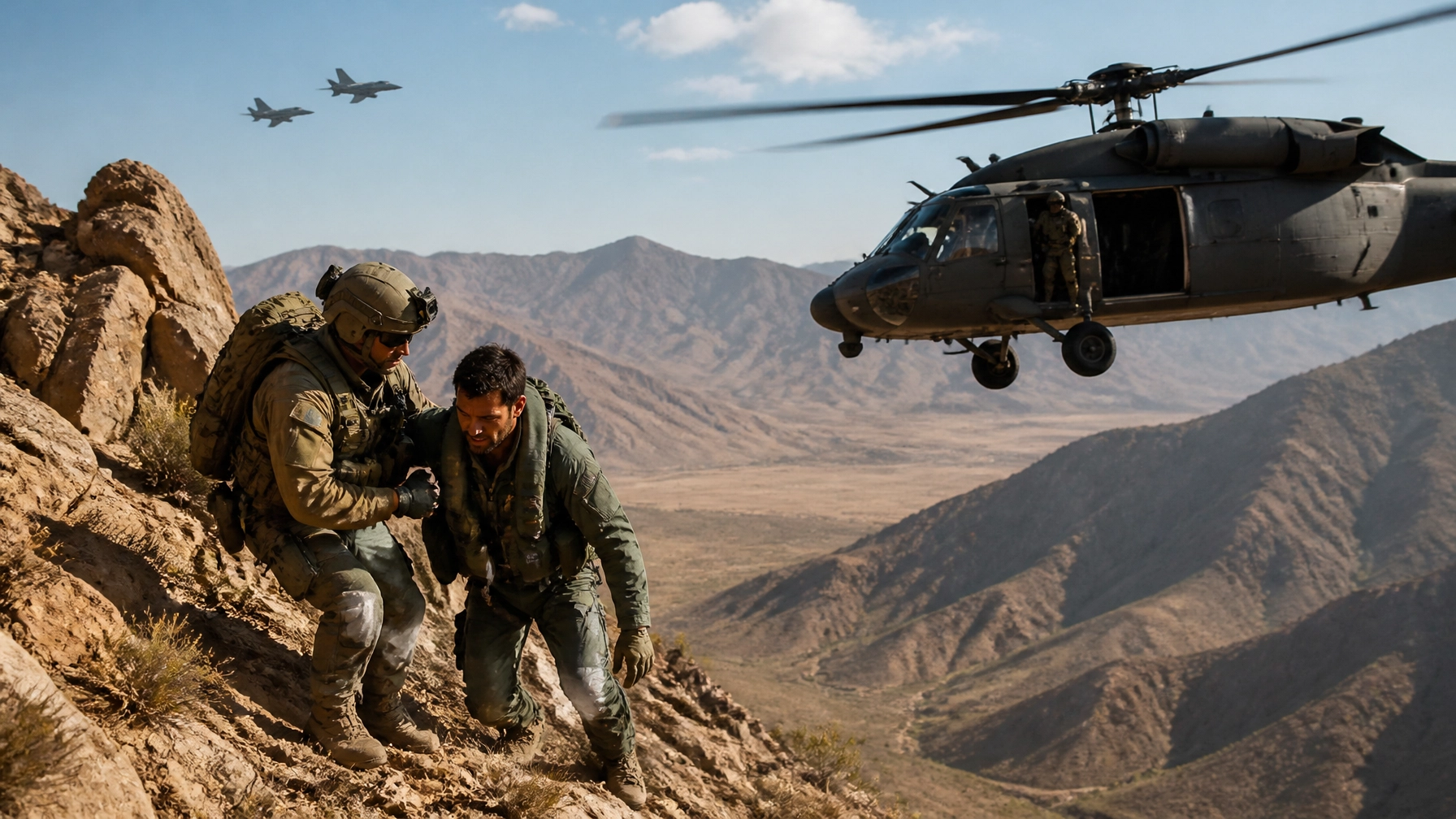
The desert floor of southern Iran became the stage for what is being described as the most audacious recovery operation in modern military history.
After forty-eight hours of nail-biting silence, the confirmation finally came through: a downed American F-15 airman, isolated deep behind enemy lines, was safely back in friendly hands. The rescue, which involved a staggering array of hardware and a level of tactical coordination rarely seen outside of a Hollywood blockbuster, has sent shockwaves through the international community. It wasn’t just a simple extraction; it was a full-scale demonstration of military might that saw the United States penetrate one of the most heavily defended airspaces in the world to retrieve one of their own.
The drama began when a US fighter jet was brought down during ongoing operations in the region. While one crew member was recovered relatively quickly, the second airman was forced to eject into a mountainous terrain crawling with hostile forces. For two days, the pilot played a deadly game of hide-and-seek with Iranian search parties, relying on survival training and sheer grit while waiting for a signal that help was on the way. The tension was palpable as the clock ticked down, with the risk of capture or worse increasing with every passing hour. When the news finally broke that the mission was a success, the message was clear: no one gets left behind, no matter how deep the territory or how high the risk.
Behind the Lines in Southern Iran
The logistics of the operation were nothing short of mind-boggling. Initial reports suggest that the rescue was split into two distinct, high-stakes phases. The first attempt to reach the pilot involved a strike package of 21 aircraft, led by an HH-60W Jolly Green II helicopter. This wasn't a quiet sneak-in mission; it was a punch through the front door. The rescue teams had to navigate treacherous mountainous corridors while actively being hunted by local forces. The terrain in southern Iran is unforgiving: jagged peaks and narrow valleys that make low-level flying a nightmare for even the most seasoned pilots.
Despite the immediate danger, the first rescue team managed to locate the airman's position. However, the mission wasn't without its "hard-hitting" moments. The rescue helicopter reportedly came under fire during the extraction, requiring the escorting fighter jets to engage ground targets to suppress the threat. It was a chaotic, high-intensity environment where a single mistake could have led to a secondary disaster. The airman was eventually winched to safety, suffering from injuries sustained during the ejection and the subsequent two days in the wilderness, but alive and in stable condition.
The sheer scale of the operation didn't stop there. Once the airman was on board, the second phase of the mission kicked in to ensure a safe exit from Iranian airspace. This involved a massive protective umbrella of over 150 aircraft. We’re talking about a combined force of fighters, bombers, and tankers, all working in a synchronized dance to prevent any Iranian retaliation. The objective was clear: create a corridor of absolute air supremacy that would allow the rescue team to exit without further incident. This wasn't just about saving one person; it was about projecting a level of power that made the prospect of interference look like a suicide mission.
A Massive Show of Tactical Force
What makes this story particularly striking for those interested in alternative journalism is the level of sophisticated deception used by the intelligence services. While the rescue force was moving in, a CIA-led campaign was reportedly underway to mislead the Iranian military. Electronic warfare and strategic misinformation were used to send Iranian search parties in the wrong direction, buying the rescue teams the precious minutes they needed to execute the extraction. It is a stark reminder that modern warfare is fought just as much in the digital and electromagnetic spectrum as it is on the ground.
The political fallout from this strike is already beginning to settle, and it’s a bit of a mixed bag. On one hand, the successful rescue is being hailed as a triumph of American ingenuity and bravery. It’s the kind of story that fills the heart with a bit of hope in an otherwise bleak geopolitical landscape. On the other hand, the fact that an F-15 was shot down in the first place raises serious questions about the effectiveness of current air defences and the escalating nature of the conflict. This wasn't a low-stakes skirmish; it was a direct confrontation that could have easily spiralled into a much larger war.
The "hard-hitting" reality is that the region remains a tinderbox. While we celebrate the return of a pilot, we cannot ignore the hundreds of sorties being flown daily and the constant risk of further casualties. The Iranian response has been predictably furious, with officials in Tehran decrying the mission as a violation of their sovereignty. Yet, the tactical precision displayed by the rescue force suggests that the US remains capable of operating with impunity when the stakes are high enough. It’s a classic case of a strategic strike that achieved its immediate goal but left a trail of diplomatic wreckage in its wake.
The High Stakes of Independent Reporting
In an era where mainstream narratives are often sanitized for public consumption, this story highlights the vital importance of independent news in the UK and beyond. The details of the 150-aircraft protective screen and the specific deception tactics employed by the CIA are the kind of insights that often get lost in the 24-hour news cycle. People want the real story: the problems, the conversations, and the local understanding of global events. That is where alternative journalism steps in, providing the space for the untold aspects of such a massive military undertaking.
The rescue of the airman is a testament to the courage of the individuals on the ground and in the air. These are people who operate in the shadows, executing missions that most of us can barely imagine. But it also serves as a warning. The ease with which a localized incident can escalate into a massive military operation involving hundreds of assets is a clear indicator of how fragile the peace in the region truly is. We are seeing a shift in how these stories are told and understood, with a growing demand for reporting that doesn't shy away from the hard-hitting truths of modern conflict.
As the airman recovers and the dust settles in the mountains of southern Iran, the conversation will undoubtedly turn to what comes next. Will this successful rescue lead to a de-escalation, or will it embolden further operations? For the readers of NowPWR, these are the questions that matter. We don't just cover the "we got him" headlines; we look at the strategic strike, the tactical force, and the human cost that lies beneath. This is news that takes business and politics seriously, providing a local understanding of a global story that is far from over. It is through this lens of independent news that we can truly begin to grasp the complexities of our world today.