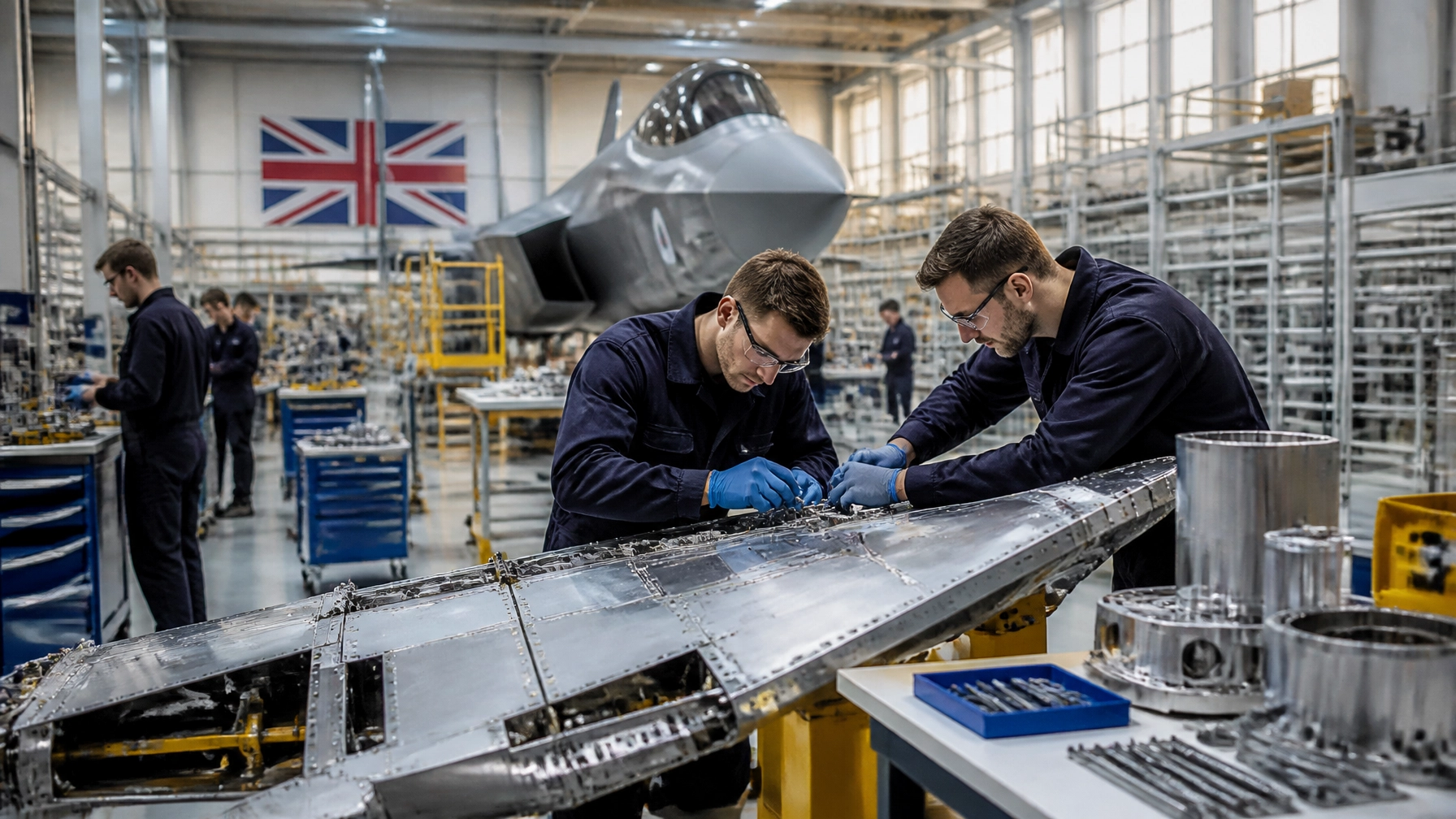
The rhetoric of a nation rearming for a more dangerous world has hit a sobering wall of financial reality. Across the United Kingdom, the very companies tasked with bolstering national security are warning of a deepening cash-flow crisis that threatens to derail the government’s ambitions before they have even left the drawing board. While political leaders speak of a "new era" of military readiness, the industrial base required to sustain such a shift is currently grappling with a procurement paralysis that has left factories quiet and balance sheets in the red.
The disconnect between geopolitical necessity and fiscal delivery has never been more pronounced. For months, the Ministry of Defence has faced mounting pressure to provide a clear, long-term roadmap for investment, yet the anticipated ten-year Defence Investment Plan remains unpublished. This delay has created a vacuum of uncertainty, leaving major contractors and small-scale innovators alike unable to plan for the future. Without a steady "demand signal" from the state, the private sector is increasingly reluctant to commit the capital necessary to expand production lines or hire the specialist engineers required to modernize the British arsenal.
The situation is further complicated by a significant black hole in the equipment budget. Estimates suggest a shortfall of tens of billions of pounds over the next decade, a gap that has forced military chiefs to hunt for billions in "efficiencies" even as they are asked to prepare for potential conflict. This search for savings is not merely a bureaucratic exercise; it is resulting in the deferral of essential programmes and the stalling of contract awards. For the firms that make up the UK’s defence industrial base, these delays are not just administrative hurdles: they are existential threats.
The Procurement Paralysis
The primary driver of the current instability is the continued absence of the government’s long-term investment strategy. Initially promised for late 2025, the plan was intended to give the industry the confidence to invest in new technologies and increased capacity. Instead, the delay into 2026 has left the sector in a state of suspended animation. Major manufacturers, often referred to as "primes," are hesitant to sign off on large-scale capital expenditure without knowing exactly what the Ministry of Defence intends to buy, in what quantities, and on what timeline.
This lack of clarity has triggered a "feast and famine" cycle that is destructive to efficient manufacturing. In the absence of a structured pipeline, work is often commissioned in short-term, reactive bursts rather than through sustained, predictable orders. This inefficiency drives up the unit cost of every piece of equipment, from munitions to advanced radar systems, ensuring that the taxpayer gets less value for money at a time when every pound is being scrutinized. Furthermore, as the UK vacillates, other nations are moving with greater speed. There are growing concerns that global manufacturers may begin to shift their focus: and their investments: to countries like Poland, Germany, or the United States, where procurement processes are seen as more decisive and funding more secure.
The paralysis also affects the ability of the UK to remain at the cutting edge of military technology. Innovation in the defence sector is not something that can be switched on and off like a tap. It requires years of sustained research and development, often funded by the profits from existing contracts. When those contracts are delayed or cancelled to fill immediate budgetary holes, the "seed corn" for future capabilities is lost. The UK risks losing its competitive edge in fields such as autonomous systems, cyber defence, and hypersonic weaponry, not because of a lack of domestic talent, but because of a failure of state-level planning and financial commitment.
Small Firms on the Front Line
While the major aerospace and defence giants have the financial reserves to weather some degree of turbulence, the impact of the funding crisis is felt most acutely within the small and medium-sized enterprises (SMEs) that form the backbone of the supply chain. These smaller firms often provide the highly specialized components and niche technologies that larger platforms rely on. However, they operate on much thinner margins and are far more vulnerable to disruptions in cash flow.
Reports from across the industry suggest that many of these vital suppliers are currently "bleeding cash" daily. The delay in prime contracts means that work is not filtering down to the sub-contractors, leaving many SMEs with idle factory floors but ongoing overheads. In some cases, firms are surviving only through the direct financial support of larger partners who realize that if these specialists go bust, the entire production line for major platforms: such as the next generation of fighter jets or naval vessels: will collapse. The loss of a single niche supplier can cause delays that ripple through the entire industry, potentially setting back multi-billion-pound programmes by years.
The human cost is equally significant. The UK defence sector employs hundreds of thousands of highly skilled workers, many in regional hubs that are central to the government’s broader economic goals. As SMEs struggle to stay afloat, they are finding it increasingly difficult to retain staff. Experienced engineers and technicians, seeing the instability within the sector, are being lured away by the energy, automotive, or commercial aerospace industries. Once this specialized workforce is lost, it cannot be easily replaced, representing a permanent erosion of the UK’s industrial capacity. Some smaller firms have already taken the difficult decision to exit the defence market entirely, pivoting their operations toward more stable commercial sectors where the government is not the sole customer.
A Threat to National Resilience
The consequences of this funding crisis extend far beyond the balance sheets of corporate entities; they represent a fundamental challenge to the UK’s national resilience. At a time when global tensions are rising and the need for a robust, sovereign defence capability is clear, the weakening of the domestic industrial base is a strategic vulnerability. Rearming is not simply a matter of writing a cheque when a crisis hits; it requires a healthy, active industry that can scale up production rapidly in response to a changing threat environment.
If the UK continues to allow its defence firms to languish in a state of financial uncertainty, it risks becoming overly dependent on foreign suppliers for critical equipment. While alliances are a cornerstone of British security, the ability to maintain, repair, and upgrade essential hardware domestically is a vital component of national sovereignty. A hollowed-out industry would leave the UK vulnerable to global supply chain shocks and the political whims of other nations. Furthermore, the rising cost of components: driven by global demand and the UK’s own procurement delays: means that even if the government does eventually provide the necessary funds, it will find that its purchasing power has been significantly diminished.
The path forward requires more than just a pledge to increase spending to a certain percentage of GDP. It requires a fundamental shift in how the Ministry of Defence engages with the private sector. The promised Defence Investment Plan must be delivered with a focus on long-term stability and timely payments, particularly for those firms at the bottom of the supply chain. Investors need to see the UK government as a reliable partner rather than a "difficult customer" prone to shifting priorities and missed deadlines. Without this change in approach, the call to arms will remain unanswered, leaving the nation’s defences built on a foundation of empty promises and underfunded ambitions.