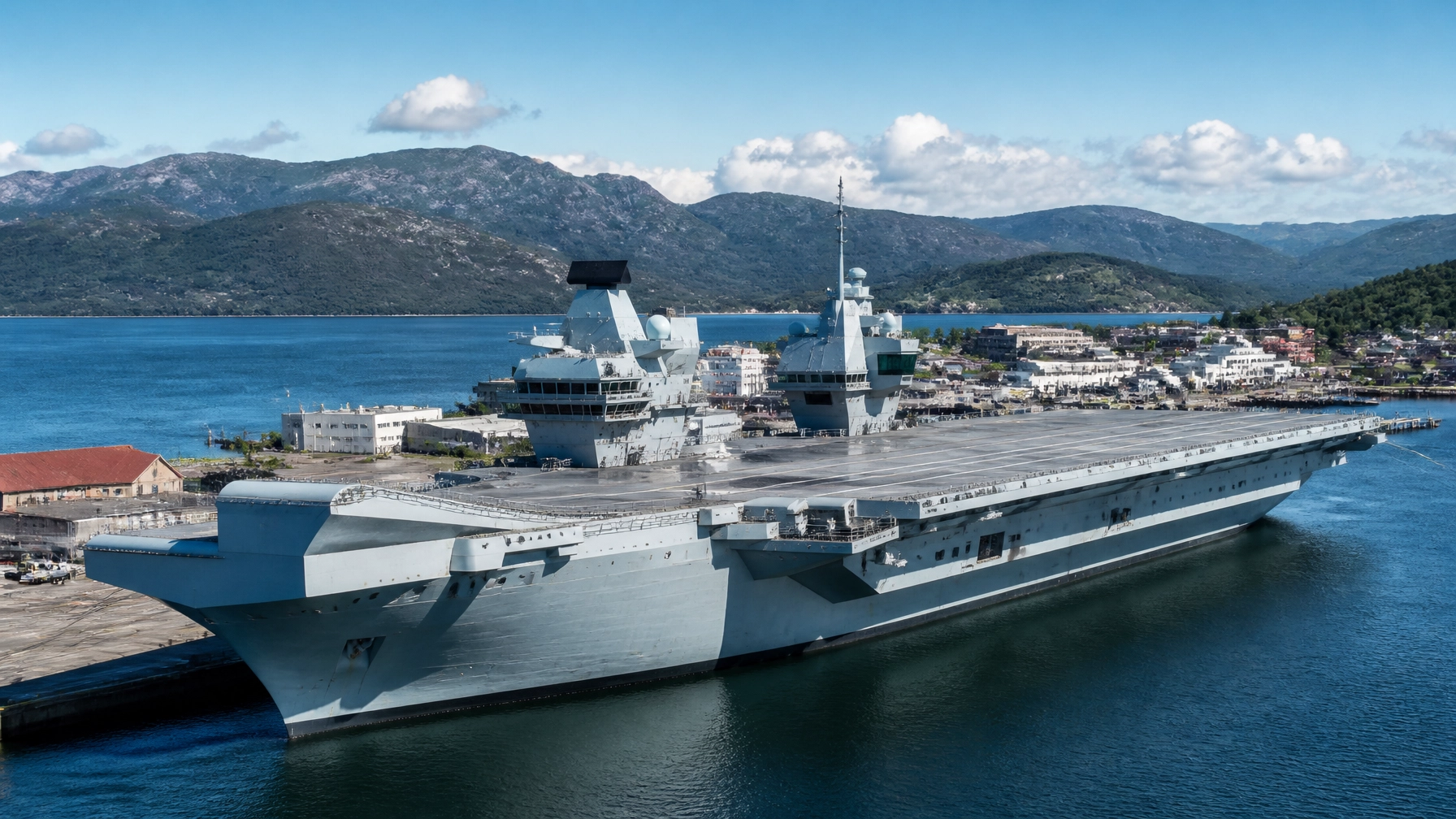
The pride of the Royal Navy, HMS Prince of Wales, finds itself once again at the centre of an uncomfortable conversation regarding the reliability of the United Kingdom’s flagship maritime assets. Currently moored in the picturesque port of Stavanger, Norway, the £3 billion aircraft carrier has been waylaid by what the Ministry of Defence describes as a "minor technical issue." While officials remain tight-lipped about the specific nature of the mechanical snag, the delay has already had a cascading effect on the vessel's planned itinerary, forcing the cancellation of a high-profile diplomatic and ceremonial visit to Copenhagen. This latest setback comes at a sensitive time for the Senior Service, as it seeks to project strength and reliability amidst heightened geopolitical tensions in the North Atlantic and beyond.
The vessel had been operating in the region as part of a significant push into the High North, participating in various exercises designed to test the integration of British naval power with allied forces. Having recently concluded its involvement in the NATO anti-submarine warfare exercise, Dynamic Mongoose, the ship was expected to transition smoothly into the next phase of its deployment. Instead, the crew and a team of specialised engineers are now working against the clock in a foreign port to rectify a fault that, while characterised as minor, is serious enough to prevent the carrier from safely resuming its mission. The optics of a premier warship being sidelined in a friendly port, rather than patrolling the deep blue, provide a stark contrast to the narrative of seamless power projection that the government frequently promotes.
Operational setbacks in the High North
The presence of HMS Prince of Wales in Norwegian waters was intended to be a robust demonstration of the UK’s commitment to Arctic security. The High North has increasingly become a theatre of strategic competition, with the melting ice caps opening new shipping routes and access to natural resources, all while Russian maritime activity in the region remains at a post-Cold War high. Participation in exercises like Dynamic Mongoose is not merely a training exercise; it is a signal of intent. The exercise involves complex coordination between surface ships, submarines, and maritime patrol aircraft from multiple NATO nations, all focused on the critical task of hunting and tracking underwater threats. For the UK’s largest warship to suffer a technical failure in the immediate aftermath of such an operation raises difficult questions about the sustained operational tempo of the Queen Elizabeth-class carriers.
Stavanger, usually a port of call for rest and recuperation or minor logistical resupply, has now become a temporary workshop. The engineering challenges of maintaining a 65,000-tonne vessel are immense, and the logistics of sourcing specific components and specialist expertise at short notice in a foreign territory can be daunting. Although the Ministry of Defence has stressed that the ship could sail in an emergency, the decision to remain in port suggests a cautious approach to avoid exacerbating the problem. This caution is well-founded, given the history of the class, but it does little to alleviate the frustration of a crew that had been prepared for a series of high-profile international engagements. The cancellation of the visit to Denmark is particularly poignant, as these "flag-flying" missions are essential tools of British soft power, reinforcing alliances through the visible presence of the nation's military might.
The delay in Norway also impacts the broader scheduling of the Royal Navy’s fleet. Every day a carrier is out of action, the pressure on other vessels increases. The UK’s carrier strike capability is built around a two-ship model, intended to ensure that at least one carrier is always available for deployment while the other undergoes maintenance or training. However, the reality of naval engineering often disrupts these best-laid plans. With HMS Prince of Wales currently occupied with repairs, the burden of potential short-notice deployments falls elsewhere, testing the resilience of a navy that has seen its hull numbers dwindle over recent decades. The strategic cost of being sidelined, even for a "minor" issue, is measured in lost training hours, missed diplomatic opportunities, and the subtle erosion of the deterrent effect that a fully operational carrier strike group is supposed to provide.
The recurring shadow of mechanical frailty
To understand the scrutiny surrounding this latest incident, one must look at the troubled history of the Queen Elizabeth-class carriers. This is not the first time HMS Prince of Wales has been hampered by technical gremlins. Most notably, in 2022, the ship suffered a major mechanical failure involving its starboard propeller shaft shortly after departing Portsmouth for a deployment to the United States. That incident resulted in the ship being towed to Rosyth for extensive repairs that lasted nearly a year, costing millions of pounds and significantly disrupting the Royal Navy’s operational cycle. The shadow of that failure looms large over any subsequent technical issue, regardless of how minor the MoD claims it to be. There is a growing sense of unease among military analysts and the taxpaying public alike that these massive investments may be inherently prone to mechanical fragility.
The recurring nature of these problems points to a deeper debate about the design and procurement of the UK’s flagship vessels. Critics argue that the complexity of the integrated electric propulsion systems and the sheer scale of the carriers make them susceptible to faults that would be more manageable on smaller, more traditional ships. While the Royal Navy maintains that the carriers represent a "quantum leap" in capability, the frequency of these "minor" issues suggests a steep learning curve in maintaining such sophisticated platforms. Each time a carrier is forced into an unscheduled port stay, it provides ammunition to those who believe the UK should have invested in a larger number of smaller, more versatile frigates and destroyers rather than putting so many "eggs in two very large baskets."
Furthermore, the transparency of the Ministry of Defence regarding these issues has been a point of contention. The use of the phrase "minor technical issue" has become a familiar refrain, one that often masks the complexity of the repairs required. In the case of the Stavanger delay, the fact that repairs are taking longer than initially anticipated suggests that the problem may be more stubborn than first thought. Engineers are reportedly working on the ship's internal systems, and while there is no suggestion of a repeat of the catastrophic shaft failure of 2022, the need for specialist intervention in Norway is a clear indicator that this is more than a simple routine fix. For a navy that prides itself on its engineering excellence, these recurring headlines are a blow to morale and a challenge to the reputation of British shipbuilding on the world stage.
Strategic readiness and the NATO alliance
The timing of this technical halt is particularly inconvenient given the current state of international affairs. The NATO alliance is currently undergoing its largest transformation in a generation, spurred by the ongoing conflict in Ukraine and the necessity of a credible deterrent against Russian aggression in Eastern Europe and the North Atlantic. The UK has positioned its carrier strike capability as a cornerstone of its contribution to NATO, offering a mobile airbase that can be deployed to support allied operations across the globe. When one of these carriers is out of commission, it creates a gap in the alliance's collective shield. The ability to maintain a persistent presence in northern waters is vital for monitoring the "GIUK Gap" (Greenland, Iceland, and the United Kingdom), a strategic chokepoint for Russian naval movements.
Beyond the immediate tactical implications, the situation in Norway highlights the logistical vulnerabilities of modern naval warfare. The dependency on specific ports and the availability of specialised parts can become a significant bottleneck during a conflict. If a carrier can be sidelined by a minor fault during a peacetime exercise, the question arises as to how it would fare under the stresses of sustained combat operations. The Royal Navy is working hard to develop "forward-based" maintenance capabilities, but the current incident shows that there is still work to be done in ensuring that these massive ships can be kept in the fight without needing to return to a major shipyard for every technical hiccup. The resilience of the supply chain and the adaptability of engineering teams are just as important as the firepower of the F-35 jets the ship carries.
As HMS Prince of Wales remains in Stavanger, the focus will inevitably turn to when it can return to sea and how the Royal Navy can prevent such incidents from becoming a regular feature of carrier operations. The lessons learned from this "minor" issue will be scrutinised at the highest levels of the Ministry of Defence. For the crew, the delay is a test of patience; for the government, it is a test of its maritime strategy. In an era where the UK aspires to be a "Global Britain," the reliability of its most visible military assets is paramount. The sight of a premier warship sidelined in a foreign fjord is a reminder that in the world of high-stakes naval diplomacy, even the smallest technical fault can have significant strategic echoes. The priority now is not just to fix the ship, but to restore the confidence that has been momentarily shaken by this latest mechanical detour.