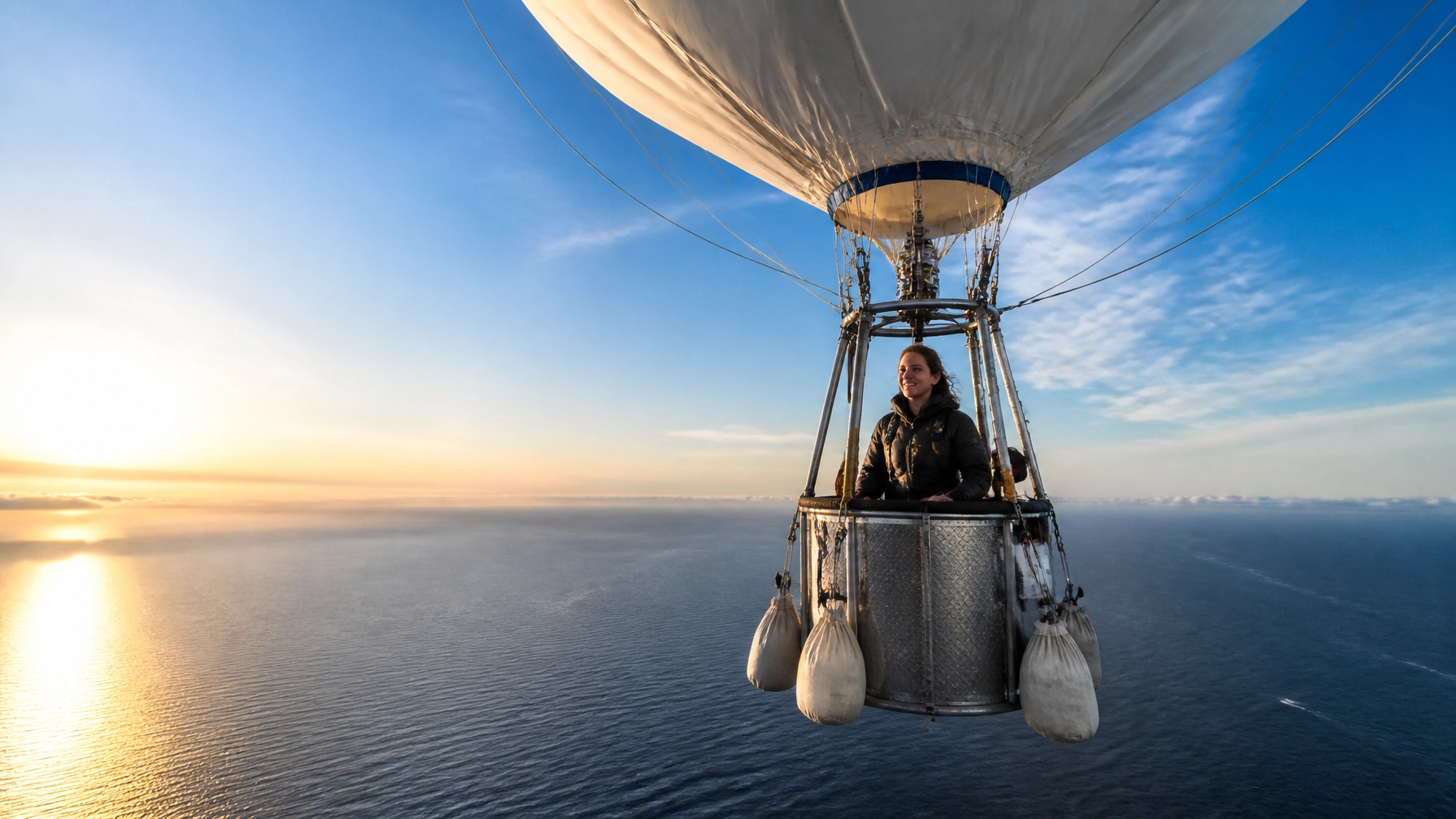
Alicia Hempleman-Adams has etched her name into the annals of aviation history, becoming the first British woman to cross the Atlantic Ocean in a hydrogen-powered balloon. The historic journey concluded early on Sunday morning when the Atlantic Explorer touched down safely in the quiet village of Bastendorf, Luxembourg. Accompanied by her seasoned American teammates, Bert Padelt and Peter Cuneo, Hempleman-Adams completed the transoceanic crossing in just over 70 hours, braving freezing temperatures and life-threatening weather conditions in an open-basket vessel that offered little more than a wicker floor between the crew and the churning waters of the North Atlantic.
The mission, which launched from Presque Isle, Maine, earlier in the week, represents a monumental achievement in the world of gas ballooning. While many have crossed the Atlantic in modern aircraft or high-tech pressurised capsules, the Atlantic Explorer relied on the pure lift of hydrogen gas and the skill of its pilots to navigate the complex air currents of the upper atmosphere. For Hempleman-Adams, a decorated balloonist who was awarded an MBE in 2024, the successful landing in Luxembourg marks the culmination of years of preparation and a lifetime spent in the shadow of great explorers. As the basket finally came to rest on European soil, the team was met with a mixture of exhaustion and exhilaration, having survived a voyage that many in the industry believed was one of the most dangerous ever attempted in recent years.
The flight was not merely a test of endurance but a demonstration of precision navigation. Without the benefit of engines or steering wheels, the crew had to rely on the varying winds at different altitudes to chart their course across 3,100 miles of open ocean. Every pound of ballast dropped and every cubic foot of gas managed was a calculated risk, ensuring that the balloon stayed within the narrow corridors of air that would carry them toward their destination. The success of the journey reinforces the viability of hydrogen as a lifting gas for long-distance flight, a method that has seen a resurgence among enthusiasts looking to push the boundaries of what is possible in the skies.
A Record-Breaking Voyage
The significance of this flight cannot be overstated within the community of global adventurers. By reaching the European mainland, Alicia Hempleman-Adams has not only secured her place as the first British woman to achieve this feat in a gas balloon but also as only the second woman in history to do so. The Atlantic has long been considered the ultimate graveyard for ballooning ambitions, a vast expanse where unpredictable storms and shifting jet streams can turn a peaceful ascent into a fight for survival in a matter of minutes. This particular expedition was designed to honour the spirit of the early pioneers while utilising modern meteorological data to ensure a safer passage.
Stepping out of the basket in Luxembourg, the team appeared weathered but triumphant. The journey began in the early hours of Thursday in Maine, following a series of frustrating delays caused by unfavourable winds and ground-level moisture. Once the Atlantic Explorer cleared the coast of North America, the crew was committed. With no way to turn back and only the vast Atlantic below, they had to trust in their equipment and each other. The three-person team shared a cramped space filled with communication gear, survival suits, and the essential supplies needed to sustain them for up to a week in the air.
During the flight, the team maintained a grueling schedule of watches, ensuring that at least one person was always monitoring the balloon’s altitude and the surrounding weather patterns. Flying at an average altitude of 14,000 feet, they were high enough to catch the faster moving winds but low enough to remain within the breathable atmosphere, though supplemental oxygen was used when they ascended further to find better currents. The physical toll of such a journey is immense, with the constant vibration of the basket and the thin air making even simple tasks an exercise in willpower. Despite these hurdles, the team reported a sense of profound peace while floating miles above the ocean, watching the sun rise and set over a horizon that few humans ever see from such a vulnerable perspective.
Navigating the Open Elements
The primary challenge of the Atlantic Explorer mission was the environment. Unlike hot air balloons, which rely on burners to maintain lift, a hydrogen balloon is a silent, constant-pressure vessel. While this allows for much longer flight times, it also makes the balloon highly susceptible to temperature changes and precipitation. The team encountered their greatest threat when flying through a system of rain clouds midway across the ocean. As the rain hit the cold envelope of the balloon, it began to freeze, coating the structure in a layer of heavy ice. This added weight threatened to drag the balloon down toward the frigid waters below, forcing the crew to make rapid decisions about discharging ballast.
Ice buildup is a notorious killer in the world of high-altitude ballooning. It changes the aerodynamics of the craft and can lead to a "death spiral" where the balloon loses lift faster than the crew can compensate. Hempleman-Adams and her colleagues had to carefully manage their reserves of sand and water ballast, knowing that every bag thrown overboard was one less safety net for the remainder of the trip. The resilience of the hydrogen cells and the structural integrity of the open basket were tested to their limits as they buffeted through the turbulent air. The crew’s ability to remain calm under the pressure of a potential ditching in the Atlantic was a testament to their combined decades of experience in the air.
Furthermore, the open basket meant that the team was fully exposed to the elements for the duration of the 70-hour flight. Temperatures at 14,000 feet often dipped well below freezing, requiring the use of specialised thermal clothing and high-altitude gear. The lack of a pressurised cabin meant that every gust of wind and every drop of moisture was felt directly by the pilots. This level of exposure is rare in modern record-setting attempts, which often favour the safety of enclosed capsules. By choosing the open-basket method, the team sought to maintain a direct connection to the history of flight, echoing the experiences of the very first people to take to the skies in the late 18th century.
Continuing a Family Legacy
For Alicia Hempleman-Adams, the drive to explore is a family trait. She is the daughter of the famed explorer Sir David Hempleman-Adams, a man who has spent much of his life conquering the world’s most inhospitable environments, from the North Pole to the highest peaks on every continent. Growing up in an environment where record-breaking was a regular topic of conversation, Alicia developed a natural affinity for the sky. Her journey across the Atlantic is more than just a personal milestone; it is a continuation of a legacy of British exploration that seeks to uncover the limits of human endurance and ingenuity.
The preparations for the Atlantic Explorer mission took years of meticulous planning, involving not just the pilots but a dedicated ground crew of meteorologists and flight controllers. The choice of Luxembourg as a landing site was not accidental; it was the result of days of careful tracking and adjustment to ensure they hit the European mainland at a point that was safe for both the crew and those on the ground. The logistical complexity of launching a hydrogen balloon in the United States and recovering it in the heart of Europe involves international cooperation and a deep understanding of global aviation regulations.
As the team begins the process of debriefing and recovering from their historic flight, the world of aviation looks on with admiration. The success of Hempleman-Adams, Padelt, and Cuneo serves as a reminder that the age of discovery is far from over. Even in an era of satellite navigation and supersonic travel, there is still room for the quiet, slow, and incredibly brave pursuit of a record in a wicker basket. The Atlantic Explorer has proven that with enough skill, courage, and a bit of favourable wind, the oldest form of flight can still make the biggest headlines, inspiring a new generation of adventurers to look toward the horizon and wonder what lies beyond.