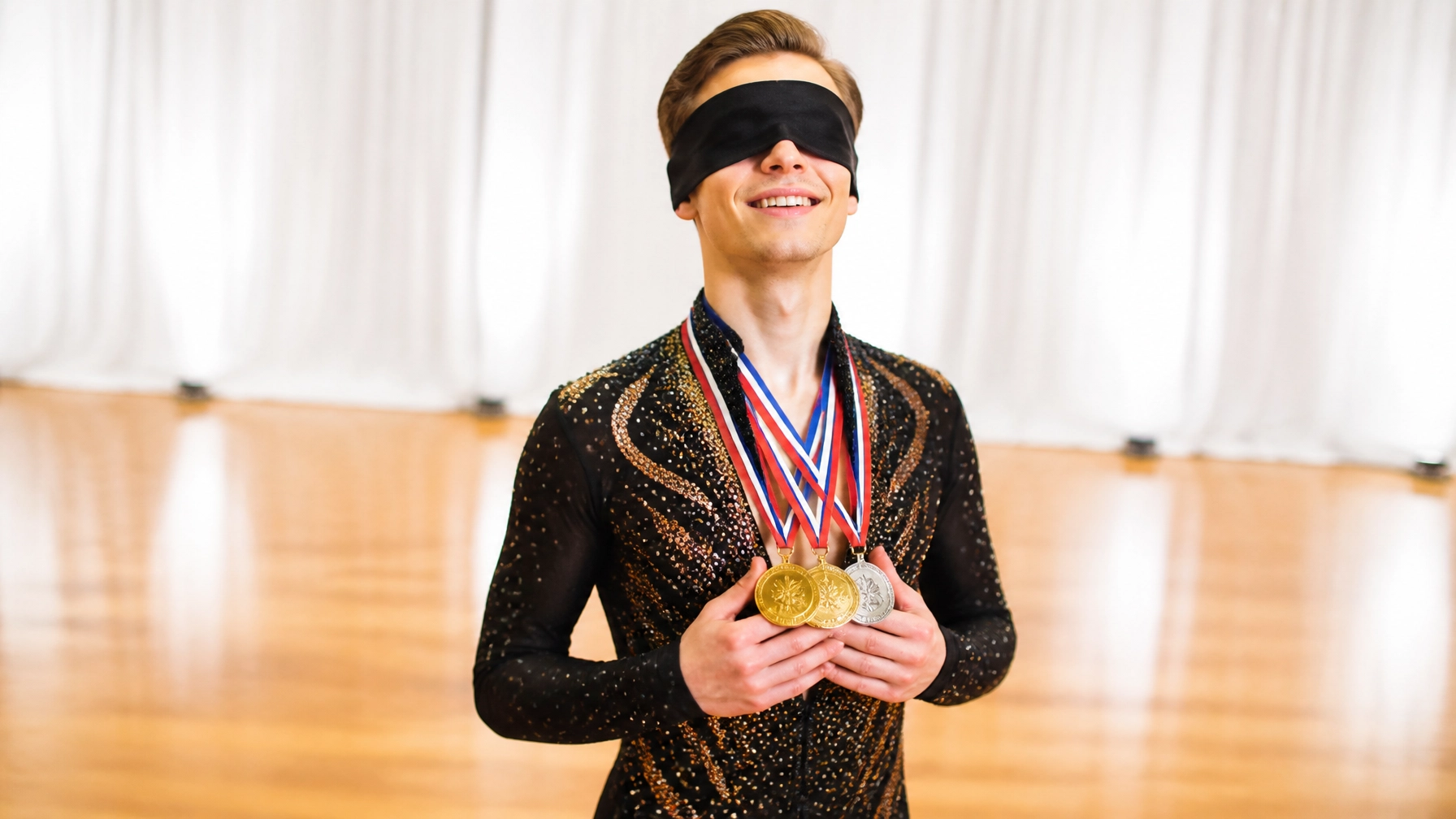
Deborah Impiazzi has proven that the rhythm of the heart does not require the guidance of sight.
At 64 years old, the dancer has recently emerged from the prestigious Freedom to Dance competition not just as a participant, but as a multi-medal-winning champion. Competing in both ballroom and Latin categories, Impiazzi walked away with a staggering seven medals, a feat that has captured the imagination of the dancing world and provided a profound reminder of the resilience of the human spirit. For Deborah, these medals represent far more than technical proficiency; they are symbols of a hard-won journey back to confidence after the world turned dark.
The transition from a sighted life to one of total blindness is a challenge that many would find insurmountable, particularly when it comes to activities that rely heavily on spatial awareness and visual cues. Ballroom dancing is a discipline of precision, where the position of a foot or the tilt of a chin can make the difference between a stumble and a score. For Deborah, the loss of her sight was a pivotal moment that could have ended her relationship with the dancefloor forever. Instead, it became the catalyst for a new way of moving, one rooted in trust, internal rhythm, and an extraordinary connection with her dance partners.
Her success at the international Freedom to Dance event was no stroke of luck. It was the result of gruelling practice and a refusal to be defined by her lack of vision. To watch her on the floor is to see a woman who is entirely present in the moment, responding to the music with a grace that belies the complexity of her situation. The seven medals she secured across various disciplines speak to a versatility that is rare even among sighted dancers. Whether it was the sharp, rhythmic demands of the Latin dances or the sweeping, ethereal flow of the ballroom routines, she met every requirement with the poise of a seasoned professional.
The story of Deborah’s triumph has resonated deeply within the community, highlighting the importance of accessibility and inclusion in the arts. Her presence at such a high-level competition sends a clear message to other performers facing physical challenges: the stage is still yours. The medals, gleaming and heavy, are tangible proof that age and disability are not barriers to excellence, but rather different sets of parameters through which talent can be expressed.
Finding the Rhythm in the Absence of Light
The journey back to the ballroom was not instantaneous. After losing her sight, Deborah had to navigate a world that had suddenly become unfamiliar and daunting. The simple act of walking down a street required a new set of skills, let alone the intricate footwork of a foxtrot or a waltz. The decision to return to dancing was a courageous one, born from a desire to reclaim a part of her identity that she feared was lost. In the early stages, it was about more than just the steps; it was about reclaiming her sense of space and her confidence in her own body’s ability to perform.
Dancing without sight requires an incredible level of trust between partners. In ballroom, the lead and the follow are always in communication, but for Deborah, this communication had to become heightened. She describes the process as a form of sensory translation, where the subtle shifts in her partner's weight and the pressure of a hand become the primary sources of information. This deep level of connection often results in a performance that is more intuitive and fluid than that of sighted couples, as the dancers are forced to feel the music and each other with a raw intensity.
The psychological impact of this return to the floor cannot be overstated. For many who experience late-onset blindness, the loss of independence can lead to isolation and a decline in mental well-being. By choosing to dance, Deborah chose to engage with the world in a vibrant, physical way. The ballroom became a sanctuary where she could shed the labels often attached to the visually impaired and simply be a dancer. This internal transformation was the true foundation upon which her competitive success was built, allowing her to step onto the competition floor with a sense of purpose that the judges found impossible to ignore.
The Grit and Grace of Competitive Success
Competing at an international level like the Freedom to Dance event is a high-pressure environment for any athlete. The lights are bright, the music is loud, and the scrutiny of the judges is relentless. For Deborah, these factors are amplified by the unique logistical challenges of her condition. She has to memorise the dimensions of the floor, the orientation of the room, and the proximity of other couples, all while maintaining the technical standards required to win. Her ability to navigate these challenges while delivering a gold-medal performance is a testament to her mental fortitude and physical discipline.
The preparation for the competition involved hours of repetitive training, focusing on "muscle memory" to ensure that every movement was second nature. In the absence of visual feedback, Deborah relied on the verbal cues of her coaches and the physical feedback from her partner to refine her technique. This meticulous approach allowed her to achieve a level of consistency that is often the hallmark of a champion. Each of the seven medals represents hours of sweat and frustration, overcome by a singular focus on the joy of the dance.
Her performance in the Latin categories was particularly noted for its energy and precision. Latin dance requires a sharp, percussive quality that can be difficult to maintain without the ability to see the placement of the limbs in relation to the floor. Deborah’s success in this area surprised many, proving that her sense of timing and rhythm is deeply ingrained. In the ballroom categories, she displayed a classic elegance, moving across the floor with a lightness that made her blindness virtually invisible to the casual observer. It was only when she was guided off the floor that the reality of her achievement truly hit home for the audience.
A Beacon of Inspiration for the Next Generation
The impact of Deborah’s victory extends far beyond her own personal trophy cabinet. She has become a figurehead for a movement that seeks to redefine what is possible for older adults and people with disabilities. In a society that often overlooks the contributions of those over 60, her success is a bold rebuttal to the concept of "slowing down."
She has shown that the sixth decade of life can be a time of peak performance and new beginnings, rather than a period of quiet retirement.
Her story is also a powerful tool for those working in the field of disability advocacy. By competing in a mainstream event rather than a segregated "para" category, Deborah has pushed the boundaries of inclusion. She has demonstrated that with the right support and a determined mindset, the barriers between "able-bodied" and "disabled" performance can be blurred or even removed entirely. The medals she won were awarded based on the same criteria as any other dancer, proving that her talent stands on its own merits.
As Deborah continues her dancing career, she remains focused on the simple joy that the music brings her. While the medals are a wonderful validation of her hard work, she maintains that the real prize is the feeling of freedom she experiences when she is on the floor. For her, dancing is a way to stay connected to herself and to others, a way to keep moving forward even when the path is not visible. Her journey serves as a reminder to us all that while we may sometimes find ourselves dancing in the dark, the light of passion and perseverance can guide us to extraordinary heights.