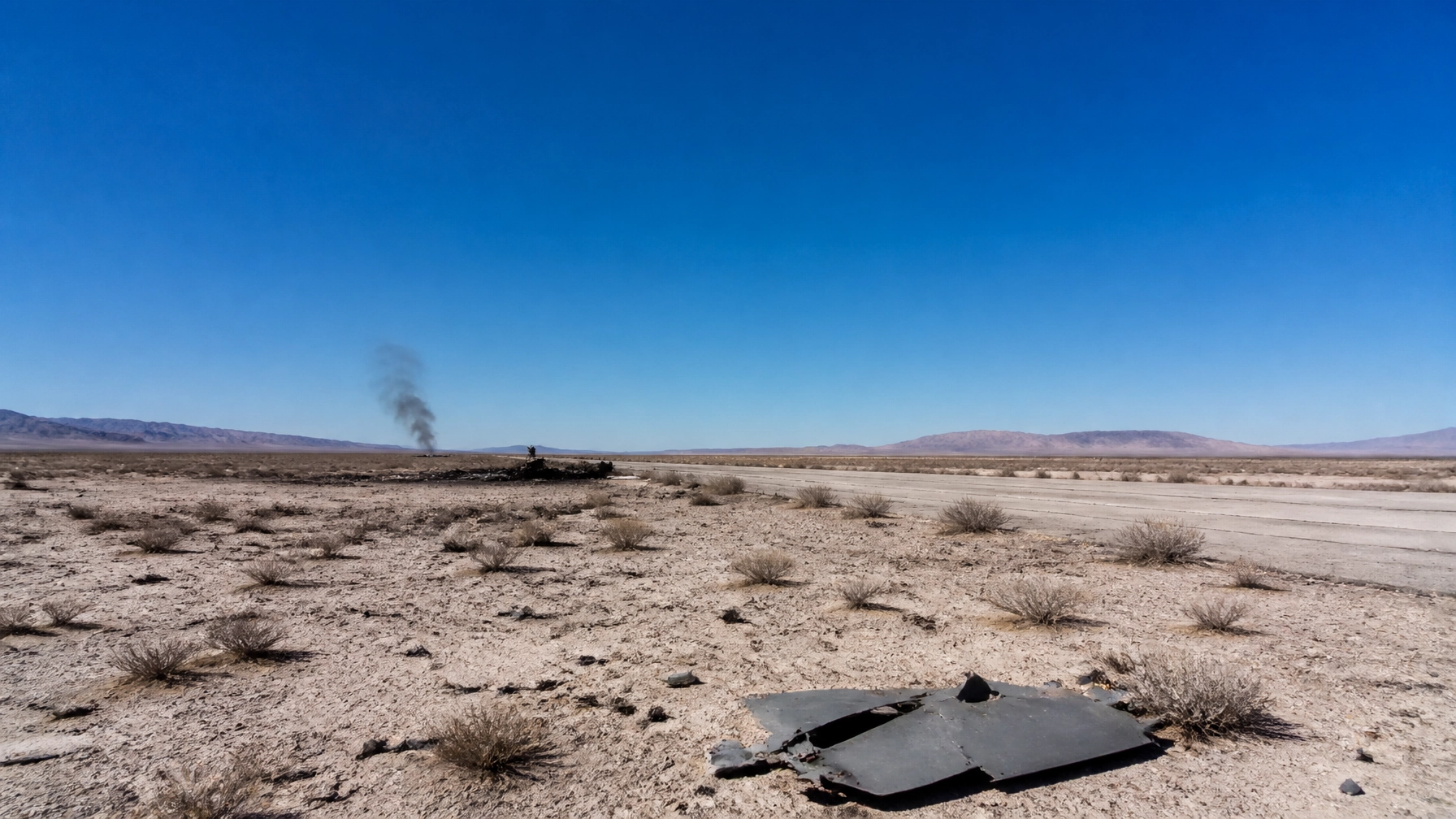
A pall of black smoke hung over the Mojave Desert on Monday morning as a routine test flight ended in one of the most significant aviation disasters for the United States Air Force in recent years.
A B-52 Stratofortress, the venerable workhorse of American aerial power, crashed shortly after lifting off from the runway at Edwards Air Force Base in California. Official reports have confirmed that all eight people on board the aircraft perished in the incident, which occurred during what was described as a critical radar modernization mission.
The crash took place at approximately 11:20 a.m. local time. Witnesses near the base perimeter reported seeing the massive eight-engine bomber struggle to gain altitude before banking sharply and plunging into the scrubland just outside the primary airfield boundaries. The impact was followed by a massive fireball that could be seen for miles across the flat desert floor. Emergency crews from Edwards and surrounding Kern County were dispatched immediately, but the intensity of the wreckage meant there was no possibility of a rescue.
Military officials at the base have been sombre in their assessments. The loss of life includes a mix of active-duty military personnel, government civilians, and private contractors. Two of the victims were employees of Boeing, the primary contractor for the B-52’s ongoing life-extension programmes. The identities of the deceased are being withheld for at least twenty-four hours to ensure that all next of kin have been properly notified, a process that is particularly complex given the multi-agency nature of the crew.
The B-52 Stratofortress involved in the crash was part of a fleet undergoing intensive upgrades designed to keep the 1950s-era airframe operational through the middle of the 21st century. This specific mission was reportedly focused on a new active electronically scanned array (AESA) radar system, a technology intended to give the bomber the kind of detection and targeting capabilities usually reserved for modern fighter jets.
Modernisation and the Price of Progress
The Stratofortress, often affectionately known as the BUFF, has been the backbone of the American strategic bomber force for seven decades. Despite its age, the Air Force has consistently chosen to upgrade the existing airframes rather than replace them entirely, citing the aircraft’s incredible structural durability and its ability to carry a massive variety of payloads. However, these upgrades are not without risk. Integrating modern electronics, new Rolls-Royce F130 engines, and advanced communication suites into a fuselage that first flew during the Cold War requires rigorous testing.
Edwards Air Force Base, located north of Los Angeles, is the premier site for such hazardous work. It is here that almost every aircraft in the American inventory has been tested and pushed to its limits. The high-risk nature of flight testing is a reality that those stationed at Edwards live with daily, yet a loss of this magnitude is rare. The last major accident involving a B-52 occurred in Guam in 2016, though in that instance, the crew was able to escape safely. This week’s tragedy marks the deadliest incident involving the airframe in decades.
Initial reports from the site suggest that the aircraft may have suffered a catastrophic engine failure or a flight control malfunction during the critical climb-out phase. Aviation experts note that at high weights and during takeoff, the B-52 is at its most vulnerable. If several engines on one wing were to fail simultaneously, the resulting asymmetrical thrust could become unmanageable at low altitudes. Investigators from the Air Force Safety Center arrived on the scene within hours of the crash to begin the painstaking process of recovering flight data recorders and examining the wreckage for signs of mechanical fatigue or bird strikes.
A Community in Mourning
The impact of the crash has been felt deeply within the tight-knit community of aerospace engineers and test pilots who call the Mojave Desert home. Edwards Air Force Base is more than just a military installation; it is a hub of innovation where civilian contractors work side-by-side with uniformed service members. The presence of Boeing staff on board the aircraft highlights the collaborative effort required to keep the ageing bomber fleet relevant in an era of hypersonic missiles and stealth technology.
Base commander Brigadier General George 'Buzz' Miller addressed the media briefly on Monday evening, standing before the main gate as the sun set over the distant smoke. He described the crew as 'some of the finest minds and bravest hearts in the service of our country.' He emphasized that the mission they were conducting was vital to national security, aimed at ensuring that the B-52 remains a credible deterrent against emerging threats.
While the runway where the crash occurred was temporarily closed, the rest of the base has moved into a period of mourning. Flags across the installation have been lowered to half-mast, and a scheduled flypast for a retirement ceremony later in the week has been cancelled. The loss of eight lives represents a significant percentage of the personnel dedicated to the B-52 radar upgrade programme, a blow that will undoubtedly delay the project as the Air Force re-evaluates its safety protocols and mourning the loss of specialized expertise.
The local township of Lancaster and the surrounding High Desert communities have also expressed their condolences. Many residents work at the base or at the nearby Plant 42 in Palmdale, where many of these aircraft are serviced. For them, the sight of a B-52 in the sky is a daily occurrence, a symbol of stability and American industrial might. To see that symbol fall is a jarring reminder of the dangers inherent in aviation, even for an aircraft with as long and storied a history as the Stratofortress.
The Search for Answers and the Future of the Fleet
The investigation into the cause of the disaster is expected to take months, if not longer. Unlike civilian air crashes, military investigations are often conducted behind a veil of operational security, though the Air Force has promised transparency given the high number of civilian casualties. A Safety Investigation Board will first look at the immediate facts to prevent any further accidents across the fleet. If a systemic issue is found with the new engines or radar installations, the entire B-52 fleet could potentially be grounded.
The B-52H model currently in service is slated to be redesignated as the B-52J once the new engines and radar are fully integrated. This tragedy raises difficult questions about the complexity of these modifications. Some critics of the programme have argued that there is a limit to how much new technology can be bolted onto a seventy-year-old airframe before the margins for error become too thin. Proponents, however, maintain that the aircraft is structurally sound and that this incident, while tragic, is likely an isolated mechanical or human error.
As the recovery teams continue their work in the desert heat, the focus remains on the families of the eight individuals who did not come home. The Air Force has established a family support centre at Edwards to provide counselling and assistance to those affected. In the coming days, memorial services are expected to be held at the base chapel, where the names of the fallen will be added to the long list of those who have given their lives in the pursuit of flight at the legendary test site.
The crash of the B-52 serves as a grim milestone in the history of Edwards Air Force Base. It serves as a reminder that even in an age of digital simulations and advanced computer modelling, the ultimate test of any technology remains the air itself. The sky over the Mojave is once again clear, but the memory of the smoke rising from the desert floor will linger for a long time in the minds of those who witnessed the end of a mission that was meant to secure the future, but instead ended in heartbreak.