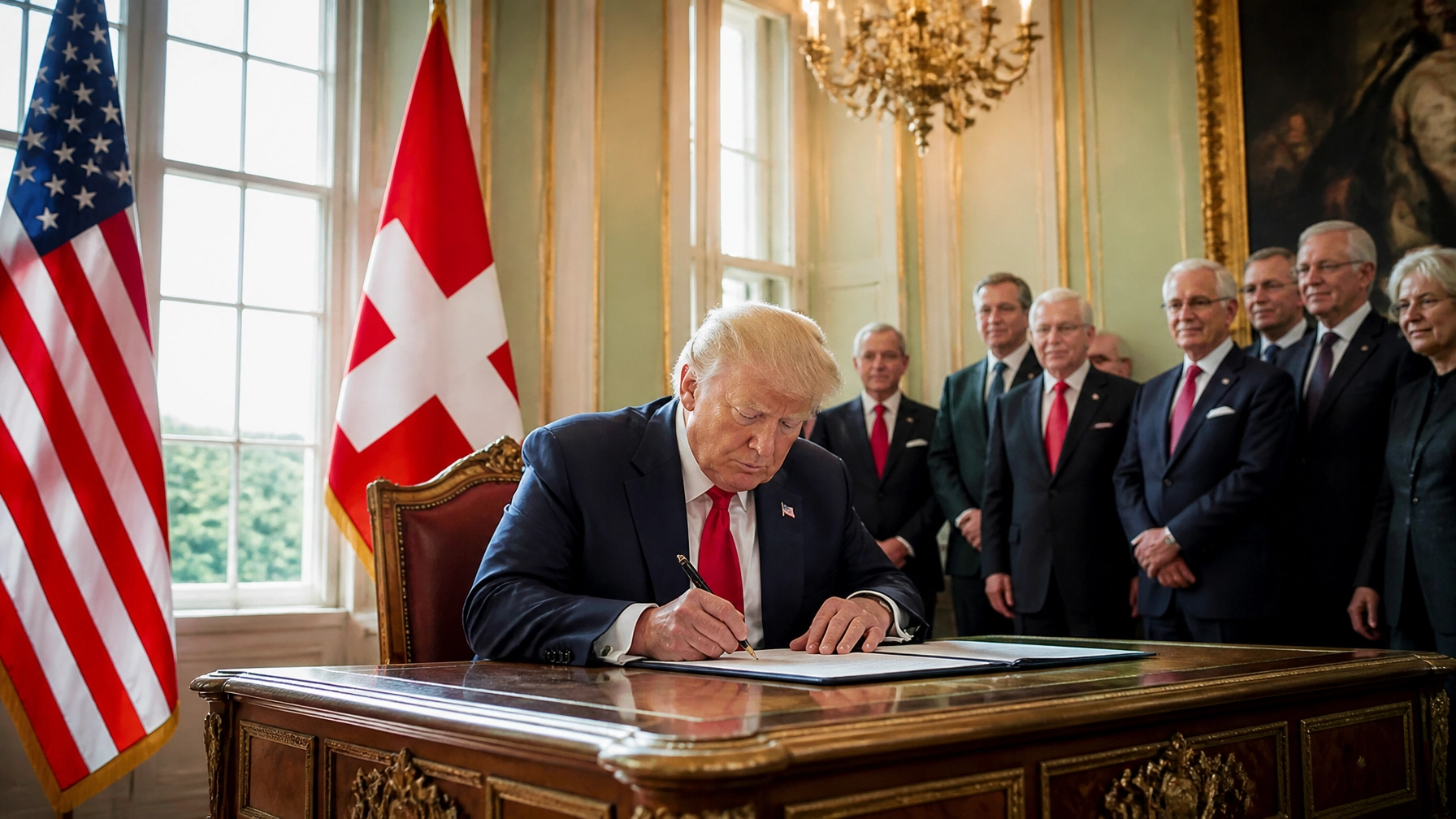
In a diplomatic breakthrough that has stunned global markets and brought an end to months of intensive military conflict, a 14-point peace deal has been formally signed in Switzerland.
The agreement, brokered through months of back-channel negotiations and finalised in a high-stakes summit, establishes a comprehensive framework designed to terminate the war between the United States and Iran. The memorandum of understanding, signed by US President Donald Trump and representatives of the Iranian government, outlines a definitive path toward the total cessation of hostilities, the reopening of vital global shipping lanes, and a phased restoration of diplomatic and economic relations. This historic document marks the most significant shift in Middle Eastern geopolitics in decades, promising a transition from active warfare to a structured period of reconstruction and verification.
The deal establishes an immediate and permanent termination of all military operations on all fronts. This ceasefire is not limited to direct engagements between primary combatants but extends to regional fronts, including the long-standing hostilities across the Israel-Lebanon border. Central to the agreement is the establishment of a 60-day negotiation window, during which both parties are mandated to hammer out the final details of a permanent treaty. During this period, a joint implementation mechanism will be created to monitor compliance and ensure that neither side engages in provocative military posturing. The international community has largely welcomed the announcement, seeing it as a necessary reprieve for a region that has faced catastrophic disruption to its infrastructure and civilian life.
A Framework for Regional Stability
The 14-point deal places a heavy emphasis on the preservation of national sovereignty and the principle of non-interference. Point seven of the agreement explicitly commits both nations to respecting each other’s territorial integrity, a move designed to address long-standing grievances regarding external support for internal opposition movements. By formalising this commitment, the deal aims to de-escalate the rhetoric of regime change that has dominated diplomatic discourse for years. This focus on sovereignty is paired with a commitment to regional de-escalation, requiring the Iranian government to rein in allied militias across the Middle East. The goal is to create a security environment where regional actors are no longer incentivised to engage in proxy warfare, thereby stabilising the broader Mediterranean and Gulf regions.
A critical component of this stability is the role of the United Nations. The final agreement, once the 60-day negotiation period concludes, is intended to be endorsed by the UN Security Council. This endorsement is designed to provide the deal with international legal backing, ensuring that the commitments made in Switzerland are not merely bilateral promises but are integrated into the global legal order. The implementation mechanism will involve international monitors who will be responsible for verifying the withdrawal of forces and the cessation of covert operations. This multilateral approach is seen as a safeguard against the unilateral withdrawal from previous agreements, providing a layer of international accountability that has been absent during the recent years of escalating tension.
Furthermore, the deal outlines a phased military drawdown. Once the final agreement is implemented, the United States has committed to withdrawing its forces from the immediate vicinity of Iranian territory, returning to a pre-war posture. This withdrawal is contingent upon the successful completion of the 60-day negotiation phase and the verification of Iranian compliance with the ceasefire terms. For the Iranian side, this means a significant reduction in the presence of foreign military assets on its doorstep, while for the international community, it signals a reduction in the risk of accidental escalation or renewed conflict. The emphasis throughout this section of the deal is on creating a predictable and transparent security environment that allows for the safe return of displaced persons and the restoration of civil administration in war-affected areas.
Economic Revitalisation and the Strait
Perhaps the most immediate global impact of the peace deal is the reopening of the Strait of Hormuz. The waterway, which serves as a vital artery for global energy supplies, had been effectively closed during the peak of the conflict, leading to a surge in international oil prices and significant disruption to global supply chains. Under the third point of the 14-point deal, Iran has agreed to immediately remove all technical and military obstacles, including undersea mines, to allow for the safe passage of commercial shipping. Maritime traffic is expected to return to pre-war levels within 30 days. In exchange, the United States has agreed to dismantle its naval blockade and lift restrictions on Iranian ports, allowing for the resumption of legitimate trade and the delivery of humanitarian aid.
To support the transition from a war economy to a period of growth, the deal outlines a monumental $300 billion reconstruction and economic package. This fund is dedicated to the rehabilitation and economic development of Iran, focusing on the repair of critical infrastructure such as power grids, water treatment facilities, and transportation networks that were damaged during the hostilities. Importantly, the agreement specifies that the funding will not be the sole responsibility of the United States. Instead, it will be financed through a combination of international partners, private capital investments, and the release of previously frozen Iranian assets. This financial commitment is intended to provide the Iranian population with a tangible “peace dividend,” incentivising continued adherence to the terms of the agreement and providing a foundation for long-term economic stability.
The schedule for sanctions relief is another cornerstone of the economic framework. The memorandum states that the United States will end all types of sanctions: including unilateral measures, UN Security Council sanctions, and IAEA-related restrictions: on an agreed-upon schedule. This relief is strictly tied to the implementation of the final deal. While some critics have expressed concern over the scale of the relief, proponents argue that it is a necessary component of the “maximum pressure” strategy’s transition into “maximum diplomacy.” By linking economic recovery directly to verifiable compliance, the deal creates a powerful economic lever to ensure that the transition period remains peaceful. The anticipated return of Iranian oil to the global market has already led to a stabilisation of energy futures, providing much-needed relief to the global economy.
Nuclear Constraints and Future Verification
The final pillars of the 14-point deal address the contentious issue of Iran’s nuclear programme. Under the new framework, Iran has reaffirmed its commitment that it will never seek to produce or develop nuclear weapons. This pledge is more than a rhetorical gesture; it is backed by specific interim commitments that will be expanded during the 60-day negotiation window. Chief among these is a moratorium on uranium enrichment above a certain percentage, ensuring that material cannot be diverted for military purposes. The agreement also includes provisions for the management of Iran’s existing stockpile of enriched uranium, with options being discussed for down-blending the material to reactor-grade levels or transporting it out of the country for safekeeping.
Verification remains the linchpin of the nuclear component. The deal grants international inspectors what have been described as “strong policing powers” to ensure that all nuclear sites are used for peaceful, civilian purposes only. These inspections are intended to be more intrusive and comprehensive than those seen in previous iterations of nuclear agreements, providing the international community with a high degree of confidence in Iranian compliance. President Trump has emphasised that the success of the deal rests on “trust but verify,” indicating that any breach of the nuclear constraints would lead to an immediate resumption of sanctions and potentially military action. This rigid verification structure is designed to satisfy those who were critical of earlier frameworks, offering a more robust safeguard against nuclear proliferation.
As the 60-day countdown begins, the focus shifts to the complex technical discussions required to finalise the treaty. The 14-point deal has provided the necessary “off-ramp” for a conflict that many feared would escalate into a broader regional war. By addressing the immediate military, economic, and nuclear concerns in a single integrated framework, the signatories have established a roadmap that, if followed, could lead to a permanent end to decades of hostility. The eyes of the world now turn to the implementation teams in Switzerland and the Middle East, who must transform this memorandum of understanding into a lasting peace that can withstand the inevitable political and security challenges of the coming months. The signing in Switzerland represents a momentous step away from the brink of total war and toward a new, albeit fragile, era of diplomacy.