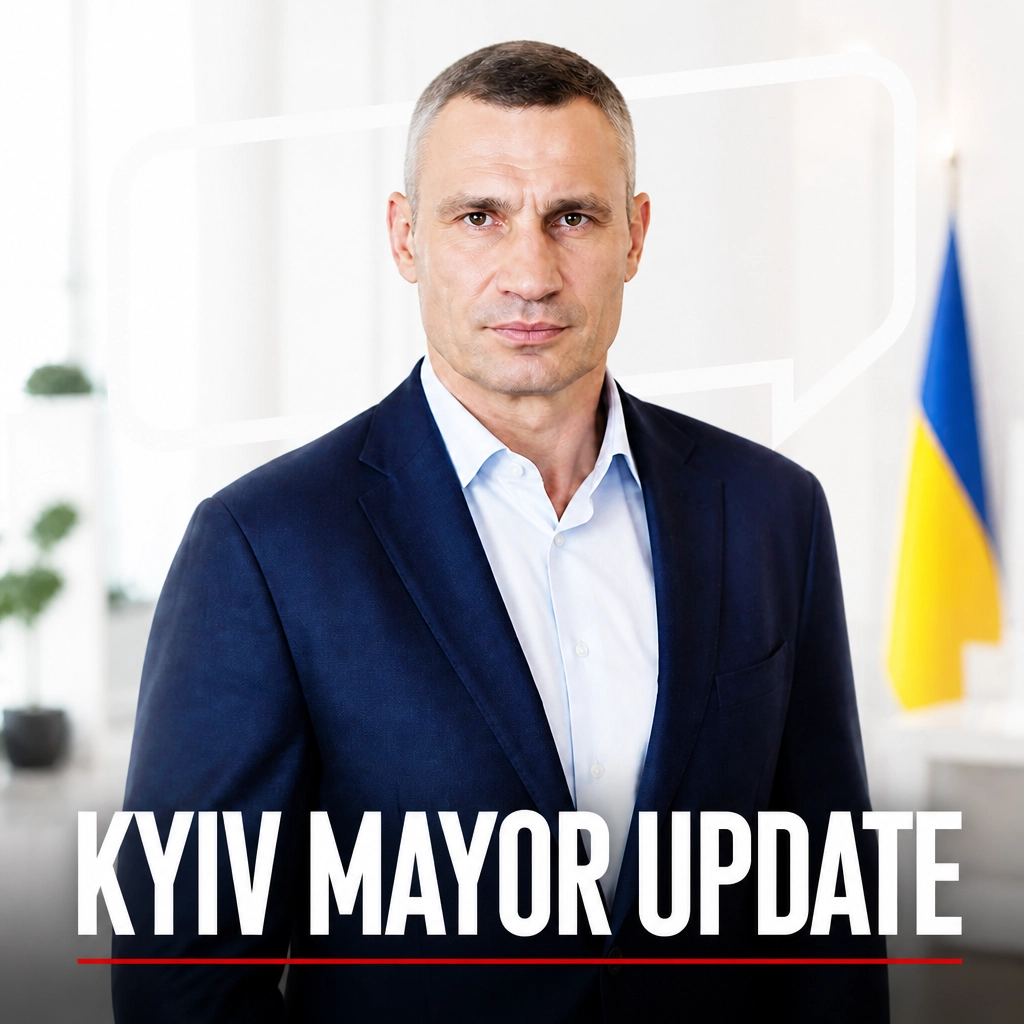
Vitali Klitschko has stood as a symbol of Kyiv’s defiance since the first tanks crossed the border, but his latest appeal to the international community carries a sharper, more urgent edge. As the conflict drags into its fifth year, the Mayor of Kyiv is not just asking for more ammunition; he is warning that the very fabric of Western democracy is at stake. During a recent address, Klitschko made it clear that the rhythm of support from the West has become dangerously out of sync with the realities on the ground. The fatigue that has begun to creep into European and American political discourse is, in his eyes, a luxury that the people of Kyiv cannot afford. For those living under the constant shadow of drone strikes and missile alerts, there is no such thing as "war weariness": only survival.
The Mayor’s rhetoric has shifted from the rallying cries of early resistance to a more sober, analytical assessment of the geopolitical landscape. He points to the recent waves of attacks that have battered the capital’s infrastructure as proof that the offensive shows no signs of slowing. According to Klitschko, the hesitation of certain allies to provide long-range capabilities is not just a tactical delay; it is a signal to the aggressor that Western resolve has limits. He argued that the incremental approach to military aid has often meant that equipment arrives just in time to prevent a collapse, but never in the quantities required to secure a decisive victory. This "drip-feed" strategy is what he believes is prolonging the suffering of his citizens.
In conversations with international delegates, Klitschko has been blunt about the consequences of a stalemate. He frames the situation in Kyiv not as a local border dispute, but as the front line of a global struggle between autocracy and freedom. When he speaks of the "vital support" required, he is referring to a comprehensive package that includes advanced air defence systems, sustained financial liquidity to keep the city’s services running, and a unified political front that doesn't waver with every election cycle. The Mayor’s concern is that as the conflict becomes "normalised" in the eyes of the global public, the sense of urgency that once defined the Western response is being replaced by a bureaucratic routine that lacks the necessary punch.
The Cost of Global Indifference
The human element of this conflict is something Klitschko refuses to let the world forget. Every time a high-rise in Kyiv is struck, he is one of the first on the scene, often seen towering over the wreckage in his familiar leather jacket. For him, the statistics of "missile interceptions" and "territorial gains" are secondary to the shattered lives of the families he represents. He has warned that global indifference is a weapon just as potent as any ballistic missile. When the international community looks away, or when debates over funding become bogged down in domestic partisan squabbles, the impact is felt directly on the streets of Kyiv.
Klitschko’s latest comments highlight a growing frustration with the pace of diplomatic processes. He has noted that while diplomats discuss the nuances of escalation, the people of his city are burying their dead. The Mayor has called for a shift in perspective, urging allies to see that the "cost" of support is nothing compared to the potential cost of a failed Ukraine. He argues that if the West fails to provide the necessary shield for Kyiv today, the price of defending London, Paris, or Berlin tomorrow will be infinitely higher. This is the hard-hitting reality he wants Western leaders to wake up to: there is no neutral ground in this fight.
The resilience of Kyiv has been remarkable, but Klitschko is quick to point out that resilience has its limits. The city’s power grid, water supply, and transport networks have been targeted relentlessly. While engineers work around the clock to patch up the damage, the Mayor knows that without more robust air defence, they are merely treating the symptoms rather than the cause. His appeal is for a proactive rather than a reactive strategy. He wants to see a commitment that doesn't just respond to the latest tragedy but prevents the next one from happening. This requires a level of consistency that he feels has been lacking in recent months.
A Call for Military Unity
Unity has always been the buzzword of the alliance, but Klitschko is now calling for a more practical, military-focused interpretation of that term. He has expressed concern over the fragmented nature of military aid, where different nations provide different platforms with varying levels of restriction. This "patchwork" approach creates logistical nightmares for the Ukrainian forces and limits their ability to conduct large-scale operations. The Mayor’s vision is for a unified military strategy where the West provides a standardised, high-capacity arsenal that allows Kyiv to truly hold the line.
He has been particularly vocal about the need for modern fighter jets and long-range precision weapons. Klitschko argues that as long as the aggressor can launch attacks from within its own borders with impunity, Kyiv will remain under threat. The Mayor’s stance is that the "red lines" drawn by Western politicians are often based on a fear of escalation that the aggressor has already ignored. By limiting the range of the weapons provided, he believes the West is effectively fighting with one hand tied behind its back. His appeal is for the removal of these constraints, allowing his country to defend itself on equal terms.
The political shifts in the United States and Europe have also been a point of focus for Klitschko. He has been clear that while he respects the domestic processes of his allies, the security of Europe should not be a political football. He has urged leaders to look beyond the next poll and consider the long-term stability of the continent. The Mayor’s message is that a strong, supported Ukraine is the best guarantee of peace for the entire region. He has called for a multi-year commitment to military and financial aid that transcends election cycles, providing the certainty that Kyiv needs to plan for the future.
Defining a Just Peace
As talk of potential negotiations begins to surface in international circles, Klitschko has been firm on what a "just peace" must look like. He has rejected any talk of territorial concessions, arguing that rewarding aggression would only set a dangerous precedent for other autocrats around the world. For the Mayor, peace cannot be achieved by simply freezing the conflict; it must be a peace based on the restoration of international law and the sovereignty of his nation. He has cautioned that any "capitulation agreement" masked as a peace treaty would only be a temporary pause before the next wave of violence.
Klitschko believes that the only way to reach the negotiating table is through strength. He has argued that the aggressor only understands the language of power, and therefore, the West must provide the military muscle to force a genuine diplomatic solution. His appeal is for a peace process that is led by Ukraine and supported by a robust international coalition. This means not only returning stolen land but also ensuring accountability for the war crimes committed during the conflict. Without justice, he believes, there can be no lasting peace.
The future of Kyiv, in Klitschko’s eyes, is inextricably linked to the European project. He sees his city as a future hub of innovation and democracy, but that vision depends entirely on the outcome of the current struggle. He has called for a clear path to European Union and NATO membership, seeing these as the ultimate security guarantees for his people. The Mayor’s final plea to the West is to stay the course. He acknowledges that the road is long and the sacrifices are many, but he insists that the goal: a free, democratic, and secure Europe: is worth every penny and every effort. The fight in Kyiv is not just about a city; it is about the world we want to live in.