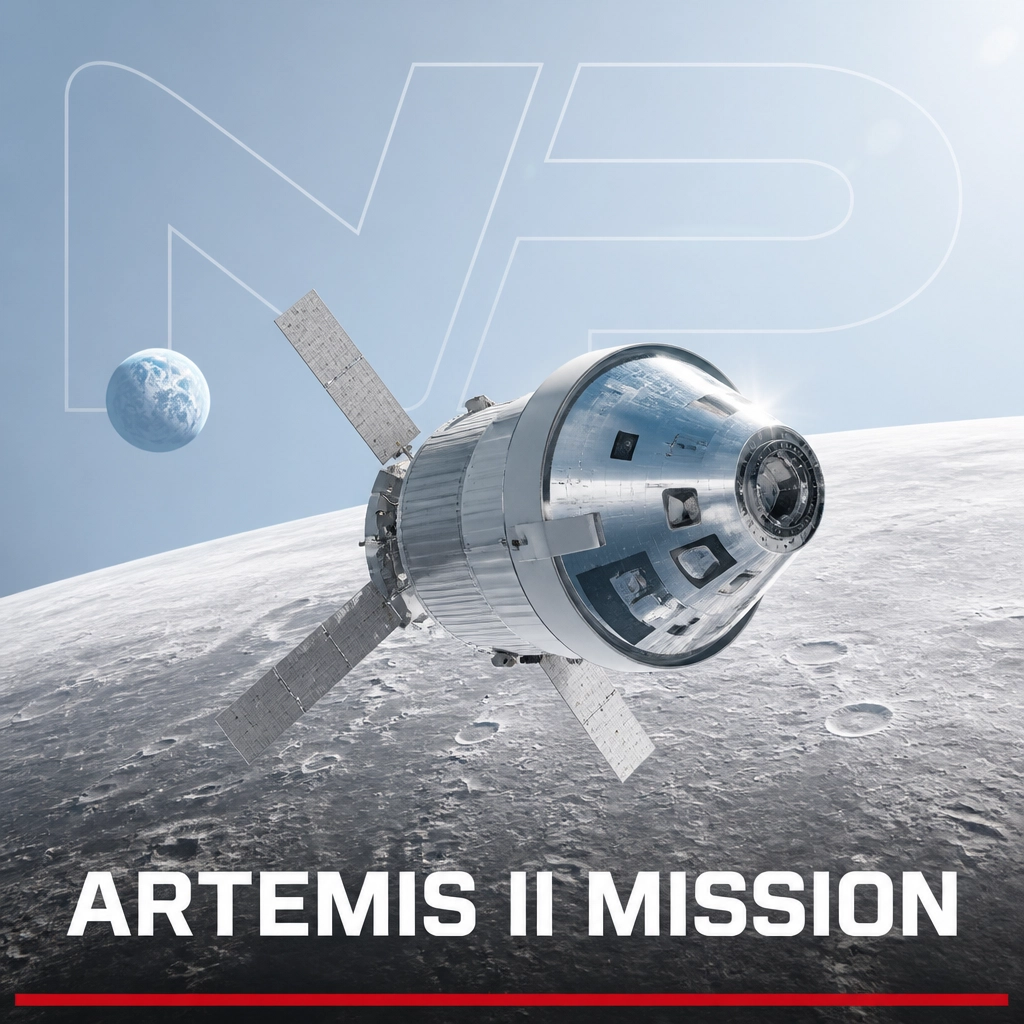
The journey to the lunar surface has taken a monumental step forward this week as the Artemis II mission successfully completed its latest critical phase. For the first time in more than half a century, a crewed spacecraft has ventured into the deep-space environment beyond low Earth orbit, marking a significant shift in the landscape of human exploration. The mission, which serves as the ultimate proving ground for the systems designed to return humans to the Moon, has hit a series of performance benchmarks that confirm the readiness of the Space Launch System and the Orion capsule for the challenges of long-duration spaceflight.
This latest milestone involves the successful execution of the translunar injection burn, a high-stakes manoeuvre that propelled the crew out of Earth's gravitational pull and onto a direct path toward the Moon. This engine firing was not just a technical requirement but a symbolic moment for the international space community, representing the point of no return for the four astronauts currently on board. With this burn completed, the mission is now officially in its lunar transit phase, with the spacecraft performing exactly as expected in the harsh conditions of deep space.
The crew on board, comprising mission commander Reid Wiseman, pilot Victor Glover, and mission specialists Christina Koch and Jeremy Hansen, have reported that all systems are functioning within normal parameters. Their presence on this flight marks several historic firsts, including the first woman, the first person of colour, and the first non-American to travel to the vicinity of the Moon. This diversity in the cockpit reflects a broader modern approach to exploration, one that seeks to represent the entirety of the global community as humanity once again looks toward the stars.
A historic leap for modern exploration
The technical success of the Artemis II mission so far is a testament to years of rigorous testing and development. The Orion spacecraft, which is the primary vehicle for the crew, has been designed to sustain human life in an environment that is far more hostile than that of the International Space Station. Beyond the protection of Earth's magnetic field, the astronauts are exposed to higher levels of cosmic radiation and must rely on entirely autonomous life-support systems. The data returning from the capsule suggests that the shielding and environmental controls are holding up well, providing a safe habitat for the ten-day journey.
One of the most complex aspects of this mission is the integration of the European Service Module, which provides the necessary power, propulsion, and air for the crew. During the initial hours of the flight, the module’s solar arrays were deployed and tracked the sun with high precision, ensuring a steady flow of electricity to the ship’s computers and life-support hardware. The successful coordination between the American-built capsule and the European-built service module is a cornerstone of this programme, demonstrating that complex international partnerships are essential for the success of deep-space missions.
As the spacecraft continues its journey, the mission control teams on the ground are monitoring the trajectory with extreme care. The path being taken is known as a free-return trajectory, which means that the gravity of the Moon will naturally pull the spacecraft around its far side and sling it back toward Earth. This design is a built-in safety feature; even if the main engine were to fail after the initial burn, the laws of orbital mechanics would ensure the crew returns home. This level of redundancy is a key lesson learned from previous eras of exploration and is central to the safety protocols of the current programme.
Pushing the boundaries of human reach
As Orion approaches the lunar vicinity, it is set to break a long-standing record for the farthest distance from Earth ever travelled by a crewed spacecraft. This milestone will surpass the record set during the Apollo 13 mission in 1970, when that crew was forced into a wide arc around the Moon due to an on-board emergency. Unlike that historic flight, the Artemis II mission is reaching these distances as part of a planned, controlled test of the vehicle’s capabilities. Reaching this point, approximately 400,000 kilometres from our home planet, is a feat that highlights the sheer scale of the engineering involved in modern rocketry.
The astronauts have been busy performing a series of proximity operations and system checks that could only be done in a real-world environment. They have tested the manual handling of the spacecraft, ensuring that they can take control of the docking and navigation systems if the automated computers were to ever malfunction. These "human-in-the-loop" tests are vital for the missions that will follow, particularly Artemis III, which will require a complex docking manoeuvre with a lunar lander in orbit around the Moon.
Furthermore, the mission is providing invaluable data on how the human body reacts to deep space. While humans have lived on the International Space Station for months at a time, that facility remains within the protective "bubble" of Earth. Artemis II is the first time since 1972 that humans have been exposed to the true deep-space environment. The biological sensors worn by the crew are monitoring their heart rates, sleep patterns, and radiation exposure, providing a goldmine of information for medical researchers who are planning even longer journeys to Mars in the decades to come.
Laying the groundwork for future landings
While the current mission does not involve a landing on the lunar surface, every minute spent in orbit is a preparation for the day when humans will once again walk on the Moon. The primary objective of Artemis II is to validate that all of Orion’s systems work as intended with a crew on board. This includes everything from the communications systems that allow high-definition video to be sent back to Earth, to the waste management and food preparation hardware that keeps the astronauts healthy and focused.
The success of the mission to date has bolstered confidence in the timeline for the next phase of the programme. Once the Artemis II crew returns safely to Earth with a splashdown in the Pacific Ocean, engineers will spend months analysing every byte of data and every piece of hardware. This analysis will inform the final preparations for Artemis III, which is currently slated to land the first astronauts at the lunar South Pole. That region is of particular interest to scientists because of the presence of water ice in permanently shadowed craters, a resource that could eventually be used to create fuel and oxygen for a permanent lunar base.
The broader impact of this mission extends beyond the technical and scientific. It serves as a reminder of what is possible when focus and resources are directed toward a common, ambitious goal. The Artemis II mission is more than just a test flight; it is a signal that the era of "flags and footprints" has been replaced by an era of sustainable exploration and permanent presence. As the spacecraft rounds the far side of the Moon and begins its trek back to Earth, the world is watching a new chapter of history being written in real-time, one that promises to bring the Moon within reach for a new generation of explorers.