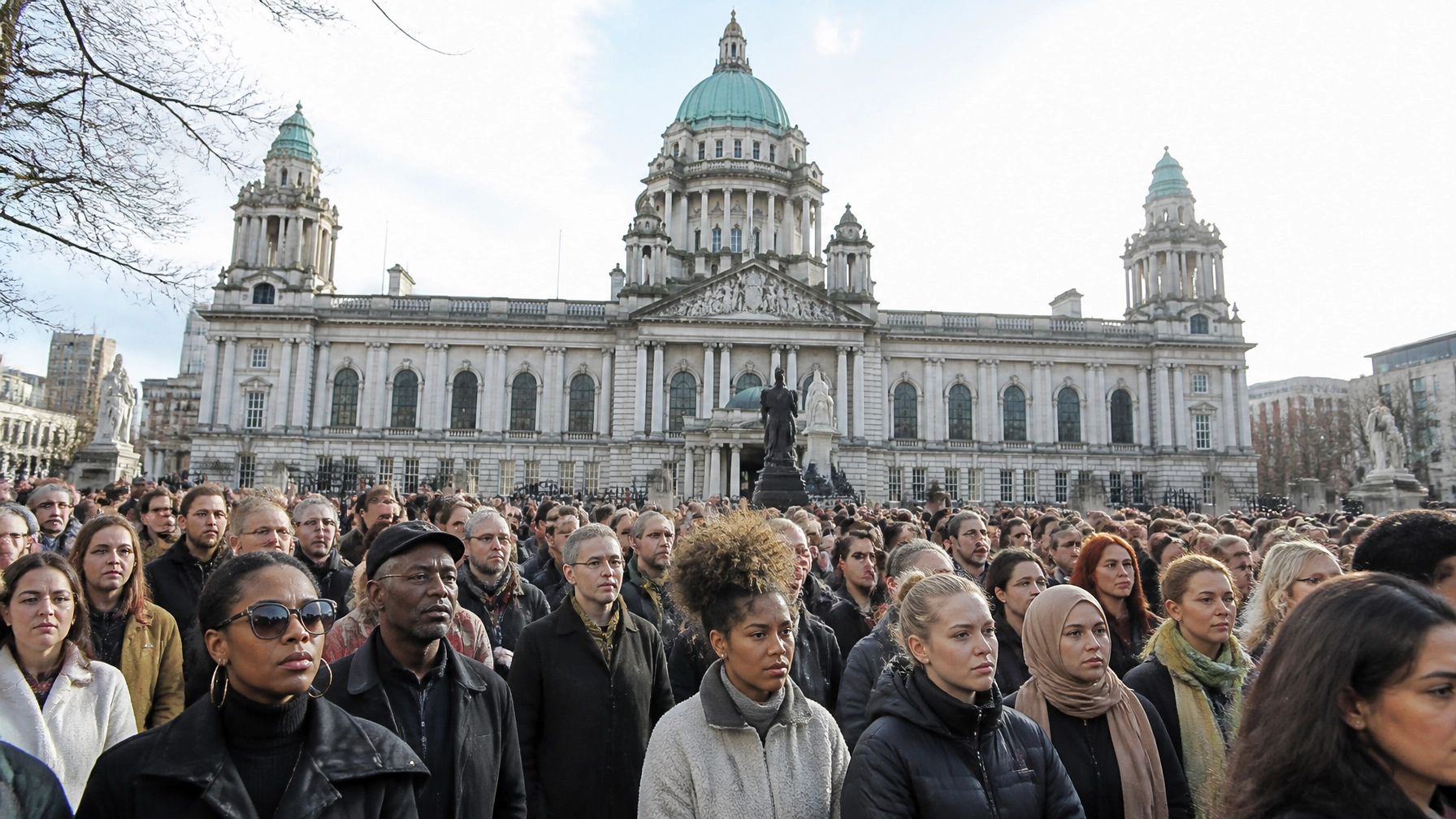
Belfast witnessed one of its most significant displays of public solidarity in recent history as thousands of people descended upon the city centre to voice their opposition to racism and communal violence. The gates of City Hall, a landmark often associated with the city's complex political past, became the focal point for a movement defined by hope and inclusivity. Men, women, and children from every corner of Northern Ireland joined forces with trade unions, community groups, and political leaders to deliver a resounding message that the recent wave of anti-immigrant unrest does not represent the spirit of the city. The sheer scale of the gathering, estimated by organisers to be one of the largest anti-racism demonstrations ever held in the region, transformed the central thoroughfares into a sea of colourful banners and rhythmic chanting.
The atmosphere was a stark contrast to the tension that had gripped parts of the city over the preceding week. Where there had been smoke from set fires and the sound of breaking glass, there was now music, applause, and a collective sense of purpose. People held aloft hand-painted signs with messages such as "Refugees Welcome" and "Belfast for All," while speakers on a makeshift stage urged the crowd to be as loud in their compassion as the rioters had been in their hate. The event, branded under the banner Together Against Hate, served as a powerful rebuttal to the disturbances that had made international headlines and left many within the migrant community feeling fearful and isolated.
A Community Responding to Targeted Violence
The rally was the culmination of a week that had seen Northern Ireland’s capital city fractured by pockets of intense violence. The unrest began following the circulation of a viral video depicting a stabbing in North Belfast, an incident that was quickly seized upon by agitators to fuel anti-immigrant sentiment. Despite the subsequent charging of a suspect, misinformation spread rapidly through social media channels, leading to a series of organised protests that rapidly descended into rioting. For several nights, masked mobs targeted businesses owned by individuals from minority backgrounds, set fire to vehicles, and engaged in clashes with the Police Service of Northern Ireland. The violence was not confined to a single area, with disturbances reported in both traditionally loyalist and nationalist neighbourhoods, creating a sense of unease that the city had not felt in years.
In the face of this intimidation, the response from civic society was swift. Local residents in the affected areas began to organise, checking on their neighbours and offering support to those whose shops had been vandalised. The anti-racism rally was seen as the official channel for this groundswell of community support. Organisers from United Against Racism and various trade unions worked tirelessly to ensure that the march would be a safe and accessible space for everyone. They emphasised that while the rioters were small in number, their actions had caused immense damage to the city’s reputation and the well-being of its residents. By gathering in such massive numbers, the participants intended to reclaim the streets and demonstrate that the overwhelming majority of people in Belfast value diversity and the contribution of the migrant community.
The march moved from the Writers’ Square towards City Hall, with the crowd growing at every junction as more people joined the procession. It was a diverse assembly that reflected the modern face of the city; nurses in their uniforms, students, long-term residents, and newly arrived families walked side-by-side. The presence of high-profile political figures from across the traditional divide was also noted, signalling a rare moment of total political consensus in a region where such unity is often hard-won. They stood together not as representatives of their respective parties, but as a unified front against the ideology of exclusion.
Challenging the Narrative of Division
Central to the speeches delivered during the rally was the idea that Northern Ireland has a "racism problem, not an immigration problem." This sentiment was echoed by several human rights campaigners who argued that the blame for social issues like housing shortages and healthcare wait times was being unfairly shifted onto some of the most vulnerable members of society. By scapegoating migrants, the agitators were attempting to distract from systemic issues that affect all working-class communities, regardless of their background. The rally aimed to challenge this narrative by highlighting the essential roles that immigrants play in the local economy and the public sector, particularly within the healthcare system, which would struggle to function without their contribution.
The speakers also touched upon the historical context of Northern Ireland, a place that has its own long history of displacement and migration. Many families in the crowd could trace their own stories back to times when their ancestors had to leave these shores in search of safety or opportunity. This historical empathy was a recurring theme, with many pointing out the irony of a society that has sent so many of its own people abroad now being seen by some as unwelcoming to those arriving here. This sense of shared experience helped to bridge gaps between different communities, as people recognised that the struggle for a fair and safe society is a universal one.
Despite fears of a counter-protest from those who had orchestrated the previous week’s unrest, only a very small number of individuals appeared to oppose the rally. They were quickly dwarfed by the sheer volume of the anti-racist crowd and kept at a distance by a significant police presence. The lack of a substantial counter-demonstration was seen by many as a sign that the agitators had failed to garner the broad public support they had hoped for. The peace and discipline maintained by the marchers further reinforced the message that this was a movement of the majority, dedicated to the rule of law and the principles of mutual respect.
Looking Toward a Future of Inclusivity
As the rally concluded, the feeling among the participants was one of renewed determination. While the event was a celebration of unity, there was also a clear acknowledgement that the work of tackling prejudice is far from over. The trauma of the preceding week’s violence will take time to heal, especially for the business owners whose livelihoods were destroyed and the families who were forced to flee their homes in fear. The rally was described not as an end point, but as a beginning: a commitment from the people of Belfast to actively stand up against hate whenever it appears.
There were calls for more robust government action to protect minority communities and to address the root causes of the anger that can be exploited by extremist groups. This includes investing in community integration programmes and ensuring that the law is applied strictly to those who incite racial hatred. The unity displayed at City Hall has provided a powerful mandate for such actions, showing that there is a vast public appetite for a more inclusive and peaceful Northern Ireland. The image of thousands of people standing together in the sunshine, cheering for a future where everyone is welcome, will likely remain a defining one for the city as it continues its journey away from the shadows of its past.
The global impact of the rally should not be underestimated. At a time when many cities across Europe are grappling with similar tensions, Belfast has provided a blueprint for how a community can respond to division with a massive, peaceful, and unified front. The stories that emerged from the day were not of conflict, but of solidarity: of neighbours protecting each other and a city coming together to protect its soul. It was a day that reminded everyone that while hate can be loud and destructive, it is ultimately no match for the collective strength of a community that chooses to stand together. The streets of Belfast, once synonymous with barriers and division, on this day became a symbol of what can be achieved when people decide that they have more in common than that which divides them.