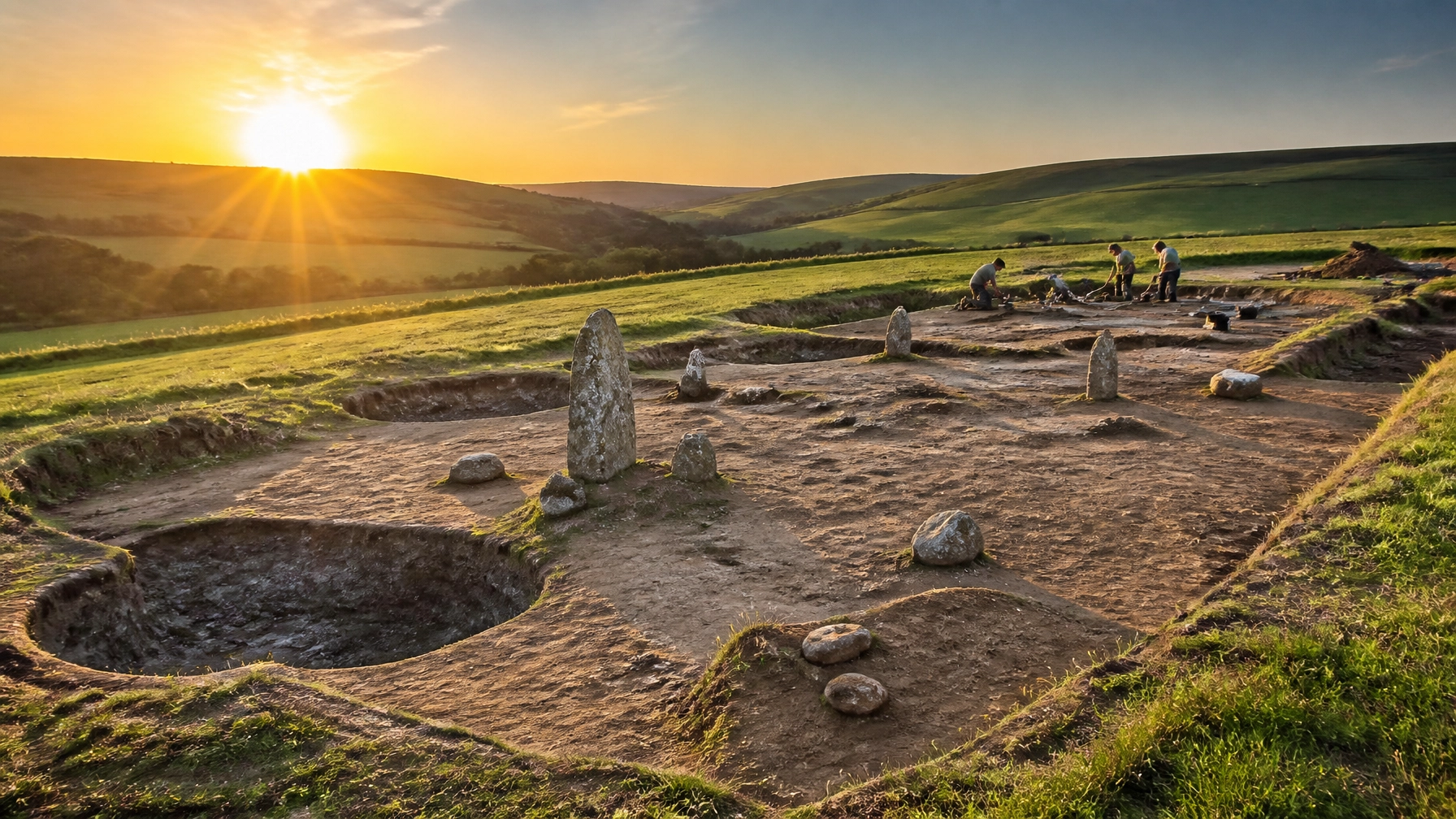
Archaeologists working on Salisbury Plain have uncovered a remarkable prehistoric structure that appears to have served as a direct precursor to the world-famous stone circle at Stonehenge. Situated in Bulford, Wiltshire, only three miles from the iconic monument, the site dates back approximately 5,000 years. Experts believe this wooden-post construction was a "prototype" designed to track the sun’s movements, mirroring the precise solar alignments that would later be immortalised in stone. The discovery provides a rare glimpse into the early experimental phases of Neolithic engineering and ritualistic planning, suggesting that the spiritual significance of the landscape was established long before the first large stones were ever moved into place.
The site, which spans roughly 13 acres, was initially excavated in preparation for a Ministry of Defence housing development. What emerged from the soil was a series of features that predate the main stone circle at Stonehenge by around 500 years. Radiocarbon dating places the activity at the Bulford site at approximately 2950 BC, a period when the inhabitants of Britain were transitioning from nomadic lifestyles to more settled, agrarian communities that invested heavily in monumental architecture. The centrepiece of this find is a pair of massive wooden poles, set approximately 120 metres apart, which functioned as markers for the solar cycle.
The Engineering of a Solar Prototype
The precision of the Bulford structure is what has most surprised the archaeological community. By aligning the two wooden posts, the ancient builders created a sightline that tracked the rising sun during the summer solstice and the setting sun during the winter solstice. This dual-alignment is the very same principle that governs the orientation of Stonehenge’s Great Trilithon and its Avenue. The discovery suggests that the Neolithic people of the Salisbury Plain had mastered the complex geometry of solar tracking using timber centuries before they attempted to replicate the feat with sarsen stones and bluestones.
The use of timber as a medium for early monumentalism is well-documented in British archaeology, yet the Bulford site stands out due to its proximity and functional similarity to Stonehenge. It serves as evidence that the builders were refining their techniques and testing their celestial observations in wood. These timber posts would have stood as towering landmarks across the chalk downlands, visible from a distance and acting as a focal point for the community. The 120-metre distance between the markers indicates a sophisticated understanding of perspective and landscape management, ensuring that the alignment remained accurate over a significant distance.
This "wooden Stonehenge" would have required regular maintenance, as timber eventually rots in the damp British soil. The decision to eventually move towards stone construction at the main Stonehenge site can be seen as an evolution of this earlier timber tradition: a desire to make these celestial alignments permanent and eternal. The Bulford site effectively acted as the blueprint, proving that the solstice alignment worked and was worthy of being cast in stone for future generations.
Ritual Gatherings and the Sun Disc Knife
Beyond the structural alignments, the excavation revealed extensive evidence of human activity that points to the site being a major hub for ritualistic gatherings. Archaeologists uncovered a total of 48 pits, many of which contained significant deposits of pottery, animal bones, worked flints, and charcoal. These remains are indicative of large-scale feasting and communal events that likely took place to coincide with the solar events the site was built to track. The presence of charcoal suggests large ceremonial fires, while the animal remains point to the slaughter of livestock for shared meals, highlighting the social importance of the solstice.
One of the most significant finds at the site was located within a specific pit interpreted as a "viewing station." This pit was strategically placed to offer the best vantage point for observing the solstice sunrise through the timber posts. Inside, archaeologists discovered a rare disc-shaped knife made of high-quality flint. The knife is thought to have been placed there as a symbolic offering. Its circular shape is believed to be a direct reference to the sun disc itself, further cementing the site's connection to solar worship. The craftsmanship of the knife is exceptional, suggesting it was an object of great value and spiritual importance rather than a mere utilitarian tool.
The distribution of the 48 pits across the 13-acre site suggests that the area was not a permanent settlement but a seasonal meeting place. People likely travelled from across the region to participate in the ceremonies held at Bulford. The artefacts recovered provide a snapshot of Neolithic life, showing a community that was deeply connected to the rhythm of the seasons and the movements of the heavens. These gatherings would have been essential for maintaining social cohesion, trade, and shared religious beliefs across the Salisbury Plain, creating a cultural framework that would eventually support the massive collaborative effort required to build Stonehenge itself.
A Career Highlight in Salisbury Plain
For the team of archaeologists involved, the Bulford discovery represents a significant milestone in the study of British prehistory. The lead archaeologist on the project, Phil Harding, described the find as the highlight of his long career. Having spent decades investigating the landscapes of Wiltshire, Harding noted that the discovery of a prototype structure so close to Stonehenge helps to fill a critical gap in the historical record. It provides a "missing link" between the early Neolithic earthworks and the later, more complex megalithic phases of the region.
One of the more compelling theories emerging from the find is that Bulford may have served as one of the original campsites or ritual centres for the very people who built the first phase of Stonehenge. It is entirely plausible that the workforce responsible for the early earthworks and timber phases of the main monument lived and worshipped at Bulford. The site offered a testing ground for their ideas, a place where they could observe the heavens and perfect the alignments that would define their greatest architectural achievement.
The discovery also reinforces the idea that Stonehenge did not appear in isolation. It was part of a vast, interconnected ritual landscape that evolved over thousands of years. From the early timber posts at Bulford to the final stone configurations, the Salisbury Plain was a theatre of constant spiritual and architectural innovation. As the development of the Ministry of Defence housing continues, the records and artefacts from the Bulford excavation will remain a vital resource for understanding how Britain’s most famous monument came to be. The transition from wood to stone was not just a change in material, but a monumental shift in how ancient people viewed their place in the cosmos, moving from the temporary to the permanent.