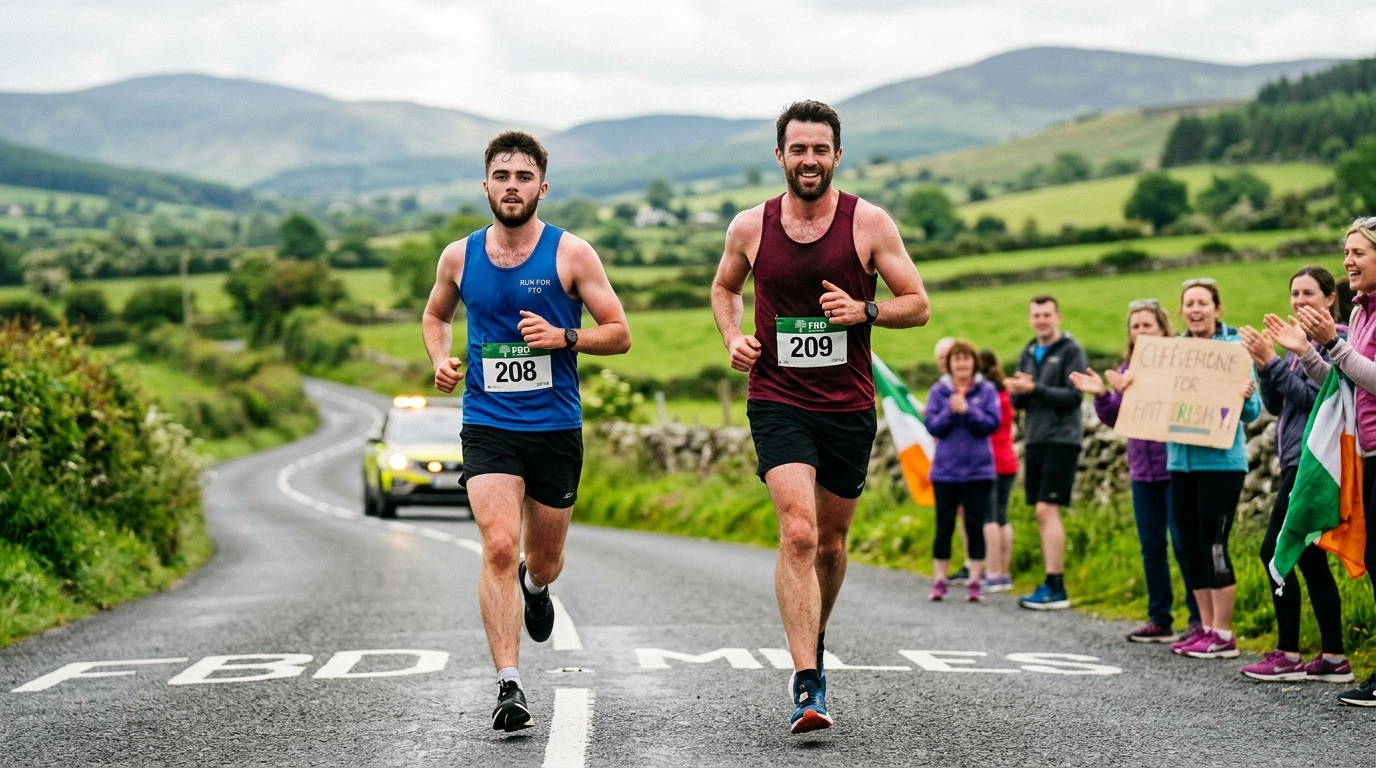
Jordan and Cian Adams, two brothers from Redditch, Worcestershire, have embarked on a physical and emotional journey that has captured the attention of the nation and the Royal Family. Known to many as The FTD Brothers, the pair are currently mid-way through a monumental challenge: running 32 marathons in 32 consecutive days across every single county in Ireland. This gruelling endeavour is not merely an athletic pursuit but a high-stakes campaign to raise awareness and vital funds for frontotemporal dementia research, a cause that has a profound and painful connection to their own lives.
The challenge began on 26 April 2026, when Jordan Adams kicked off the mission at the London Marathon. Adding a layer of physical hardship to an already daunting distance, Jordan completed the London course while carrying a 25-kilogramme fridge on his back. This feat served as a powerful visual metaphor for the heavy burden that families living with dementia carry every day. Following the London event, the brothers crossed the Irish Sea to begin their 32-county tour, starting their trek through the rugged landscapes and bustling towns of Ireland.
Their journey is a tribute to their mother, Geraldine, who passed away from frontotemporal dementia in March 2016 at the age of 52. The loss was not an isolated tragedy within their family history; the brothers have seen twelve of their Irish relatives succumb to the same disease. This staggering family history points to a rare, inherited gene mutation that causes familial frontotemporal dementia. Both Jordan, 30, and Cian, 25, have undergone genetic testing and received the devastating news that they both carry this mutation. This result gives them a 99.9 per cent chance of developing the disease in their 40s, effectively turning their fundraising efforts into a race against their own biological clocks.
A personal race against a ticking clock
The brothers’ motivation is driven by the reality of their diagnosis and the desire to change the future for others. Frontotemporal dementia differs from more common forms of the condition, such as Alzheimer’s, by primarily affecting the lobes of the brain responsible for behaviour, personality, and language. Because it often strikes at a younger age, frequently in a person’s 40s or 50s, the impact on families is uniquely devastating, often hitting people while they are still in the prime of their careers or raising children. Jordan and Cian have spoken openly about the “ticking clock” they live with, using their platform to highlight the urgent need for a cure or effective treatments before their own symptoms likely begin.
Their campaign, originally aiming for a target of £100,000, has seen an explosion of support. As they moved through the various counties of Ireland, the brothers were met with local running clubs, families affected by dementia, and well-wishers who joined them for stretches of the road. This grassroots support, combined with a viral social media presence, propelled their fundraising total past the £1 million mark. This milestone is a testament to the brothers’ resilience and the public’s recognition of the severity of the cause. The funds are directed towards Alzheimer’s Research UK, specifically earmarked for research into frontotemporal dementia, an area that has historically seen less funding than other neurodegenerative conditions.
The physical toll of running approximately 26.2 miles every single day for over a month is immense. The brothers have faced the unpredictable Irish weather, from lashing rain in the western coastal counties to unseasonable heat in the midlands. Each day involves a carefully managed routine of ice baths, intensive physiotherapy, and high-calorie diets to keep their bodies from breaking down. Despite the blisters, muscle fatigue, and the mental exhaustion of repeating such a demanding distance daily, the pair have maintained a consistent pace, driven by the memory of their mother and the hundreds of messages they receive from people across the globe who are living in the shadow of dementia.
Navigating thirty-two counties of hope
The route across Ireland was meticulously planned to ensure that no part of the country was left out. From the Giant’s Causeway in the north to the Ring of Kerry in the south, the brothers have used the scenery of Ireland as a backdrop for a message of hope. In each county, the local community has played a vital role, often organising small events or providing accommodation for the brothers and their support team. This collective effort has turned a private family mission into a national event, sparking conversations about genetic testing and the importance of early diagnosis in every town they visit.
In early May, the brothers received a significant boost in the form of a personal letter from Prince William, the Prince of Wales. The letter arrived just as they were preparing for their marathon in Carrick-on-Shannon, County Leitrim. In the message, the Prince praised their “remarkable strength, courage, resilience and determination.” He acknowledged the personal weight of their challenge, noting the bravery required to face their own genetic futures while working so tirelessly to help others. For Jordan and Cian, the royal recognition was a surreal moment that validated the years of work they have put into dementia advocacy.
The royal correspondence noted the importance of their work in shining a light on a condition that is often misunderstood or overlooked. Prince William’s support has provided a further surge in donations and media interest, ensuring that the final leg of their journey remains in the public eye. The brothers expressed that while the letter was a massive honour, their primary focus remains on the finish line in Dublin and the long-term goal of funding a breakthrough in FTD research. They view the royal pat on the back as a tribute to their mother and the many relatives they lost, whose stories are now being told on a global stage.
Royal support for a million-pound milestone
As the challenge nears its conclusion, the focus shifts to the final marathon scheduled for Dublin on 28 May 2026. The finish line is expected to be a major event, with hundreds of supporters planned to run the final miles alongside the brothers. The data collected from their journey, both in terms of fundraising and the physical impact of such an endurance feat, will likely be used to further the conversation around health and dementia awareness. The brothers have already indicated that while this 32-marathon challenge is their largest to date, it is by no means the end of their work with Alzheimer’s Research UK.
The impact of the £1 million raised cannot be overstated. In the world of medical research, such a sum can fund several years of laboratory work, clinical trials, or the development of new diagnostic tools. For frontotemporal dementia, where the path to a cure is still in its relatively early stages compared to other diseases, this influx of capital is transformative. It allows scientists to explore the specific mechanisms of the gene mutation that the Adams brothers carry, potentially leading to gene therapy or other interventions that could stop the disease before it starts.
Jordan and Cian Adams have transformed a terminal diagnosis into a catalyst for international change. Their journey through the 32 counties of Ireland has served as a moving tribute to their family history and a defiant stand against a genetic legacy. With the backing of the Prince of Wales and the generosity of thousands of donors, the brothers are proving that even when faced with the most daunting of futures, there is immense power in moving forward, one mile at a time. The final marathons in the coming weeks will likely see the fundraising total climb even higher, cementing their place as some of the most effective and inspiring health campaigners of the decade.
The brothers are scheduled to complete their 32nd marathon in Dublin on 28 May 2026, marking the end of a 32-day journey that covered 838.4 miles. Jordan and Cian remain committed to their advocacy work, planning further events to ensure that the momentum generated during their Irish tour continues to benefit the scientific community and families affected by the disease.