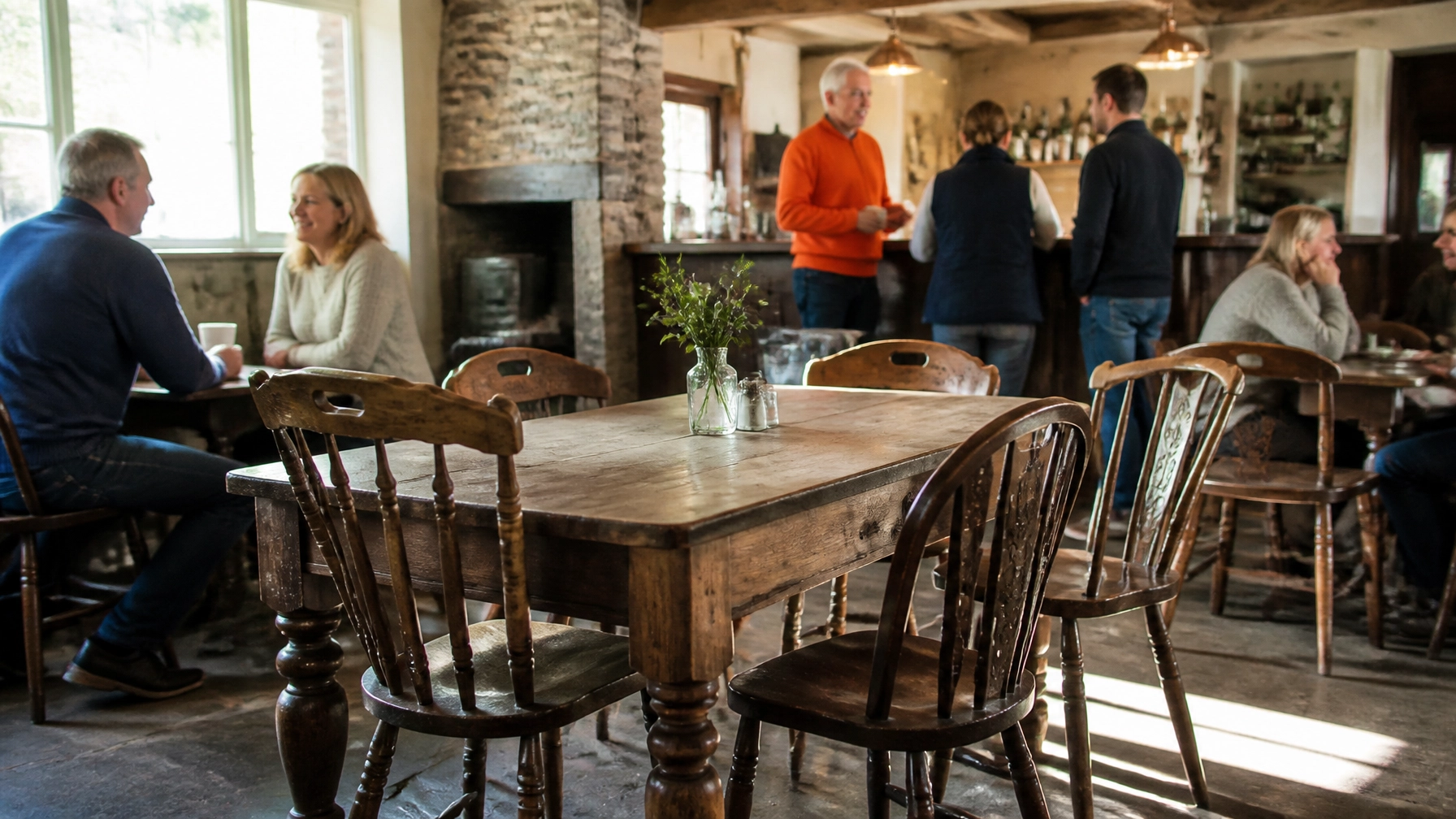
In the quiet corners of Shropshire’s historic market towns and tucked-away village greens, a quiet revolution is taking place at the local pub.
It does not involve a new craft ale or a refurbished beer garden, but rather a simple piece of furniture and a splash of bright orange. The Empty Chairs project, a grassroots initiative born from personal tragedy, is transforming how residents in the county interact with one another, proving that the solution to one of society’s most pressing problems might be as simple as an invitation to sit down.
Loneliness has long been described as a modern epidemic, particularly in rural counties like Shropshire where transport links can be sporadic and community spaces are often few and far between. While the digital age promised to bring people closer, many find themselves more isolated than ever, surrounded by screens but lacking genuine human contact. This is where Empty Chairs steps in, reclaiming the traditional role of the British pub as the beating heart of the community and a sanctuary for those who might otherwise spend their evenings in silence.
The concept is deceptively straightforward. At a designated time each week, a local host visits a pub and reserves a table. They are easily identifiable by their bright orange clothing: a colour chosen for its warmth and visibility. On the table, they place a small sign and, most importantly, they leave several chairs unoccupied. These are not just vacant seats; they are open invitations. Anyone who feels the need for company, whether they are grieving, new to the area, or simply having a difficult week, is welcome to join the table. There is no membership fee, no formal registration, and no pressure to stay. It is a space for conversation, or even just for being in the presence of others without the weight of expectation.
A foundation built on friendship and loss
The origins of the Empty Chairs project are rooted in a deeply personal story of loss and the subsequent realisation of how isolating grief can be. It was founded by Dean Perryman following the death of his best friend, Rob. In the aftermath of that loss, Perryman found himself grappling with the sudden void left by a lifelong companion. He recognised that while people are often surrounded by acquaintances, the loss of a primary social connection can lead to a profound sense of isolation that is difficult to articulate.
Perryman’s vision was to create a safety net for people before they reached a point of crisis. He understood that while mental health services and crisis lines are vital, there was a missing middle ground: a place for those who are just "not quite right" and need a friendly face. By taking the initiative into pubs, Perryman tapped into a familiar environment that feels less clinical and more accessible than a support group. It was about moving the conversation from the shadows into the light of a public house, where the clinking of glasses and the low hum of chatter provide a natural backdrop for connection.
Since its inception, the project has expanded at a rate that highlights the universal nature of the problem it seeks to solve. What started as a local endeavour has now seen more than 250 hosts across the United Kingdom and internationally. In Shropshire, the project has found fertile ground. From the bustling streets of Shrewsbury to the rural reaches near Oswestry, pub landlords and community members have embraced the idea. They recognise that their establishments are more than just businesses; they are social glue. By hosting an Empty Chairs table, these venues are reaffirming their commitment to the welfare of their patrons, ensuring that no one has to drink alone unless they choose to.
The mechanics of rural connection
In rural areas, the challenges of loneliness are often compounded by geography. Shropshire’s sprawling landscape means that many residents, particularly the elderly or those without access to a car, can go days without a meaningful interaction. The Empty Chairs project works by creating regular, predictable opportunities for socialising. Because the sessions are free and held in public spaces, the barriers to entry are significantly lowered. You do not need an invitation to the Empty Chairs table; the empty chair itself is the invitation.
The choice of the colour orange is strategic. It serves as a beacon in a crowded room, a signal that the person wearing it is there specifically to listen and talk. These hosts are not trained therapists, and the project is careful to state that it is not a crisis support service. Instead, the hosts are community members who want to give back. Their role is to facilitate a welcoming atmosphere, to make the first move in a conversation, and to ensure that anyone who joins the table feels seen and heard. This low-pressure approach is key to the project's success. It removes the social anxiety that often prevents people from reaching out, providing a structured yet casual way to meet new people.
For many participants in Shropshire, the project has been life-changing. There are stories of recent retirees who found themselves lost without the structure of a workplace, and young parents feeling the isolation of the stay-at-home routine. By sitting at an Empty Chairs table, they have found a new network of friends and a renewed sense of belonging. The project demonstrates that while we often think of loneliness as an individual problem, its solution is inherently collective. It requires the community to look out for one another and to provide the spaces where these interactions can flourish.
Reclaiming the pub as a social sanctuary
The success of Empty Chairs also speaks to a broader movement to protect and revitalise the Great British Pub. In recent years, pubs have faced numerous challenges, from rising costs to changing social habits. However, by aligning themselves with social causes like the fight against loneliness, pubs are proving their enduring relevance. They are one of the few remaining "third places": spaces that are neither home nor work: where people from all walks of life can congregate.
By hosting these sessions, Shropshire's publicans are seeing the benefits of a more engaged and loyal customer base. It creates a positive atmosphere that benefits everyone in the building, not just those at the reserved table. There is a sense of warmth that comes from knowing your local pub cares about more than just the bottom line. It fosters a culture of kindness and awareness, where regulars might start to notice if someone they haven't seen in a while could benefit from a seat at the table.
As the Empty Chairs project continues to grow, its impact in Shropshire serves as a model for other rural communities. It shows that addressing the loneliness epidemic does not always require massive government intervention or complex technological solutions. Often, it just requires a bit of courage from a host, a supportive local business, and the willingness of a stranger to take a seat. In the heart of the county, the message is clear: the table is set, the chairs are waiting, and you are more than welcome to join.