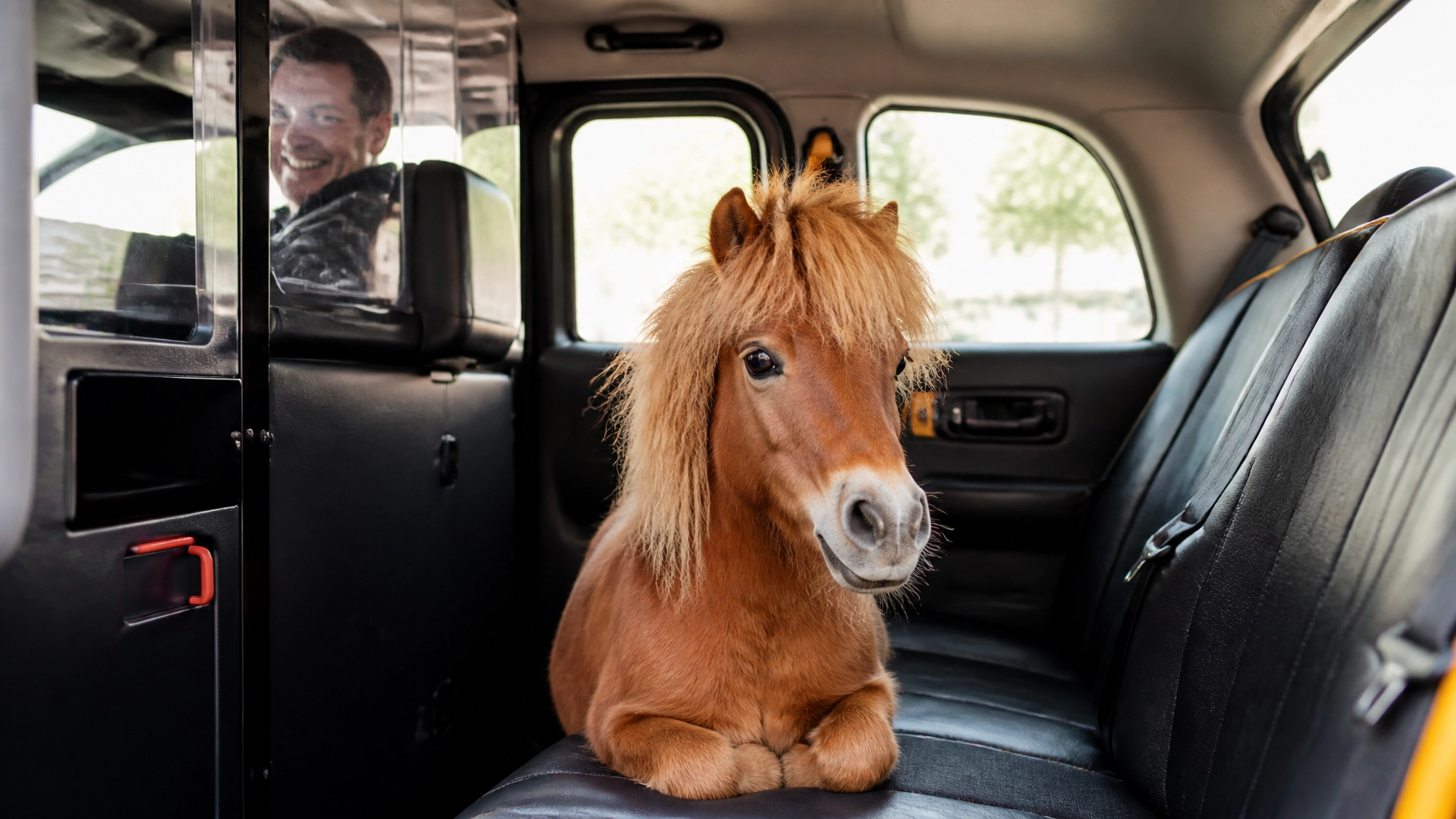
In the bustling heart of London, where the rhythmic hum of traffic and the hurried pace of city life often mask the silent struggles of its inhabitants, an unusual sight has begun to capture the public imagination.
A miniature horse named Rusty, small enough to stand comfortably in the back of a traditional black cab, has become a beacon of hope for many navigating the complexities of mental health. For his owner, Maria, the journey with Rusty is deeply personal, rooted in a battle with Post-Traumatic Stress Disorder (PTSD) that once threatened to narrow her world to the confines of her own home. Today, they traverse the capital together, proving that sometimes the most profound healing comes in the smallest packages.
Maria’s story began far from the public eye, in the grip of debilitating anxiety and the lingering shadows of trauma. Like many who live with PTSD, the world often felt overwhelming, a series of sensory triggers that made everyday tasks seem insurmountable. Traditional therapies provided some relief, but it was the introduction of Rusty that truly shifted the trajectory of her recovery. The miniature horse offered a form of grounding that was immediate and undeniable. Animals do not judge, nor do they require the complex social navigation that human interactions often demand. Rusty simply was, and in that presence, Maria found a stable anchor.
The decision to take Rusty into the city was not born of a desire for novelty, but rather a need to reconnect with the community. Maria realised that if Rusty could help her find calm amidst the chaos, he might do the same for others. The logistical challenge of moving a horse through London was solved by the city's most iconic transport: the black taxi. Drivers, initially bewildered by their four-legged passenger, soon became part of the story, witnessing firsthand the smiles and double-takes from pedestrians as a small, furry head peered out from the window of a cab stuck in Gridlock.
A Therapeutic Presence on London Streets
The presence of a miniature horse in a London taxi is more than just a charming anecdote; it is a mobile intervention in a city often criticised for its isolation. When Rusty and Maria disembark at their destinations: be it a busy square in Westminster or a quiet street in south-west London: the atmosphere shifts. There is an immediate softening of the urban environment. People who would otherwise keep their heads down, lost in their phones or their thoughts, stop and engage. The barriers that usually define city life seem to dissolve in the presence of an animal.
For Maria, these outings are a form of exposure therapy, a way to reclaim the space that PTSD had taken from her. By focusing on Rusty’s needs and the reactions of the public, she is able to bypass the internal monologue of anxiety. The horse acts as a social lubricant, facilitating conversations about mental health that might otherwise never happen. Passers-by often feel a strange sense of permission to share their own stories, prompted by the simple, non-threatening presence of a horse. It is a reminder that vulnerability is a universal human experience, and that connection is often the first step toward healing.
The impact on the community is tangible. In the back of a taxi, Rusty is a passenger, but on the pavement, he is a bridge. Children with special needs, who may struggle with sensory processing, find comfort in his gentle nature. Elderly residents, perhaps feeling the weight of loneliness in a rapidly changing city, find a moment of companionship. The sight of a mini horse being transported via taxi has become a symbol of a more compassionate, connected London, where the unconventional is embraced for the sake of the common good.
Transforming Mental Health Through Connection
Beyond the immediate joy Rusty brings, his work highlights the growing recognition of animal-assisted therapy as a legitimate and powerful tool in the mental health toolkit. While the concept is not new, the application of it in an urban, mobile setting is a departure from more traditional equestrian therapy, which usually takes place in rural stables. Rusty brings the therapy to the people, meeting them in the spaces where they live and work. This accessibility is crucial, particularly for those whose mental health conditions make travelling long distances or visiting unfamiliar rural locations difficult.
Biological research suggests that interacting with animals can lower cortisol levels, the hormone associated with stress, and increase the production of oxytocin, which promotes feelings of well-being and trust. For individuals with PTSD, who often live in a state of hyper-vigilance, these physiological shifts are not just pleasant; they are transformative. The rhythmic stroking of a horse’s coat or the steady, calm breathing of the animal can help regulate the human nervous system, bringing a person back from the brink of a panic attack or a dissociative episode.
Maria’s journey illustrates that mental health support does not always have to be clinical. While medical intervention is vital, the integration of community-based, animal-led support provides a holistic layer of care. It challenges the stigma surrounding mental illness by making it a visible, discussed part of everyday life. When people see Maria and Rusty, they don't just see a woman and her horse; they see a success story. They see that it is possible to live a full, active life even when carrying the weight of trauma, provided the right support systems are in place.
Reaching the Most Vulnerable in the City
The mission of Rusty and Maria extends far beyond the pavements of central London. Their schedule often includes visits to hospices and special needs centres, places where the stakes are higher and the need for comfort is acute. In these settings, Rusty’s role shifts from a public curiosity to a deeply personal companion for those facing the end of life or dealing with complex disabilities. The gentleness of a miniature horse is perfectly suited for these environments, where space is often limited and patients may have limited mobility.
In hospices, the presence of an animal can provide a rare moment of normalcy and joy in a sterile, medicalised environment. For patients who may have had pets throughout their lives, the chance to interact with a horse can trigger positive memories and offer a sense of peace. The staff at these facilities report that after a visit from Rusty, there is a noticeable lift in the overall morale of the ward. It provides a shared topic of conversation, a break in the routine, and a reminder of the world outside the hospital walls.
The future of Rusty’s mission looks toward expanding this reach, continuing to challenge how we think about mental health and community connection. By prioritising the untold stories of those who struggle in silence, Maria and Rusty are paving the way for a more empathetic society. Their story is a testament to the power of resilience and the unexpected ways in which we find our way back to ourselves. As they continue their taxi rides across the capital, they remain a poignant reminder that even in a city of millions, no one has to be truly alone when they have the right companion by their side.