The rugged, sun-scorched landscapes of Yemen have long provided a backdrop for tales of resilience and grit, but a recent tragedy in the southern Dhale province has left the nation in mourning.
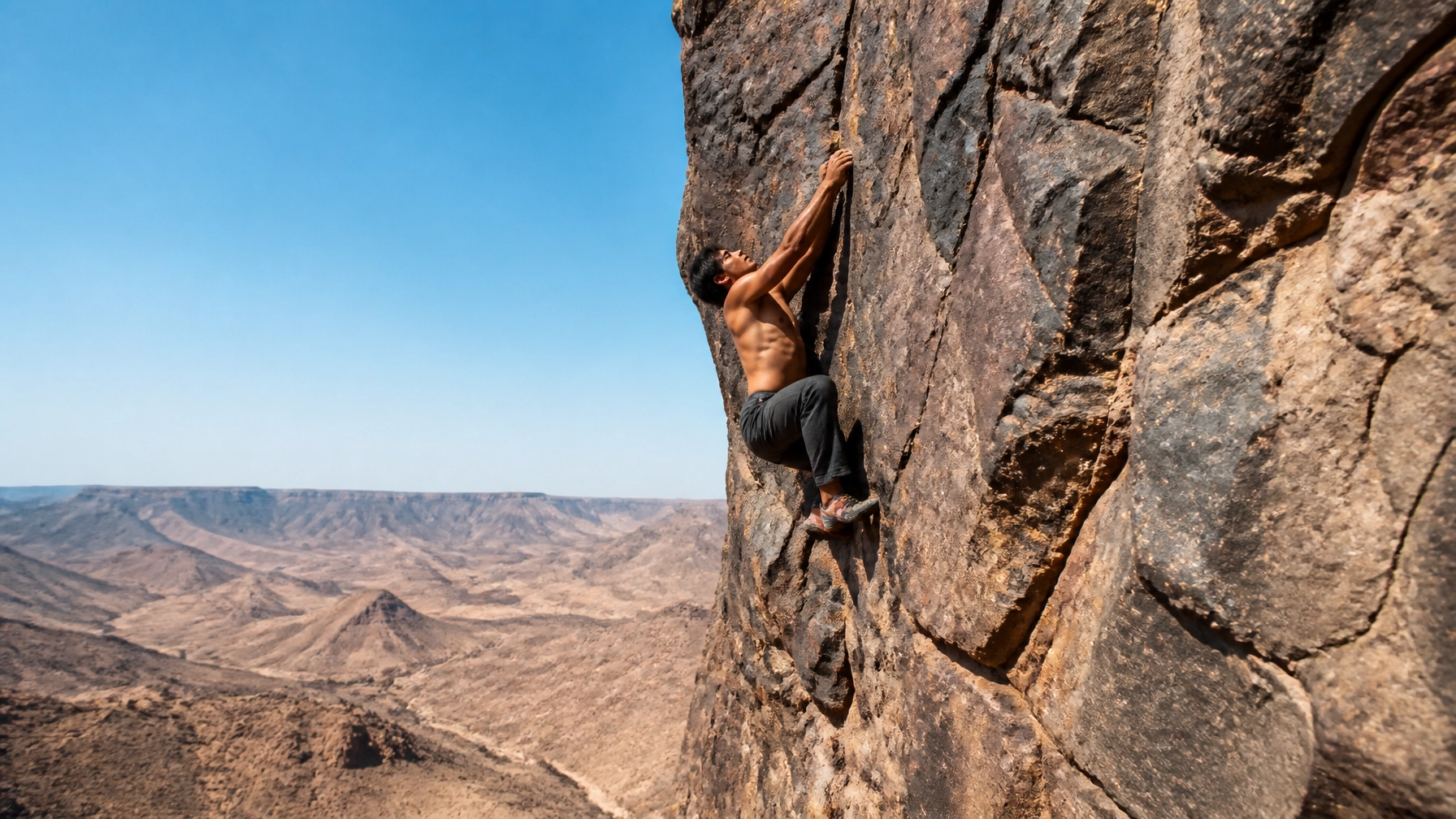
Al-Qaqa Ibn Antar, a 30-year-old daredevil whose gravity-defying feats earned him the moniker of the "Spider-Man of Yemen," has died following a catastrophic fall during an ambitious ascent. The incident occurred at the Haradhat Damt volcanic crater, a site as beautiful as it is treacherous, where the young climber’s luck finally ran out in front of a horrified audience. Known for his fearless approach to free-climbing: scaling near-vertical rock faces without the aid of ropes, harnesses, or safety equipment: Ibn Antar had become a symbol of defiance and raw skill in a country more often associated with conflict than extreme sport.
His death marks the end of a career that was built on the edge of a knife, highlighting the thin line between viral fame and fatal consequence.
The Haradhat crater, located near the town of Damt, is a geological marvel, characterized by its towering limestone walls and a deep, sulfurous lake at its base. For Ibn Antar, it was the ultimate playground. He had spent years honing his craft on the various peaks of the region, often posting videos of his ascents to a growing legion of followers on social media. To his fans, he was more than just an athlete; he was a man who seemed to move with the grace of a mountain goat, finding finger-holds where others saw only flat rock. However, the nature of free-soloing means that there is zero margin for error. On this particular afternoon, the conditions appeared ideal, with the bright Arabian sun illuminating the crater’s depths, but a single slip-up transformed a routine climb into a national tragedy.
A Life Lived on the Edge
To understand the impact of Al-Qaqa Ibn Antar’s death, one must first understand the unique space he occupied in Yemeni culture. In a region where traditional sports like football dominate, Ibn Antar’s pursuit of extreme climbing was an anomaly. He didn't have access to the high-tech gear or indoor climbing gyms found in the West; his training was entirely organic, forged on the very rocks he sought to conquer. This lack of formal infrastructure only added to his legend. He was a self-taught master of the vertical world, relying entirely on his physical strength and mental fortitude. Those who knew him described a man who was deeply connected to the land, seeing the mountains not as obstacles, but as extensions of himself.
His nickname, the Spider-Man of Yemen, was not just a tribute to his climbing style but also a reflection of the hope and excitement he brought to his community. In a time of immense hardship for many in the country, his videos provided a brief, heart-pounding escape. He would often scale heights that seemed impossible, standing atop ridges with his arms outstretched, silhouetted against the setting sun. This pursuit of the extreme was driven by a desire to showcase the natural beauty of Yemen to the world, proving that even in a war-torn nation, the human spirit could still soar.
Yet, the very videos that brought him fame also created a pressure to constantly up the ante, pushing him toward more dangerous locations and more difficult routes.
The Haradhat crater presented a specific set of challenges that Ibn Antar had successfully navigated before. The rock in the area is often crumbly and unpredictable, requiring a delicate touch and a constant reassessment of every handhold. Free-climbing in such an environment is a psychological battle as much as a physical one. One must remain perfectly calm while suspended hundreds of feet above the ground, knowing that their life depends on the friction between their fingertips and the stone. Ibn Antar had mastered this calm over years of practice, but the inherent instability of volcanic rock means that even the most experienced climber is at the mercy of the geology.
The Fatal Final Climb
The events leading up to the tragedy were captured in a brief but harrowing video that has since circulated widely. Ibn Antar was attempting to scale a particularly steep section of the crater wall, roughly 120 metres above the surface of the lake. In the footage, he can be seen making steady progress, moving with his trademark confidence. However, as he reached a section of the rock that appeared particularly sheer, something went wrong. For a split second, he seemed to lose his grip, his body tensing as he sought a new point of contact. He managed to hang on with one hand for a moment, a testament to his incredible upper-body strength, but the rock face offered no further purchase.
The fall was sudden and absolute. Witness reports suggest that there was a collective gasp from those watching from the rim of the crater as the climber plummeted into the void. Falling from a height of over 300 feet, the impact with the water was equivalent to hitting concrete. The crater lake, known for its high mineral content and thermal temperatures, swallowed the daredevil almost instantly. The depth of the water and the sheer scale of the crater made immediate rescue impossible for the onlookers. Local authorities were alerted, but the logistics of conducting a recovery operation in such a remote and difficult environment meant that help would not arrive for some time.
Yemen’s Civil Defense Authority eventually deployed a specialized team, including divers trained in high-altitude and high-temperature environments. The recovery process took approximately four hours, as the team navigated the treacherous descent into the crater and searched the murky, sulfurous depths of the lake. Ibn Antar’s body was eventually located nearly 30 metres below the surface. The news of the recovery sent shockwaves through the town of Damt and beyond, as the reality of the loss began to set in. It was a somber end for a man who had spent his life defying the laws of physics, only to be reclaimed by the very earth he loved to climb.
A Legacy Written in Stone
The aftermath of Ibn Antar’s death has sparked a broader conversation about the risks associated with extreme sport in the digital age.
While his courage was never in doubt, the tragedy has forced a reckoning with the lack of safety standards and the pressure of social media visibility. In the pursuit of the perfect shot or the most daring video, the fundamental rules of mountain safety are often sidelined. For many young Yemenis, Ibn Antar was a hero, but his death serves as a stark reminder that the mountains do not forgive mistakes. There is a growing call within the local athletic community for better education on climbing safety and the importance of using proper equipment, even for those as talented as the Spider-Man of Yemen.
Despite the tragic circumstances, Ibn Antar’s legacy remains one of incredible bravery and passion. He showed a generation of Yemenis that they could define themselves by their talents and their dreams, rather than by the circumstances of their birth or the political climate of their country. Tributes have poured in from across the Arab world, with fellow climbers and fans sharing stories of how his videos inspired them to explore their own landscapes. He was a pioneer in every sense of the word, carving out a niche for himself in a field that few in his country had ever considered. The images of him standing atop the peaks of Dhale will remain a part of the national consciousness for years to come.
As the dust settles at the Haradhat crater, the site remains a place of pilgrimage for those who wish to pay their respects to the fallen climber. The limestone walls still stand as a silent testament to his final ascent, and the turquoise waters of the lake continue to mirror the bright Yemeni sky. While the "Spider-Man of Yemen" may no longer be scaling its heights, his spirit lives on in the rugged terrain he so dearly loved. The tragedy in Damt is a reminder of the fragility of life, but also of the heights that can be reached when one is truly fearless. For Al-Qaqa Ibn Antar, the final ascent was not just a fall, but the culmination of a life lived with a perspective that few will ever know.